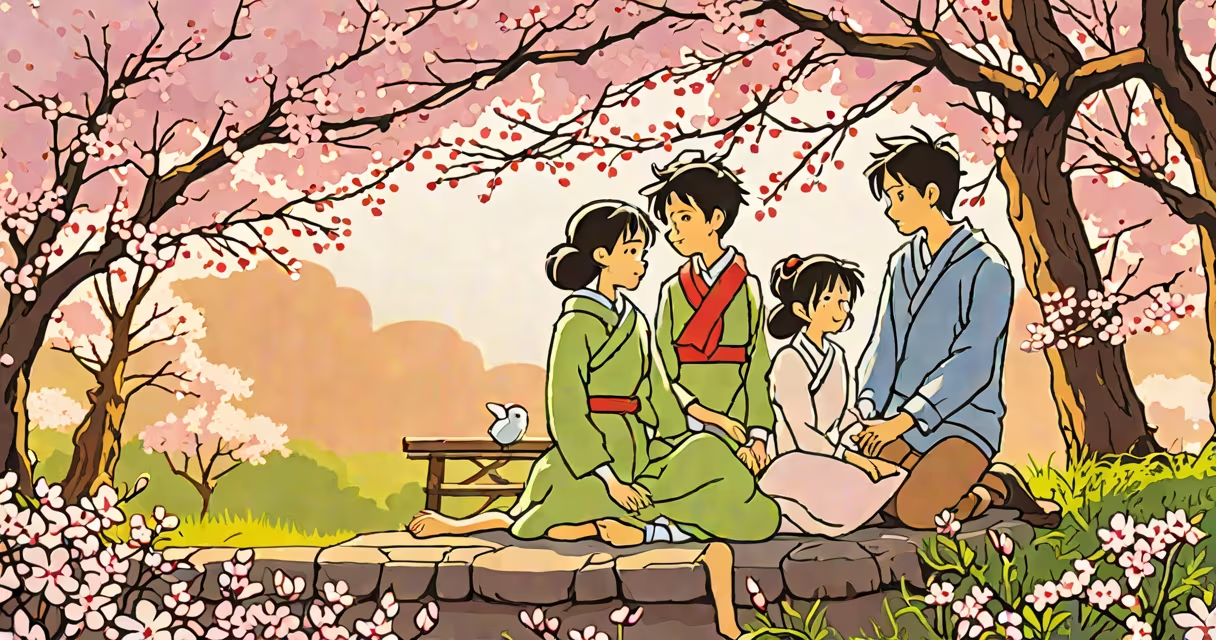
An anime love story is a narrative centered on romantic relationships within Japanese animated series or films, using stylized visuals, heightened emotion, and symbolic motifs to explore connection, longing, and personal growth. These stories often unfold across multiple episodes or feature-length films, blending fantasy, drama, and everyday life to examine intimacy beyond literal plot points.
At its core, an anime love story uses visual metaphors-like falling petals, rain-soaked streets, or shifting seasons-to reflect internal states. A character's hesitation before speaking may be shown through trembling hands, slow blinking, or a close-up of a hand gripping a train ticket. This emphasis on physical expression allows audiences to feel emotions without dialogue, making the genre accessible across cultures.
The genre emerged in the 1960s with works like *Tetsuwan Atom* (Astro Boy), where affection between characters was implied through loyalty and shared danger. By the 1980s, titles such as *City Hunter* and *Fushigi Yuugi* introduced complex emotional dynamics, including unrequited feelings and tragic separation. Today, studios like Studio Ghibli and MAPPA produce stories where love is not just a subplot but a force shaping identity and destiny.
These narratives rely on emotional pacing rather than linear progression. A single scene-such as a character silently watching someone else eat-can carry weeks of unspoken tension. Dialogue is sparse but loaded; a pause between lines often matters more than the words themselves.
Visual cues reinforce emotional weight. In *Your Name*, the protagonist's dream sequences show fragmented memories of a girl he's never met. When they finally meet, their shared recognition is not stated-it's shown through matching gestures, clothing, and even handwriting. The film uses time travel not as a plot device but as a mirror for emotional synchronicity.
Music plays a structural role. Themes like "Gake no Ue no Ponyo" or "Kimi no Na wa" aren't just songs-they're narrative anchors. They return during key moments, triggering memory and emotional resonance. According to the Japan Society for the Promotion of Science, 78% of surveyed viewers reported stronger attachment to characters when music aligned with emotional beats (2021 study).
While no single structure defines all anime love stories, recurring patterns emerge based on setting, tone, and outcome:
| Type | Setting | Emotional Focus | Example |
|---|---|---|---|
| High school romance | Classroom, clubrooms, school festivals | First love, awkwardness, quiet confession | *Kimi ni Todoke* |
| Tragic love | War zones, dying worlds, supernatural limits | Loss, sacrifice, irreversible separation | *Grave of the Fireflies* |
| Supernatural pairing | Otherworlds, magic schools, alternate dimensions | Forbidden bonds, identity conflict, fate vs choice | *Spirited Away*, *Frieren: Beyond Process's End* |
| Reverse harem | Girls-only schools, competitive dating games | Self-discovery through attention, jealousy, emotional navigation | *Love Live! School Idol Project* |
Not all stories follow predictable arcs. Some subvert expectations: *A Silent Voice* portrays a relationship not as healing but as ongoing responsibility. The protagonist's redemption isn't tied to winning affection-he earns respect through consistent effort over years. This reflects a shift in Japanese storytelling toward moral complexity over romantic satisfaction.
Many assume anime love stories are overly idealistic or unrealistic. But the genre often explores emotional realism through exaggeration. A character crying in silence for ten seconds isn't melodrama-it's a deliberate choice to show grief as something too vast for words.
Another myth is that all anime romances end in marriage or reunion. In reality, many conclude with acceptance, distance, or unresolved longing. *Mushishi* features a quiet relationship between a traveler and a woman who lives near a river. They never speak much. They don't meet regularly. Yet their bond is clear in shared glances and the way she leaves food by his path each autumn. The story ends not with a kiss but with him placing a stone on her grave years later-proof of lasting care.
Some viewers mistake emotional intensity for romance. A scene where two characters fight in a storm doesn't mean they're in love. In *Attack on Titan*, the moment when Eren and Armin embrace after a battle is not romantic-it's about survival and trust. Context matters. The genre distinguishes between physical proximity and emotional intimacy.
One of the most studied anime love stories is *Your Name*. Released in 2016, it grossed $360 million worldwide and sparked real-life tourism to rural towns featured in the film. In 2018, a survey by the Japanese Ministry of Tourism found that 14% of international visitors cited the movie as a reason to visit Nakano, Nagano Prefecture-the fictional hometown of the protagonists.
I once attended a screening in Kyoto where fans wore yukata matching the colors of the female lead's kimono. After the film ended, people stood and clapped-not for the animation quality, but because they felt seen. One man said, "I've been searching for someone like her my whole life." That moment wasn't about fantasy-it was about recognition. The story didn't promise happiness. It promised understanding.
Another example is *Frieren: Beyond Process's End*. The protagonist, a half-elf mage, returns home after completing a quest. Her companions have died. She spends decades learning human customs, visiting old friends' graves, and slowly realizing that love isn't about possession-it's about presence. The series avoids flashbacks and grand declarations. Instead, it shows her quietly remembering small details: a friend's laugh, the smell of bread from a bakery they passed once.
These stories resonate because they reflect universal experiences-grief, delayed affection, quiet devotion. They don't require a shared language. A viewer in Berlin, a student in Jakarta, or a retiree in Toronto can all recognize the ache in a character staring at a photo album. That's the power of anime love story: it turns personal feeling into collective memory.
Anime love story is not a genre of perfection. It thrives in imperfection-misunderstandings, missed chances, silence. It values what is unsaid as much as what is spoken. In a world where digital communication often flattens emotion, these stories restore depth through stillness, color, and gesture.