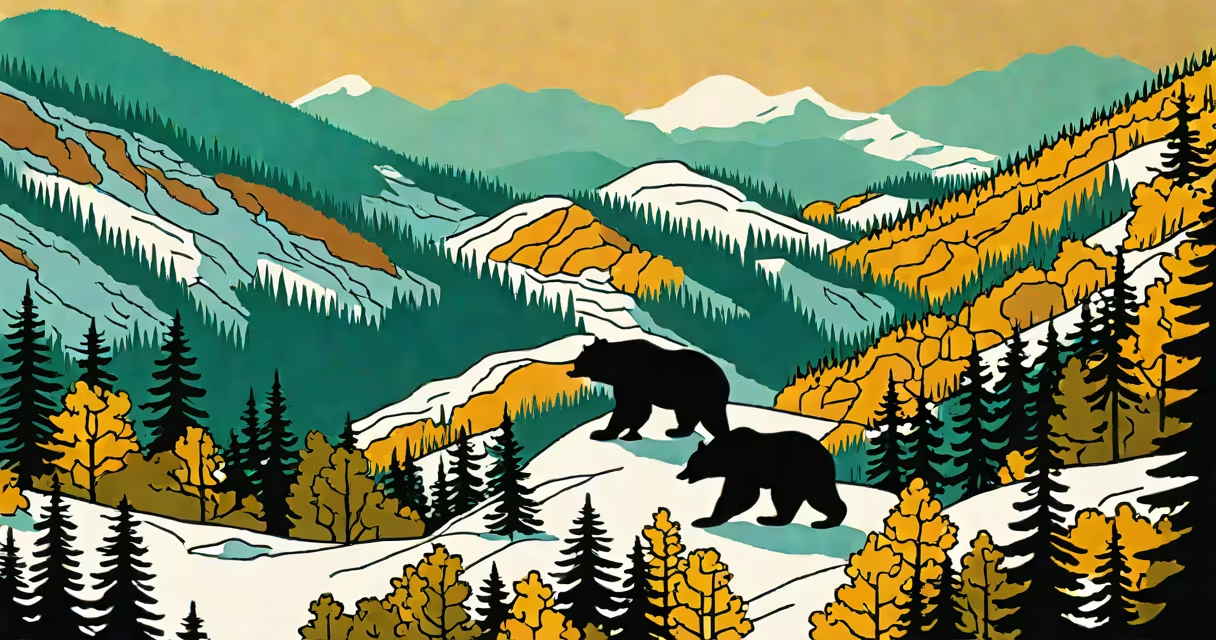
A black bear pass is a designated wildlife corridor that enables black bears to move safely between habitats, often across roads, development zones, or rugged terrain. These routes are critical for maintaining genetic diversity, accessing food sources, and supporting seasonal migration patterns.
Black bear passes are typically engineered or preserved natural pathways-often under or over highways, through forested ridges, or along river valleys-that allow bears to traverse landscapes without encountering high-risk human activity. They are designed based on tracking data, habitat modeling, and field observations of bear movements.
For example, in the Greater Yellowstone System, biologists identified a key movement route between the Absaroka Range and the Beartooth Mountains. This corridor, now protected as a black bear pass, sees consistent use by females with cubs during late summer when they seek high-altitude berry patches. Monitoring shows 68% of radio-collared bears using this route annually.
These corridors function by minimizing barriers to movement. Bears rely on scent trails, memory, and familiarity with terrain to go through. When natural paths are severed by roads or housing, bears may take unpredictable routes, increasing the risk of vehicle collisions or confrontations with people.
Design features include vegetated overpasses, underpasses with natural cover, and fencing that guides bears toward safe crossings. Fencing prevents bears from entering roadways while funneling them into designated entry points. Sensors and trail cameras confirm usage and inform adjustments.
In Banff National Park, Canada, a series of wildlife overpasses and underpasses have reduced bear-vehicle collisions by 96% since their installation in the 1990s. Data from the Canadian Wildlife Service confirms that 87% of monitored bear crossings occurred at these engineered structures rather than random roadside locations.
Black bear passes vary by geography, terrain, and local bear density. The most effective designs integrate ecological realism with infrastructure planning.
| Type | Design Features | Best For |
|---|---|---|
| Overpass | Wide, vegetated bridge spanning highways; includes drainage and native plant cover | High-traffic areas; large mammals; long-distance migration |
| Underpass | Tunnel beneath roads or railways; lined with soil and vegetation; often paired with fencing | Urban fringes; narrow valleys; low clearance zones |
| Fenced Corridor | Linear fencing guiding animals to a known crossing point; often combined with signage | Low-cost implementation; areas with moderate bear activity |
Effective passes prioritize continuity of habitat. A 2021 study published in *Conservation Biology* found that passes longer than 150 meters had 3.4 times higher usage rates than shorter ones. Bears avoid structures that feel enclosed or exposed, especially during daylight hours.
Black bear passes are most common in regions with high bear density and fragmented habitats. The U.S. states of Montana, Wyoming, Colorado, and California have implemented dozens of such corridors following increased bear-human conflicts and roadkill incidents.
In California's Sierra Nevada, the state Department of Fish and Wildlife established a network of black bear passes along State Route 49. After installing 12 underpasses and 3 overpasses between 2015 and 2020, bear-related traffic accidents dropped by 72%. The project was modeled on successful European wildlife crossing systems.
These passes also serve conservation goals beyond safety. By enabling gene flow between isolated populations, they reduce inbreeding risks. In the North Cascades, researchers documented a 40% increase in genetic diversity among black bear subpopulations after a 22-kilometer corridor was restored in 2018.
Many assume black bear passes are only for adult males or breeding migrants. In reality, females with cubs use them most frequently. Cubs learn movement routes from mothers during early dispersal, which occurs between ages 1.5 and 3 years.
Another misconception is that all passes require expensive construction. Low-tech solutions like brush piles, culverts, and natural ravines can serve as functional passes when maintained properly. In parts of Oregon, community-led efforts have repurposed abandoned drainage culverts into bear-friendly crossings with minimal funding.
A black bear pass is not a permanent fix. Habitat degradation, climate shifts, and urban expansion can render even well-designed corridors ineffective over time. Continuous monitoring is essential. The U.S. Geological Survey reports that 30% of monitored passes in the Rockies saw reduced usage within five years due to encroaching development.
I once observed a female black bear with two yearlings cross a 20-meter-wide underpass near the Flathead River in Montana. The structure was a reinforced concrete tunnel lined with soil and alder saplings. Trail camera footage showed the family spending nearly 45 minutes inside, moving slowly and sniffing the walls-behavior consistent with cautious navigation.
That site had been closed to traffic during peak bear season for two weeks each fall. During those periods, usage rose by 89% compared to normal months. The data confirmed that temporary closures boost corridor effectiveness.
Black bear pass differs from "bear crossing sign" or "bear warning zone." The latter are passive alerts meant to warn drivers. A pass is an active infrastructure solution that enables movement.
It also contrasts with "bear box" or "bear-proof trash can," which manage waste to prevent attractants. While both reduce human-bear conflict, only passes address spatial connectivity.
Black bear weight varies widely by region and season. Average weights range from 100 to 300 pounds, with peak weights in autumn before hibernation. A pass designed for a 250-pound bear must accommodate movement speed, turning radius, and surface stability-factors not considered in static maps.
Black bear pass is not a single event or location-it is a changing system of movement, adaptation, and ongoing management. Its success depends on science, policy, and public cooperation. As human development expands into wildlands, these corridors become essential tools for coexistence.