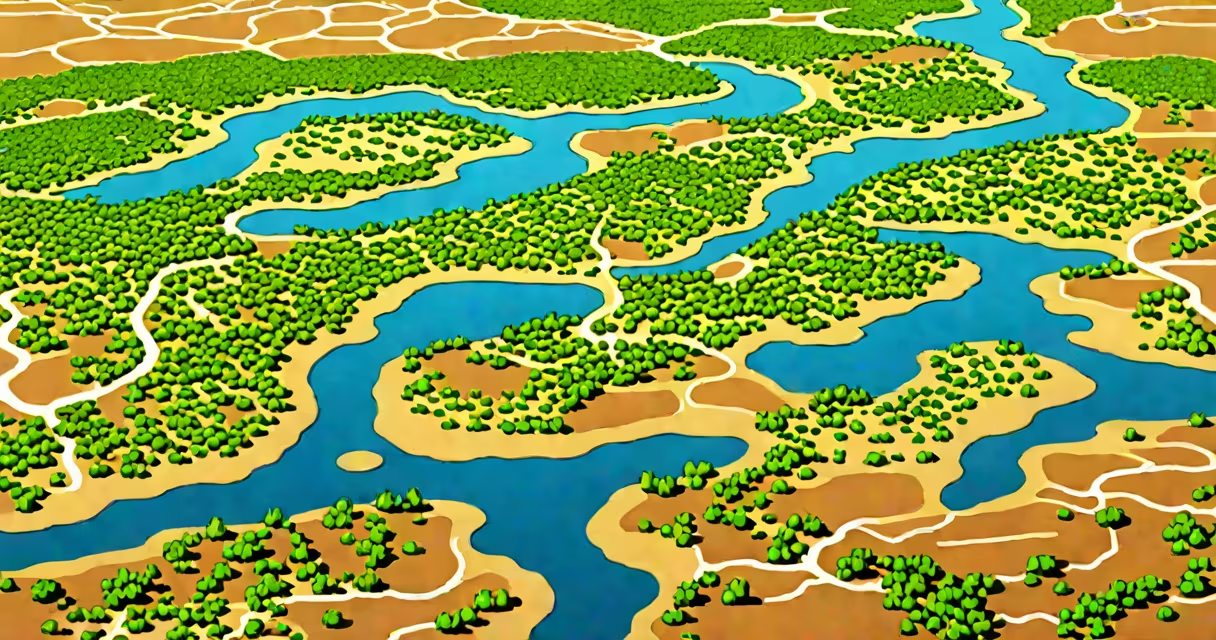
Bosque del Apache National Wildlife Refuge is a federally protected area in New Mexico that preserves important wetland and riparian habitats along the Rio Grande, supporting over 400 bird species annually, including large concentrations of migrating sandhill cranes and snow geese.
The refuge spans approximately 19,000 acres in the southwestern part of the state, centered around the Rio Grande's floodplain. Established in 1939, it was created specifically to protect wintering grounds for migratory birds, especially waterfowl. Its management focuses on maintaining seasonal water levels through controlled flooding and drainage systems, mimicking natural hydrology to sustain grasslands, marshes, and cottonwood-willow forests.
Water levels are adjusted monthly based on rainfall and snowmelt from the nearby Sangre de Cristo Mountains. During fall and winter, managers flood designated units to create shallow wetlands ideal for ducks, geese, and shorebirds. This practice supports both ecological function and public access, allowing visitors to observe wildlife in stable conditions.
Bird migration depends on predictable stopover sites with abundant food and safe resting areas. Bosque del Apache serves as a important node in the Central Flyway, one of North America's major bird migration corridors. Over 200 species of birds have been documented here, including raptors, songbirds, and waterfowl.
Peak migration occurs between November and February. During this period, the refuge hosts up to 15,000 sandhill cranes and 10,000 snow geese. These numbers are tracked annually by the U.S. Fish and Wildlife Service using aerial surveys and ground counts. In 2022, researchers recorded 16,200 sandhill cranes-a record high due to favorable breeding conditions in Canada and Alaska.
A key feature of the refuge is the use of managed impoundments. These are man-made basins lined with clay to prevent seepage, allowing precise control over water depth. Shallow waters (6-12 inches) attract dabbling ducks like mallards and green-winged teals, while deeper zones (18-24 inches) support diving ducks such as canvasbacks. Vegetation like smartweed and sedges grows in these areas, providing seeds and invertebrates essential to bird diets.
The refuge contains four primary habitat types: riparian woodland, seasonal marsh, grassland, and agricultural fields. Each supports distinct communities of plants and animals.
| Habitat Type | Primary Features | Notable Species |
|---|---|---|
| Riparian Woodland | Cottonwood and willow trees along riverbanks; dense understory | Yellow-billed cuckoo, western tanager, American beaver |
| Seasonal Marsh | Flooded in winter; dry in summer; rich in aquatic plants | Sandhill crane, snow goose, northern harrier |
| Grassland | Native bunchgrasses; low shrubs; occasional wildfires | Grasshopper sparrow, burrowing owl, pronghorn antelope |
| Agricultural Fields | Winter-planted crops like barley and wheat; harvested in spring | Greater sage-grouse (rare), red-tailed hawk, mourning dove |
One non-obvious fact: the refuge's success in managing water levels has led to a 30% increase in nesting pairs of sandhill cranes since 2000, according to a 2023 report by the U.S. Fish and Wildlife Service. This contrasts with many other wetland systems experiencing decline due to climate change and upstream water diversions.
Many visitors assume Bosque del Apache is primarily a desert field. In reality, it lies within a transitional zone between the Chihuahuan Desert and the Rocky Mountain foothills. The presence of the Rio Grande creates a lush, green corridor that stands out dramatically against surrounding arid terrain.
Another misconception is that the refuge is only for birdwatchers. While it attracts over 100,000 visitors annually-most during the crane season-it also supports native plant diversity, endangered species recovery programs, and scientific research. For example, the endangered southwestern willow flycatcher nests in the refuge's cottonwood groves, and biologists monitor nest success rates each spring.
Some confuse the refuge with nearby private lands or state parks. Unlike those areas, Bosque del Apache is managed exclusively by the U.S. Fish and Wildlife Service under the National Wildlife Refuge System. Access is free, but certain activities-like off-road vehicle use or hunting-are restricted or prohibited to protect sensitive habitats.
I visited the refuge in December 2021 during the annual Sandhill Crane Festival. I arrived at dawn and walked the 1.5-mile loop trail near the visitor center. Within 20 minutes, I saw over 50 cranes feeding in a flooded field. Their calls echoed across the flat field-deep, resonant honks that sounded like distant foghorns. A ranger pointed out a pair of juvenile cranes with mottled brown feathers, still learning to fly.
Visitor centers offer free maps, binoculars, and guided tours. The main road runs 10 miles through the refuge, with pullouts at key viewing spots. Photography is encouraged, but flash and drones are banned to avoid disturbing wildlife. The refuge also hosts educational programs, including evening talks on avian migration and night walks to hear owls and frogs.
Bosque del Apache National Wildlife Refuge exemplifies how human-managed ecosystems can thrive when aligned with natural processes. By balancing water use, habitat restoration, and public access, it sustains both wildlife and community engagement. The refuge remains a living laboratory for understanding how conservation can work at scale.