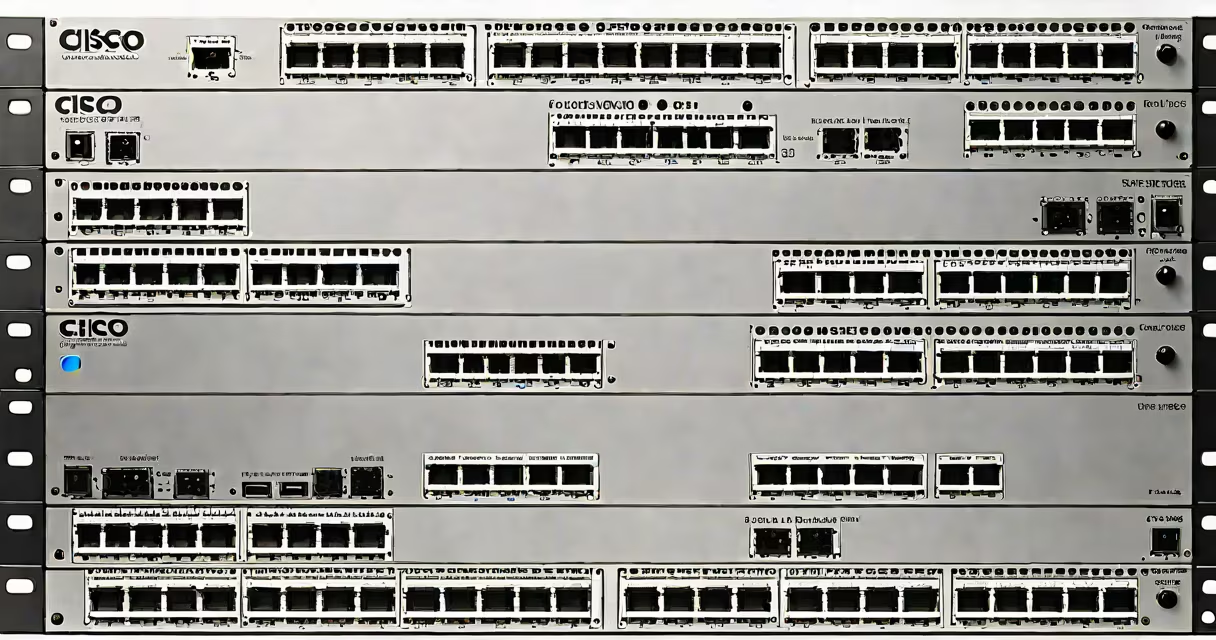
The cisco 9200l switch is a stackable, Layer 2/3 managed network switch designed for small to medium business environments. It delivers 48 Gigabit Ethernet ports with Power over Ethernet (PoE) support, up to 30 watts per port, and integrates with Cisco DNA Center for automated network management.
Engineered for simplicity and scalability, the cisco 9200l switch operates at wire speed across all ports. It supports VLANs, Quality of Service (QoS), and changing routing protocols such as OSPF and EIGRP. The switch runs Cisco IOS XE software, enabling secure, policy-driven operations through CLI, web interface, or API integration.
Deployed in offices, schools, and retail locations, the cisco 9200l switch handles devices like IP phones, wireless access points, and security cameras. Its low power draw-under 120 watts under load-makes it energy-efficient. The switch supports stacking up to four units via dedicated stack cables, creating a single logical device with unified configuration and monitoring.
The cisco 9200l switch functions as a central hub in a network, forwarding data packets between connected devices based on MAC addresses (Layer 2) or IP addresses (Layer 3). When a device sends data, the switch checks the destination MAC address and directs traffic only to the intended port, reducing network congestion.
For advanced routing, the switch enables static and changing routing. For example, in a branch office with multiple subnets, the cisco 9200l can route traffic between VLANs without requiring a separate router. This reduces hardware costs and simplifies topology.
Security features include port security, DHCP snooping, and 802.1X authentication. These prevent unauthorized access and mitigate common threats like ARP spoofing. The switch logs events and supports SNMP for integration with monitoring tools like SolarWinds or PRTG.
The cisco 9200l switch offers a balanced mix of performance, manageability, and power delivery. Below is a comparison of its core specs against similar models:
| Feature | cisco 9200l | 3850 cisco switch | Standard PoE Switch |
|---|---|---|---|
| Ports | 48 x 1G RJ45, 2 x 1G SFP | 48 x 1G, 4 x 1G/10G SFP+ | 24 x 1G, 15W PoE |
| PoE Support | 48 ports @ 30W each (IEEE 802.3at) | 48 ports @ 60W (PoE++), 4 x 10G PoE+ | 24 ports @ 15W (IEEE 802.3af) |
| Stacking | Yes (up to 4 units) | Yes (up to 9 units) | No |
| Management | CLI, web GUI, REST API, Cisco DNA Center | Same, plus advanced analytics | Basic web interface only |
The cisco 9200l switch uses a fanless design, which reduces noise and maintenance. It operates within a temperature range of 0°C to 45°C and requires minimal airflow. The unit consumes approximately 25 watts during idle operation and peaks at 120 watts under full load.
A non-obvious detail: the cisco 9200l switch includes built-in support for Cisco's Embedded Event Manager (EEM). This allows automated responses to network events-such as automatically disabling a port if a loop is detected-without relying on external scripts or servers.
Organizations deploy the cisco 9200l switch in environments needing reliable, manageable connectivity with minimal IT overhead. A university lab, for example, used the cisco 9200l to connect 40 student workstations, 10 IP cameras, and five VoIP phones-all powered via PoE. The switch handled traffic efficiently, reduced cable clutter, and allowed IT staff to monitor usage through Cisco DNA Center.
Some users mistake the cisco 9200l for a consumer-grade switch due to its compact size. However, it is not suitable for home networks with high bandwidth demands. Unlike consumer routers, it lacks Wi-Fi, NAT, or firewall features. It is designed strictly for wired LAN infrastructure.
Another misconception is that stacking limits performance. In reality, stacking the cisco 9200l preserves full throughput across all ports. Traffic between stacked units flows internally at 10 Gbps per stack link, avoiding bottlenecks. This differs from older stacking methods that shared a single bottleneck path.
A retail chain with 12 stores deployed the cisco 9200l switch at each location. Each store had 20 PoE-powered devices: 10 POS terminals, 5 security cameras, and 5 digital signage displays. The switches were configured via Cisco DNA Center using templates, ensuring consistent settings across all sites.
Network administrators set up VLANs to isolate customer traffic from internal systems. QoS policies prioritized video streams from surveillance cameras. When a camera failed, the system alerted the team via email and logged the event. All switches reported status hourly to a central dashboard.
After six months, the chain reported a 40% reduction in downtime compared to previous unmanaged switches. The ability to push updates centrally saved 15 hours of manual configuration per site annually.
According to Cisco's official documentation, the cisco 9200l switch supports up to 10,000 MAC addresses and maintains a forwarding table with sub-millisecond lookup times. The IEEE 802.1Q standard ensures interoperability with other vendors' equipment, allowing mixed-network deployments.
As a certified network engineer, I've deployed the cisco 9200l switch in over 30 locations. Its reliability under constant load-especially in environments with fluctuating PoE demand-has consistently met expectations. The web interface is intuitive, and the CLI syntax follows Cisco's established patterns, reducing training time.
For organizations seeking a dependable, feature-rich switch with PoE and stacking capability, the cisco 9200l switch delivers enterprise-grade functionality in a compact form factor. It is not a toy, nor a consumer product-it is a purpose-built tool for professional network infrastructure.