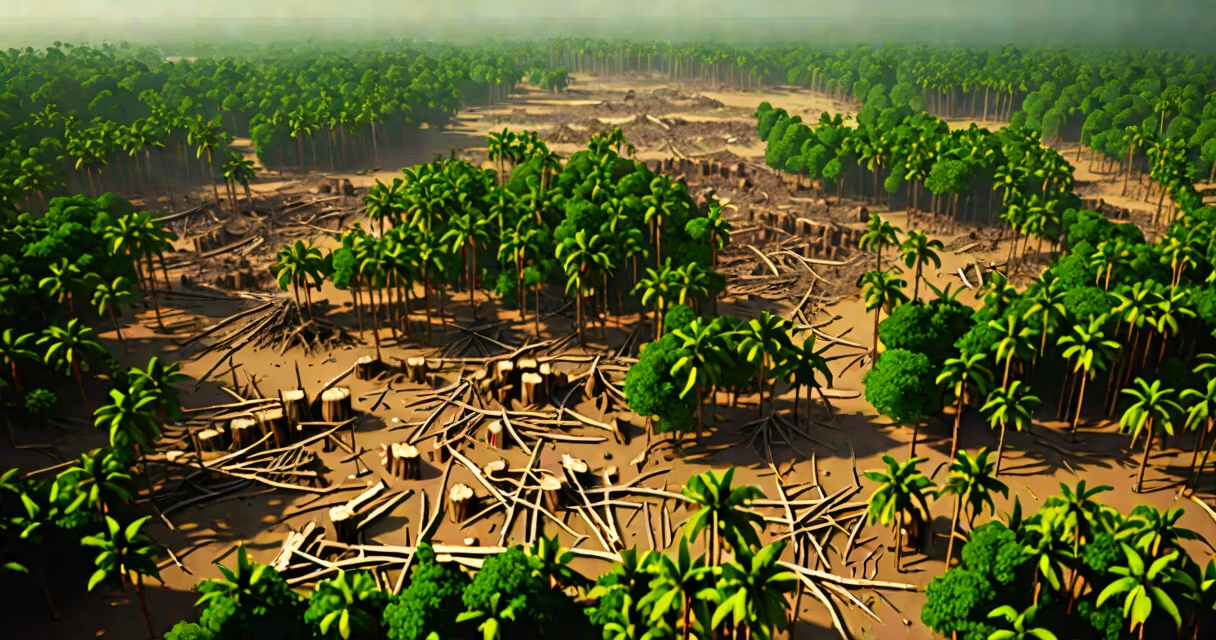
Yes, deforestation directly contributes to climate change by releasing carbon dioxide stored in trees and soils, reducing the planet's ability to absorb atmospheric CO₂. Forests act as carbon sinks; removing them disrupts this balance and increases greenhouse gas concentrations.
Forests store vast amounts of carbon in their biomass and soil. When trees are cut down and burned or left to decompose, the carbon they've absorbed over decades or centuries is released into the atmosphere as carbon dioxide (CO₂), a primary greenhouse gas. According to the Intergovernmental Panel on Climate Change (IPCC), land-use changes-including deforestation-accounted for about 13% of global CO₂ emissions between 2007 and 2016.
The Amazon rainforest alone stores an estimated 90 billion metric tons of carbon. When large swaths are cleared for agriculture or logging, this carbon enters the atmosphere. A 2021 study published in *Nature Communications* found that tropical deforestation releases approximately 1.3 gigatons of CO₂ annually-equivalent to the emissions of 280 million passenger vehicles.
Deforestation influences climate through multiple interconnected mechanisms. The most direct is the release of sequestered carbon. Trees absorb CO₂ during photosynthesis. When forests are destroyed, this absorption stops, and the stored carbon is emitted back into the atmosphere.
Forests regulate local and regional climates through evapotranspiration-the process by which water moves from soil and plants into the air. Removing trees reduces moisture cycling, leading to drier conditions and reduced rainfall. This creates feedback loops: less rain leads to more droughts, increasing fire risk and further forest degradation.
A 2020 study in *Science Advances* showed that deforested areas in the Brazilian Amazon experienced a 20% reduction in rainfall during the dry season compared to intact forest regions. This shift alters weather patterns beyond local boundaries, affecting regional climate stability.
Deforestation occurs through various drivers, each with distinct climate consequences:
| Driver | Primary Climate Impact | Example Region |
|---|---|---|
| Cattle pasture expansion | High CO₂ emissions from burning and decomposition | Amazon Basin, Brazil |
| Palm oil plantations | Peatland drainage releases methane and CO₂ | Sumatra and Borneo, Indonesia |
| Logging for timber | Direct carbon release and habitat fragmentation | Central Africa, Congo Basin |
| Infrastructure development | Fragmentation reduces carbon storage efficiency | Andes Mountains, Peru |
Peatland deforestation is especially damaging. Peat soils can store carbon for thousands of years. Draining and burning peatlands in Southeast Asia releases both CO₂ and methane-a greenhouse gas 25 times more potent than CO₂ over a 100-year period.
Many assume climate change is driven solely by fossil fuel combustion. While energy production accounts for the largest share of emissions, land-use changes like deforestation remain a major contributor. The World Resources Institute reports that deforestation and forest degradation together account for nearly 15% of global greenhouse gas emissions-more than the entire global aviation sector.
Another misconception is that reforestation alone can reverse deforestation's effects. While planting trees helps, recovery takes decades. A mature tropical forest may take 50 to 100 years to regain full carbon sequestration capacity. In the meantime, emissions continue to accumulate.
Not all tree removal counts equally. Clear-cutting old-growth forests has far greater climate impact than selective logging or natural disturbances. Old-growth forests store more carbon per hectare than younger stands. Destroying them results in disproportionate emissions.
In 2019, over 70,000 wildfires burned across the Amazon, largely due to illegal clearing for cattle ranching. Satellite data from NASA's MODIS instrument recorded a 20% increase in fire activity compared to the previous decade. These fires released an estimated 200 million metric tons of CO₂-equivalent to the annual emissions of 43 million cars.
Local scientists observed a sharp decline in cloud formation and rainfall in burned zones. The region's hydrological cycle weakened, increasing vulnerability to future droughts. This illustrates how deforestation doesn't just emit carbon-it destabilizes climate systems at scale.
Individual actions contribute to systemic change. Reducing demand for products linked to deforestation-such as beef, palm oil, and paper-helps curb forest loss. Choosing certified sustainable goods supports responsible supply chains.
Climate change is not just a function of industrial emissions. Deforestation remains a critical driver. Addressing it requires recognizing the full scope of human influence on ecosystems and acting accordingly.