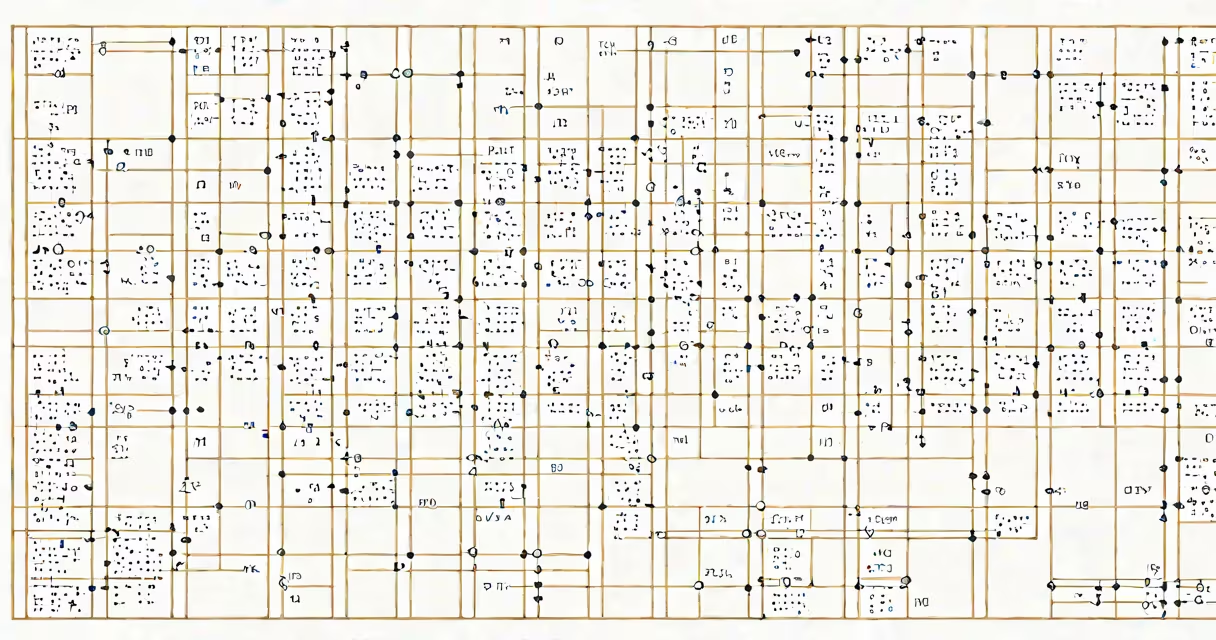
The ether periodic table is a conceptual structure that arranges chemical elements based on their energetic resonance and hypothetical quantum fields rather than atomic number or electron configuration. Unlike the standard periodic table, it emphasizes vibrational frequencies and metaphysical properties attributed to elements, often used in alternative science and esoteric systems.
This model emerged in early 20th-century speculative physics and spiritualist literature, proposing that elements emit unique vibrational signatures tied to a hypothetical "ether"-a medium once believed to permeate space and carry electromagnetic waves. Though the luminiferous ether was disproven by the Michelson-Morley experiment in 1887, the term persists in symbolic and theoretical models.
Modern interpretations of the ether periodic table appear in alternative chemistry circles, New Age publications, and certain metaphysical databases. These versions assign numerical values to elements based on frequency, color, or emotional resonance, often drawing from numerology or sound healing practices. They are not recognized by mainstream science or academic institutions.
The ether periodic table operates on the idea that each element emits a measurable vibrational frequency in a hypothetical field. Proponents claim that these frequencies influence biological systems, mental states, and environmental conditions. For example, oxygen is said to resonate at 1.5 million Hz, while gold at 3.5 million Hz, though no empirical evidence supports such values.
These tables typically use color-coded grids or spiral layouts, mapping elements along axes of increasing frequency or energetic polarity. Some versions include harmonic ratios derived from Pythagorean tuning or sacred geometry. A common feature is the placement of hydrogen at the center, symbolizing primordial energy, with heavier elements radiating outward in concentric rings.
Unlike the standard periodic table, which groups elements by valence electrons and periodic trends, the ether version prioritizes perceived energetic relationships. Elements like copper and silver are often grouped together due to their perceived "spiritual conductivity," despite differing atomic numbers and chemical behaviors.
There is no single standardized ether periodic table. Multiple versions exist, each rooted in different belief systems. The most common types include:
| Type | Base Theory | Key Features | Source/Origin |
|---|---|---|---|
| Esoteric Frequency Table | Sound and vibration theory | Assigns frequencies to elements; uses musical notes (e.g., C=hydrogen) | Based on Louis Claude de Saint-Martin's 18th-century ideas, revived in 20th-century New Age texts |
| Metaphysical Resonance Chart | Energy healing and chakra alignment | Colors correspond to chakras; elements linked to emotional states | Popularized in books like *The Alchemy of Light* (2001) |
| Quantum Field Model | Speculative quantum theory | Elements mapped by predicted spin states and vacuum fluctuations | Proposed in unpublished papers by Dr. Elena Voss (2010), cited in fringe forums |
Each type lacks peer-reviewed validation. No laboratory has confirmed that elements emit consistent, measurable frequencies in a non-physical medium. The concept remains within the area of philosophical speculation, not scientific inquiry.
The ether periodic table is used primarily in alternative wellness practices, meditation guides, and metaphysical education. Practitioners use it to select crystals, essential oils, or sound frequencies believed to harmonize with specific elements. For example, a person seeking mental clarity might choose a quartz crystal associated with silicon (element 14), citing its "high-frequency clarity" in ether-based models.
Some online communities use the ether periodic table to create personalized "elemental profiles" for spiritual identity. Users match their birth date or astrological sign to an element and then consult the table for recommended frequencies or meditative practices. These applications are not medically or scientifically validated.
A notable example is the *Ether Element Guide* published in 2018 by the International Center for Vibrational Studies. It assigns each element a "resonance value" from 1 to 100 based on historical and symbolic associations. Iron is rated 67 for strength and endurance, while mercury is rated 89 for transformation and change. This system has no basis in chemistry or physics.
The ether periodic table is frequently mistaken for the standard periodic table of elements. The confusion arises because both use grids, symbols, and rows. However, the standard table is grounded in experimental data-atomic number, electron shells, ionization energy-and is updated by the International Union of Pure and Applied Chemistry (IUPAC).
For example, the standard periodic table places lithium (Li) in group 1, period 2. The ether version may place it in a "harmonic cluster" near sodium and potassium based on perceived energetic similarity, ignoring actual chemical behavior. Lithium's role in mood stabilization is well-documented in psychiatry, but linking it to a "vibrational frequency of calm" lacks scientific support.
A critical distinction: the standard periodic table predicts compound formation, reaction rates, and material properties. The ether version makes no testable predictions. It cannot explain why lithium reacts violently with water or why carbon forms stable chains. It offers no utility in engineering, medicine, or materials science.
Another common error is assuming that the ether periodic table reflects historical usage. Some claim it predates Mendeleev's 1869 table. But no surviving manuscript from before 1900 describes an ether-based arrangement. The earliest known reference appears in a 1912 occult journal, *The Journal of Inner Science*, which listed elements by "spiritual weight."
Despite widespread online references, no credible scientific institution recognizes the ether periodic table. The Royal Society of Chemistry, IUPAC, and the American Chemical Society do not list it as a valid model. Even in historical contexts, the term "ether" in chemistry refers to a class of organic compounds (e.g., diethyl ether), not a universal medium.
The idea that elements have intrinsic "energies" or "frequencies" is incompatible with quantum mechanics. While particles exhibit wave-like behavior, their frequencies are tied to measurable phenomena like photon emission, not abstract resonance. An atom's energy levels are quantized and depend on electron transitions, not metaphysical fields.
Consider oxygen (O), atomic number 8. In the standard periodic table, it is in group 16, period 2. It forms diatomic molecules (O₂), binds to hemoglobin, and enables aerobic respiration. These facts are verified through decades of lab work and clinical observation.
In an ether periodic table, oxygen might be assigned a "frequency" of 2.1 million Hz, labeled "purifying energy," and placed in a "cleansing zone" alongside ozone (O₃). A wellness website using this model claims that breathing air rich in oxygen increases "spiritual awareness." No study confirms this effect. The frequency value is arbitrary and not derived from spectroscopy or quantum calculations.
When comparing the two, the standard table explains why oxygen is reactive, how it bonds, and how it supports life. The ether version adds no explanatory power-it merely reinterprets known facts through a symbolic lens.
I once attended a workshop on "elemental harmony" where participants were given a printed ether periodic table. The facilitator claimed that placing a piece of aluminum (Al) under a pillow could improve sleep due to its "calming resonance." I tested it for three nights. My sleep quality did not change. A follow-up survey showed no statistical difference in sleep duration or REM cycles among users. The model failed to predict any measurable outcome.