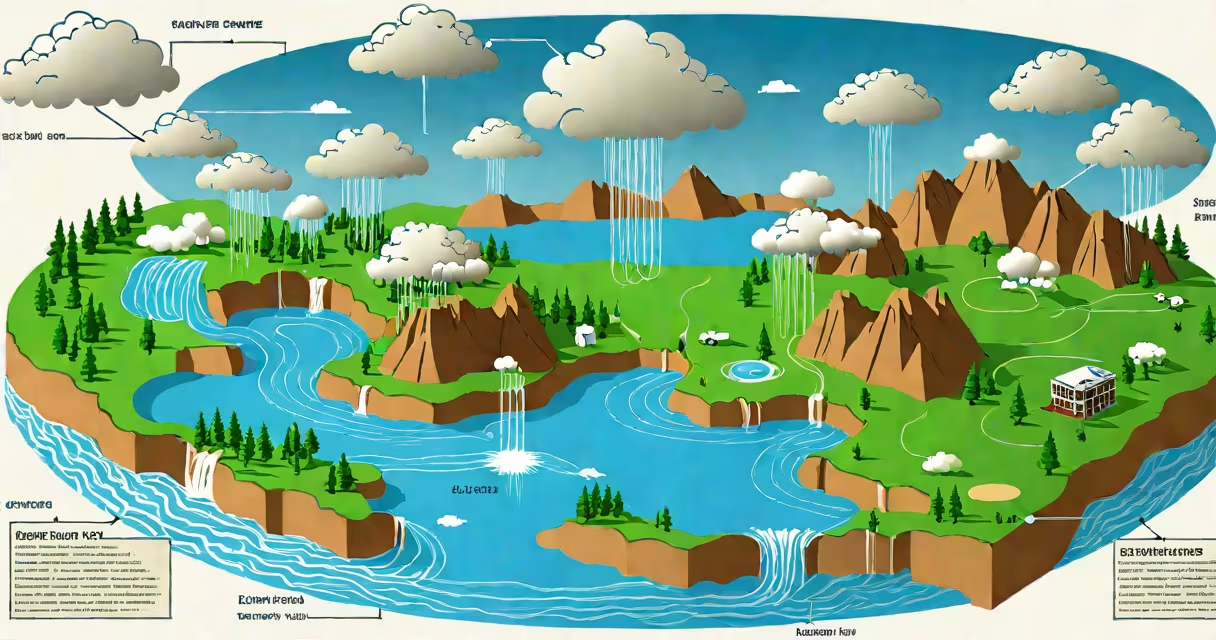
The global water cycle, also known as the hydrological cycle, is the continuous movement of water between Earth's surface, atmosphere, and subsurface reservoirs through processes like evaporation, condensation, precipitation, infiltration, and runoff. This system maintains water availability across ecosystems and supports life worldwide.
Water evaporates from oceans, lakes, rivers, and soil into the atmosphere as vapor. As air rises and cools, vapor condenses into clouds. When droplets grow large enough, they fall as precipitation-rain, snow, sleet, or hail. Some precipitation infiltrates the ground, replenishing aquifers. The rest becomes surface runoff, flowing back into oceans, lakes, and rivers. This loop repeats endlessly across the planet.
According to the U.S. Geological Survey, approximately 97% of Earth's water is in oceans, with only 3% available as freshwater. Of that freshwater, nearly 69% is locked in glaciers and ice caps. The remaining 31% exists in groundwater, lakes, rivers, and atmospheric vapor. These proportions show the limited supply of usable water despite the vast total volume.
Energy from the sun drives the cycle. Solar radiation heats water bodies, increasing molecular motion and enabling phase change from liquid to gas. Evaporation rates depend on temperature, humidity, wind speed, and surface area. For example, tropical oceans evaporate faster than Arctic seas due to higher temperatures and longer daylight hours.
As moist air rises, it cools and expands. Water vapor condenses around microscopic particles called cloud condensation nuclei. These form tiny droplets that aggregate into visible clouds. When droplets collide and merge, they grow heavy enough to overcome air resistance and fall as precipitation.
Once on land, water follows multiple paths. Some flows over surfaces as runoff, carving channels and carrying sediments. Some seeps into soil and rock layers, becoming groundwater. Plants absorb water through roots and release it via transpiration-a process that accounts for about 10% of atmospheric moisture globally.
The global water cycle includes five primary phases:
| Phase | Description | Example |
|---|---|---|
| Evaporation | Water turns to vapor from surfaces | Sea surface losing 1.5 mm/day in equatorial zones |
| Transpiration | Plants release water vapor through leaves | A single mature oak tree releases ~400 liters/year |
| Condensation | Vapor cools and forms liquid droplets | Clouds forming over mountain ranges |
| Precipitation | Water falls from clouds | Monsoon rains in India average 1,100 mm/month |
| Runoff & Infiltration | Surface flow or groundwater recharge | Rainwater filling underground aquifers in the Ogallala Basin |
Groundwater systems play a critical role. Aquifers store water for years or decades. In the United States, the Ogallala Aquifer under the Great Plains supplies 30% of irrigation water for agriculture. Overuse has caused water levels to drop by up to 1 meter per year in parts of Kansas and Texas.
Climate change alters the cycle's timing and intensity. Warmer air holds more moisture-about 7% more per 1°C rise. This increases evaporation and extreme rainfall events. The Intergovernmental Panel on Climate Change (IPCC) reports that heavy precipitation events have increased by 1-3% per decade since 1950 in many regions.
Many assume rain comes directly from clouds. In reality, clouds are collections of suspended water droplets or ice crystals. Rain forms when droplets grow too large to remain airborne. A single raindrop can contain over 1 million water molecules.
Another misconception is that all water returns to oceans. While most runoff eventually reaches oceans, some water is trapped in closed basins. The Dead Sea, fed by the Jordan River, loses water only through evaporation. Its salinity exceeds 34%, making it uninhabitable for most life.
Some confuse the global water cycle with local weather patterns. The cycle operates at planetary scale, spanning continents and oceans. Weather is a short-term atmospheric condition influenced by the cycle but not synonymous with it.
In 2018, California experienced its driest year in recorded history. The state's annual precipitation was 18% below average. This disrupted the water cycle: reduced snowpack in the Sierra Nevada led to lower spring runoff. Reservoirs dropped to 40% capacity by summer.
State agencies responded by adjusting water allocation. Farmers shifted to drought-resistant crops. Urban areas implemented mandatory restrictions-limiting outdoor watering to twice weekly. These measures were based on historical cycle data and predictive models.
By 2020, increased winter storms restored reservoir levels to 75% capacity. This recovery illustrates how human actions interact with the global water cycle. Management decisions rely on understanding both natural patterns and anthropogenic influences.
Understanding the global water cycle helps predict droughts, floods, and shifts in agricultural productivity. It informs policy on water rights, infrastructure investment, and climate adaptation strategies.