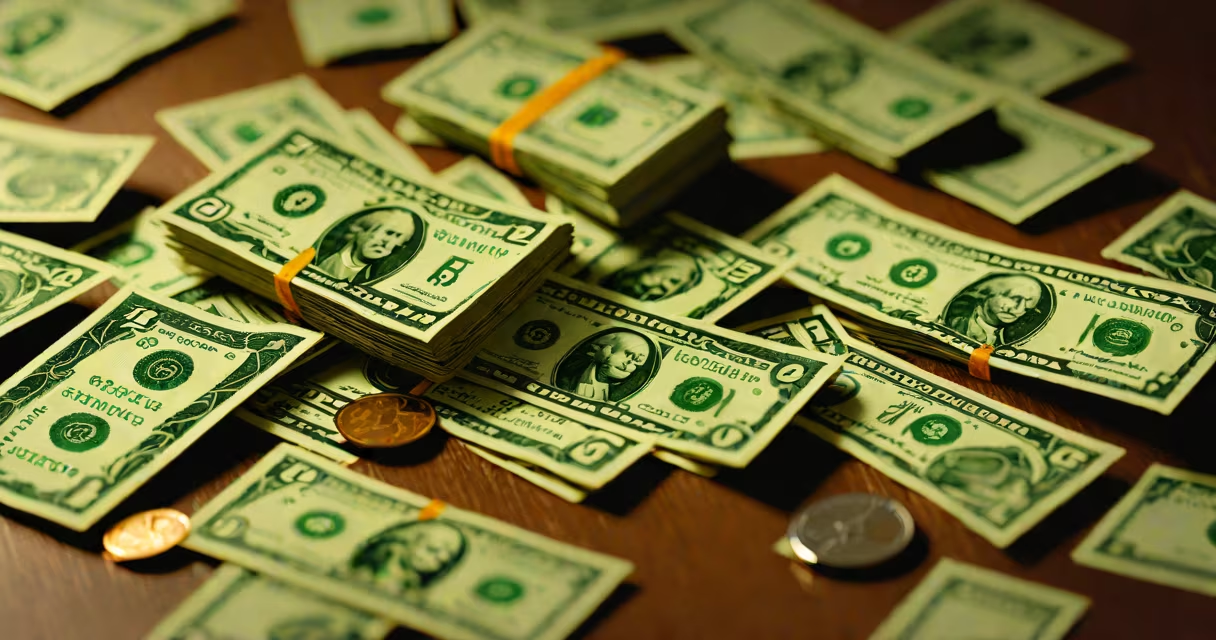
Hard cash meaning refers to physical money-bills and coins-that exists independently of bank accounts, digital wallets, or credit systems. It's tangible, immediate, and requires no intermediary to transfer value.
Unlike digital funds, which rely on networks, passwords, and servers, hard cash is a direct exchange of value. You hold it, count it, and spend it without waiting for processing times or fees. This form of payment has existed for centuries and remains central to personal finance, small businesses, and informal economies worldwide.
For example, when someone says "I'll pay you in hard cash," they mean actual dollars, euros, or yen-not a bank transfer, gift card, or cryptocurrency. The term emphasizes the physicality and immediacy of the transaction.
Hard cash operates through a system of government-issued currency backed by national trust, not intrinsic value. A $20 bill is worth $20 because the U.S. Treasury guarantees it, not because it contains gold or silver. Its value comes from legal tender status and public acceptance.
Transactions using hard cash require no authorization, internet connection, or third-party verification. When you hand over a $50 bill for a $45 purchase, the seller accepts it instantly. No delay, no processing fee, no risk of chargebacks. The exchange is complete the moment the bill changes hands.
This makes hard cash ideal for situations where speed, privacy, or reliability is essential. Street vendors, flea markets, and informal trades often prefer it. In emergencies-like power outages or network failures-cash becomes the only viable payment method.
Hard cash includes both paper currency and coinage issued by a country's central bank. The U.S. Federal Reserve issues paper money in denominations from $1 to $100. Coins include pennies (1¢), nickels (5¢), dimes (10¢), quarters (25¢), and half-dollars (50¢).
| Type | Common Denominations | Use Case |
|---|---|---|
| Paper bills | $1, $5, $10, $20, $50, $100 | Large purchases, everyday spending |
| Coins | 1¢, 5¢, 10¢, 25¢, 50¢ | Change, vending machines, small transactions |
| High-value notes | $100 (U.S.), €500 (Euro) | International trade, bulk transfers |
Some countries issue commemorative or collectible versions of hard cash, such as the U.S. $100 bill featuring Benjamin Franklin, or the Canadian $100 polymer note with a holographic maple leaf. These remain valid for transactions but may attract higher interest among collectors.
Despite the rise of digital payments, hard cash remains widely used. In the United States, 62% of adults reported using cash for at least one transaction in 2023, according to the Federal Reserve's 2023 Report on the Payment System. That number drops slightly in urban areas but stays high in rural communities and among lower-income households.
Small businesses often accept hard cash because it avoids processing fees. A local diner charging $12 for a meal might lose 2.5% to 3% in fees if paid via credit card. Cash eliminates that cost entirely. Similarly, independent sellers at farmers' markets avoid the 2.9% fee common with mobile payment apps.
Another reason is privacy. Digital transactions leave a trail. Hard cash leaves none. This appeals to people who want to avoid surveillance, protect their financial habits, or conduct sensitive exchanges discreetly. For example, a person buying a used car might prefer cash to avoid triggering a credit check or leaving a record.
Hard cash is often confused with "cash" in the broader sense. In finance, "cash" includes checking accounts, savings, and liquid assets. But hard cash specifically means physical currency. Saying "I have cash" doesn't always mean you're holding bills-you might mean money in a bank account.
A key distinction: hard cash cannot be lost to hacking, frozen by banks, or reversed by fraud systems. Once spent, it's gone. This also means it's irreversible. If you give someone $20 in cash and later regret it, there's no way to undo the transaction.
Another misconception is that hard cash is obsolete. While digital adoption grows, physical money persists. In 2022, the U.S. Mint produced over 10 billion coins, and the Bureau of Engraving and Printing printed more than 7 billion new bills. These numbers show continued demand.
Even in tech-forward nations like Sweden, where 80% of transactions are digital, hard cash is still used-just less frequently. The Swedish central bank, Riksbank, reports that 20% of Swedes still carry cash, especially for small purchases or gifts.
Consider Maria, a food vendor at a weekend market in Portland, Oregon. She sells handmade empanadas for $6 each. Her customers pay in hard cash-mostly $5 and $10 bills, sometimes coins.
Each day, she collects $300 in cash. She keeps $100 in her wallet for change and deposits the rest into her business account on Monday. She doesn't use a card reader because the fee would eat into her profit margin. Her customers don't mind paying in cash-they value speed and simplicity.
When a customer pays with a $20 bill for a $12 purchase, Maria gives back $8 in change-four $1 bills and four quarters. The entire exchange takes under 15 seconds. No app, no PIN, no confirmation screen. Just hand-to-hand transfer.
This scenario illustrates why hard cash remains functional and preferred in many settings. It's efficient, private, and accessible-even when smartphones aren't available.
Hard cash is not digital currency, crypto, or virtual money. Bitcoin, Ethereum, and stablecoins exist online and depend on blockchain technology. They are not physical and cannot be held or passed like a $20 bill.
It's also not credit. Using a credit card to buy something creates debt. You're borrowing money from the issuer and repaying it later. Hard cash involves no obligation-it's a one-time transfer of owned value.
Finally, hard cash is not interchangeable with "liquid assets." While cash is the most liquid asset, "liquidity" refers to how quickly an asset can be converted to cash. Stocks, bonds, and real estate are liquid assets-but they aren't hard cash until sold and exchanged physically.
One non-obvious fact: hard cash can be counterfeit. The U.S. Secret Service investigates over 100 counterfeit cases annually. Most fake bills are detected by trained staff, but some slip through. This is why businesses often check serial numbers and use counterfeit detection pens.
I once bought a vintage jacket at a thrift store in Seattle. The owner asked for hard cash only. I handed over two $20 bills and a $5 bill. He counted them slowly, checked the serial numbers, and nodded. The transaction took 20 seconds. No receipt, no app, no tracking. Just a handshake and a sale.
That moment reminded me that hard cash isn't outdated-it's still trusted. It's not flashy, but it works. When digital systems fail, people go back to paper and metal.
Understanding hard cash meaning helps clarify financial decisions. managing a business, knowing the difference between physical money and digital equivalents prevents confusion and improves control.