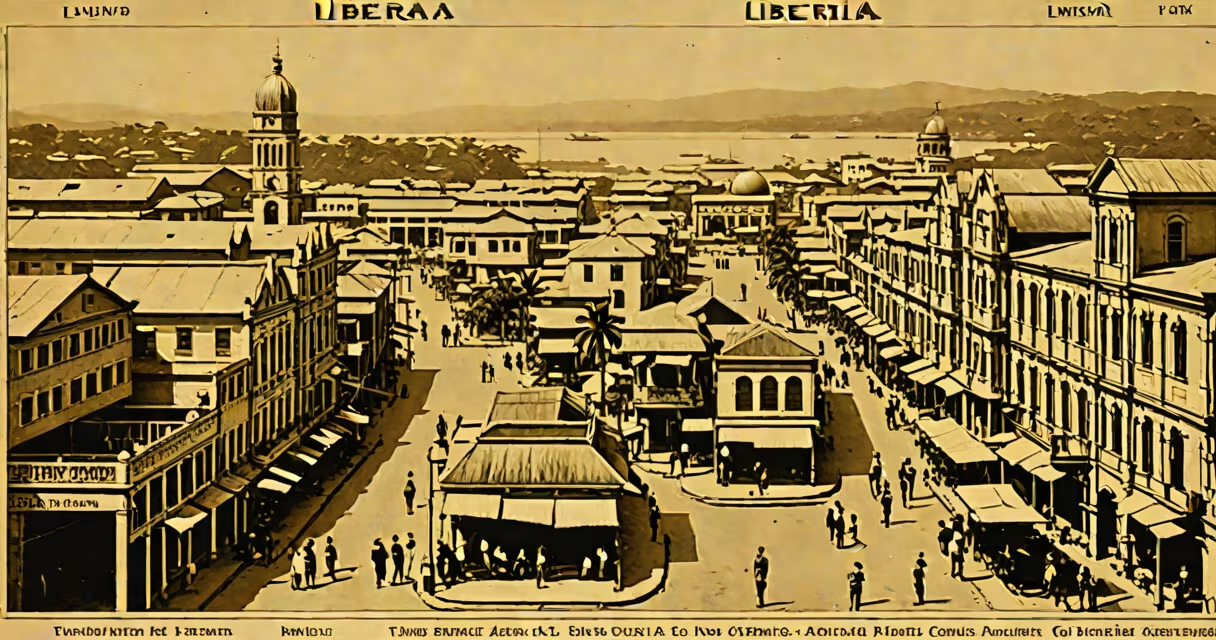
Liberia was founded in 1822 by the American Colonization Society as a settlement for formerly enslaved Africans freed in the United States. It became the first African republic established by people of African descent, declaring independence in 1847. The nation's early government was modeled on the U.S. Constitution, and its ruling elite-Americo-Liberians-descended from settlers who arrived between 1822 and 1860.
The country's foundation rested on a dual narrative: the resettlement of freed Black Americans and the presence of indigenous communities who had lived on the land for centuries. This duality shaped political exclusion, cultural tension, and eventual civil strife. By the late 19th century, the government controlled most of the coastal region, while inland tribes were marginalized under a system of indirect rule.
Despite formal independence, Liberia remained economically dependent on foreign trade and foreign investment. Its capital, Monrovia, grew into a hub of commerce and diplomacy, yet rural populations faced limited access to education, healthcare, and infrastructure. The nation's trajectory diverged sharply from neighboring states due to its distinct origin story and racialized power structure.
The American Colonization Society, formed in 1816, promoted the relocation of free Black Americans to Africa. Between 1822 and 1860, approximately 10,000 individuals were transported from the U.S. to what became Liberia. These settlers brought with them Western religious practices, educational systems, and political ideals rooted in Enlightenment principles and U.S. constitutionalism.
Settlements were established along the coast, including Monrovia (named after U.S. President James Monroe). The colonists negotiated treaties with local chiefs, though many agreements were later disputed or ignored. The settlers formed a self-governing colony under the authority of the U.S.-backed society until they declared independence in 1847.
A key distinction often missed is that Liberia was not a British or French colony. Unlike most African nations colonized during the Scramble for Africa, Liberia was founded by diasporic Africans and maintained sovereignty throughout the 19th century. This rare status gave it international recognition as a free state, though its internal governance excluded the majority of the population.
Liberia's 1847 constitution mirrored the U.S. model: a president elected by a small electorate, a bicameral legislature, and a judiciary. However, citizenship was restricted to those of African descent, excluding indigenous groups and mixed-race populations. The ruling class-Americo-Liberians-numbered fewer than 5% of the population but held nearly all political power.
By the 1900s, indigenous groups such as the Kpelle, Bassa, and Gio had organized resistance against land seizures and forced labor. The government responded with military campaigns and suppression. A 1915 report by the League of Nations noted "widespread discontent" among rural populations, citing "denial of rights and unequal treatment."
One example of systemic exclusion: in 1920, only 1.2% of Liberia's population could vote. The government required literacy tests and property ownership for suffrage-barriers designed to exclude poor and illiterate citizens. These policies entrenched a divide between coastal elites and interior communities, fueling long-term instability.
Civil war erupted in 1989 when Charles Taylor, a former government official, led a rebellion from the borderlands. His forces captured Monrovia in 1990, triggering a decade of violence. The conflict involved multiple factions, warlords, child soldiers, and widespread atrocities. Over 250,000 people died, and millions were displaced.
Human Rights Watch documented systematic rape, torture, and execution of civilians. In 1992, the National Patriotic Front of Liberia (NPFL) committed mass killings in the town of Gbarnga. The UN estimated that 70% of women in conflict zones experienced sexual violence. These events are not isolated incidents-they reflect patterns seen in other post-colonial conflicts, such as those in Rwanda and Sierra Leone.
After years of war, peace accords were signed in 2003. A transitional government was installed, and Ellen Johnson Sirleaf became Africa's first elected female head of state in 2006. Her administration focused on rebuilding institutions and attracting foreign aid. Yet challenges persisted: corruption, weak infrastructure, and ethnic tensions remained unresolved.
Liberia is frequently mistaken for a typical African nation shaped by European colonization. It is not. While other countries in West Africa were partitioned during the Berlin Conference (1884-1885), Liberia was recognized as independent by Britain, France, and the U.S. in 1849. This recognition was based on its claim to self-governance and treaty relations, not colonial oversight.
Another misconception: that Liberia's founding was purely altruistic. The American Colonization Society included slaveholders and white abolitionists who believed Black people could not integrate into U.S. society. Their goal was not emancipation but removal. As historian John C. Inscoe notes in *The Atlantic World and the Founding of Liberia* (2017), "The project was less about freedom than about maintaining racial hierarchy."
| Feature | Liberia | Other West African Colonies |
|---|---|---|
| Founding Group | Free Black Americans & Afro-Caribbeans | British, French, Portuguese administrators |
| Independence Date | 1847 | 1960s (e.g., Ghana, Nigeria) |
| Ruling Elite Origin | Settlers from U.S. and Caribbean | Colonial appointees or local elites co-opted by Europeans |
| Language of Government | English (American variant) | English, French, Portuguese |
When I visited Monrovia in 2018, I met a historian who showed me a 19th-century letter written by a settler describing the "civilizing mission" of the colony. He pointed out that the term "civilization" was used to justify exclusion, not uplift. That moment underscored how identity politics shaped national memory-and how deeply roots of inequality ran.
Liberia's history reveals a paradox: a nation born from liberation efforts that later perpetuated exclusion. Its founding was a response to American slavery, yet its governance replicated racial hierarchies. The 2003-2008 civil war stemmed not from external invasion but from internal fractures-between rulers and ruled, settlers and natives, urban and rural.
Today, Liberia remains one of the poorest nations in the world. The World Bank reports a GDP per capita of $580 (2023), with 70% of the population living below the poverty line. Yet the country has made progress in democratic participation: voter turnout reached 78% in the 2023 presidential election, the highest in West Africa.
Understanding the history of Liberia requires recognizing both its strong origins and its enduring struggles. It is not a mirror of other African nations, nor is it a success story in isolation. Its path reflects the complexities of nation-building in a post-slavery world.