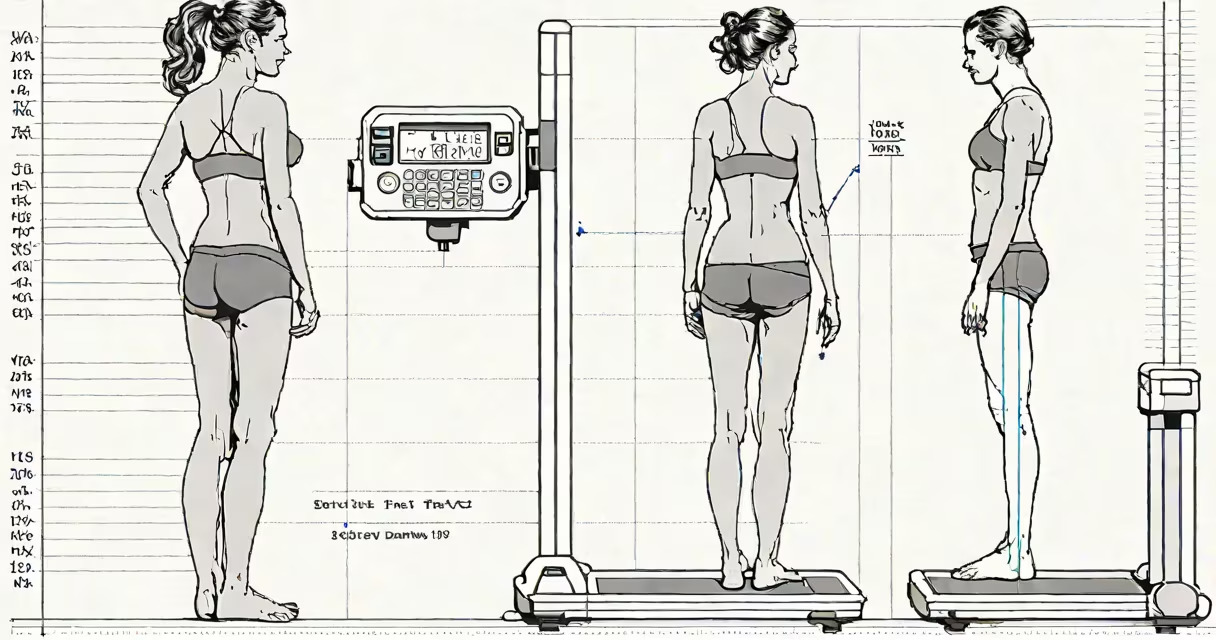
BMI and body fat percentage are two distinct health metrics used to assess body composition. BMI estimates weight relative to height, while body fat percentage measures the actual proportion of fat in the body. Both are widely used in clinical and fitness settings to evaluate health risk and physical condition.
BMI is calculated using a simple formula: weight in kilograms divided by height in meters squared. For example, a person weighing 70 kg and standing 1.75 m tall has a BMI of 22.86 (70 ÷ 1.75² = 22.86). This value falls within the "normal weight" range according to the World Health Organization (WHO), which defines normal BMI as 18.5 to 24.9.
Body fat percentage requires a different approach. It cannot be determined from height and weight alone. Methods include skinfold calipers, bioelectrical impedance analysis (BIA), dual-energy X-ray absorptiometry (DEXA), and hydrostatic weighing. Among these, BIA is most accessible via consumer body fat scales. These devices send a weak electrical current through the body and measure resistance. Since fat conducts electricity poorly compared to muscle and water, the result estimates fat mass.
The BMI formula is standardized globally. It uses metric units: kilograms for weight and meters for height. A BMI under 18.5 indicates underweight, 18.5-24.9 is normal, 25-29.9 is overweight, and 30 or higher is obese. This classification applies to adults aged 20 and older.
To convert imperial units to metric: divide pounds by 2.2046 to get kilograms, and inches by 39.37 to get meters. For example, a 150-pound person (68.04 kg) who is 5'6" (1.676 m) tall has a BMI of 24.0 (68.04 ÷ 1.676²).
Despite its simplicity, BMI has limitations. It doesn't distinguish between muscle and fat. A muscular athlete may have a high BMI yet low body fat. The Centers for Disease Control and Prevention (CDC) acknowledges this limitation and recommends combining BMI with other measurements like waist circumference for better health insight.
There are several ways to estimate body fat percentage, each with varying accuracy and accessibility. The most common methods are:
| Method | Accuracy | Accessibility | Cost |
|---|---|---|---|
| Skinfold calipers | ±3-5% | Medium (requires training) | $50-$150 |
| Bioelectrical impedance (BIA) | ±3-8% | High (home scales) | $50-$300 |
| Dual-energy X-ray absorptiometry (DEXA) | ±1-2% | Low (clinical setting) | $100-$300 |
| Hydrostatic weighing | ±1-2% | Low (specialized labs) | $100-$200 |
For home use, BIA scales are the most practical. They often come with apps that track changes over time. However, results depend on hydration levels, time of day, and recent food intake. For best results, measure in the morning after fasting and voiding the bladder.
A non-obvious fact: many consumer BIA scales overestimate body fat in people with high muscle mass. This happens because they assume average body water content. A study published in the Journal of the International Society of Sports Nutrition found that BIA devices can misclassify athletes as having higher body fat than they actually do.
BMI and body fat percentage serve different purposes. BMI is a population-level screening tool. It's used in public health reports and clinical guidelines to identify trends in obesity. Body fat percentage gives a clearer picture of metabolic health. High visceral fat (fat around organs) increases risk for type 2 diabetes, heart disease, and certain cancers.
For example, a man with a BMI of 25.5 (overweight) may still have a healthy body fat percentage of 18%. Conversely, someone with a normal BMI of 22.0 could have 30% body fat, placing them in the "high body fat" category. According to the American Council on Exercise (ACE), men with over 25% body fat and women with over 32% are considered obese based on body composition.
I once used a DEXA scan during a research study and was surprised to see that my body fat percentage was 21%, despite a BMI of 24.1. My lean mass was higher than average, which pulled my BMI into the normal range. This confirmed that relying solely on BMI can mask underlying health risks.
Many people think BMI directly measures body fat. It does not. A person with high muscle mass can have a high BMI but low body fat. This is especially true among athletes and bodybuilders.
Another misconception is that body fat percentage is the same as body mass index. They are not. BMI is a ratio of weight to height; body fat percentage is a direct measurement of fat mass relative to total body mass. One can be normal while the other is elevated.
Some online calculators claim to estimate body fat from BMI alone. These are inaccurate. A 2021 review in the journal Nutrients found that such tools had error rates exceeding 10% in diverse populations. Always use validated methods or consult a healthcare provider for precise assessments.
Consider a 35-year-old woman who weighs 145 pounds (65.8 kg) and is 5'5" (1.65 m) tall. Her BMI is 24.0 (65.8 ÷ 1.65²), which is in the normal range. She uses a BIA scale and gets a reading of 34% body fat. This exceeds the ACE threshold for women (32%), indicating high body fat.
She then undergoes a DEXA scan at a clinic. The result confirms her body fat is 33.5%. Her lean mass is lower than expected for her age and activity level. She adjusts her diet and adds strength training. After six months, her BIA reading drops to 28%, and her BMI remains stable at 24.0.
This example shows that tracking both metrics offers deeper insight than either alone. A stable BMI can hide increasing fat mass, which is a red flag for metabolic health.