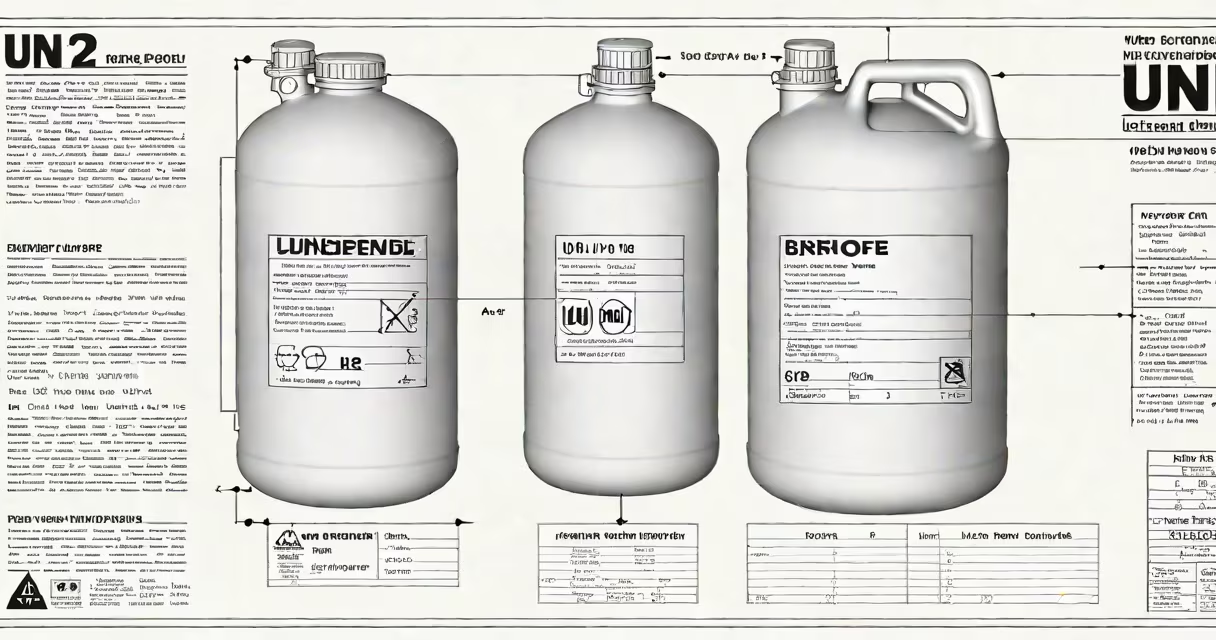
Isopropyl alcohol's UN number is UN 1219, a four-digit code assigned by the United Nations to classify this flammable liquid for safe international transport under hazardous materials regulations.
UN numbers are part of a globally recognized system used to identify dangerous goods during shipment. UN 1219 specifically applies to isopropyl alcohol (also known as isopropanol or 2-propanol) when transported in bulk or in containers exceeding certain thresholds. This identifier ensures consistency across borders, helping customs officials, emergency responders, and logistics teams quickly recognize the substance and its risks.
The number appears on shipping documents, packaging labels, and placards on vehicles transporting the chemical. It is required for compliance with regulations set by the U.S. Department of Transportation (DOT), the International Air Transport Association (IATA), and the International Maritime Organization (IMO).
When isopropyl alcohol is shipped commercially, especially in quantities above 5 liters, the UN number must be included on the package label. The label displays "UN 1219" along with the proper shipping name: "ISOPROPYL ALCOHOL, 75% or higher."
This classification triggers specific handling rules. For example, the material must be packed in UN-approved containers designed to withstand pressure and prevent leakage. Vehicles carrying it must display hazard placards showing the UN number and the appropriate hazard class-Class 3, Flammable Liquid.
A real-world example: A chemical distributor ships 500 liters of 99% isopropyl alcohol from Ohio to a hospital in Toronto. The product is packaged in 20-liter steel drums, each labeled with "UN 1219," the hazard symbol for flammability, and the proper shipping name. Without this label, the shipment would be rejected at the border under the North American Free Trade Agreement (NAFTA) safety protocols.
UN 1219 applies only to pure or concentrated forms of isopropyl alcohol. Diluted solutions-such as those used in hand sanitizers containing 60-70% alcohol-are typically exempt from UN number requirements unless they exceed 1 liter per package or are transported in bulk.
For reference, the following table outlines the scope of UN 1219:
| Material Type | UN Number | Applicability |
|---|---|---|
| Isopropyl alcohol, 90% or higher | UN 1219 | Required for transport in quantities >5 L |
| Hand sanitizer (70% isopropyl) | Not assigned | Exempt under IATA Special Provision A144 |
| Isopropyl alcohol solution (50%) | UN 1219 | Required if >1 L per package |
Many suppliers mistakenly assume all isopropyl alcohol products require UN 1219. That's not true. The threshold depends on concentration, volume, and mode of transport. A 1-liter bottle of 70% isopropyl alcohol sent via courier doesn't need the UN number, but a 20-liter drum of 90% alcohol does.
One widespread error is equating UN 1219 with a safety rating or purity level. It is not. The number only identifies the substance for transport purposes. A product labeled UN 1219 may still be of varying purity and is not automatically "safe" or "medical-grade."
Another misconception is that UN numbers are optional for small shipments. They are not. Even a single 5-liter drum of isopropyl alcohol shipped across state lines in the U.S. must carry UN 1219 if it meets the criteria under 49 CFR § 172.101.
A third confusion arises from mixing up UN 1219 with other similar chemicals. For example, ethanol (ethyl alcohol) has UN 1114, and methanol has UN 2965. These are distinct substances with different hazards and transport rules. Using the wrong number leads to misclassification and potential fines.
I once supervised a warehouse receiving a shipment of industrial-grade isopropyl alcohol labeled with UN 1219. The driver refused to unload until we confirmed the storage area had fire suppression systems and ventilation rated for flammable vapors. The presence of UN 1219 triggered the safety protocol. Without it, the team might have assumed the product was low-risk.
Regulatory bodies such as the U.S. Department of Transportation and the World Health Organization both emphasize that accurate UN numbering prevents accidents. According to the DOT's Hazardous Materials Regulations (49 CFR Part 172), mislabeling can result in penalties up to $75,000 per violation.
Emergency responders rely on UN numbers to access Material Safety Data Sheets (MSDS) and containment procedures. In a 2021 incident reported by the National Response Center, a spill of isopropyl alcohol in a distribution center was contained faster because the first responder identified the UN 1219 code on the container and activated the correct response protocol.
The UN number system originates from the United Nations Committee of Experts on the Transport of Dangerous Goods. This body develops model regulations adopted by countries worldwide. The number UN 1219 was assigned based on the chemical's physical and health hazards, including flammability, eye irritation, and respiratory effects.
Understanding that isopropyl alcohol's UN number is UN 1219 clarifies how global trade in hazardous chemicals is managed. It's not a suggestion-it's a requirement. transporting in a vehicle, knowing this code ensures compliance, safety, and legal protection.