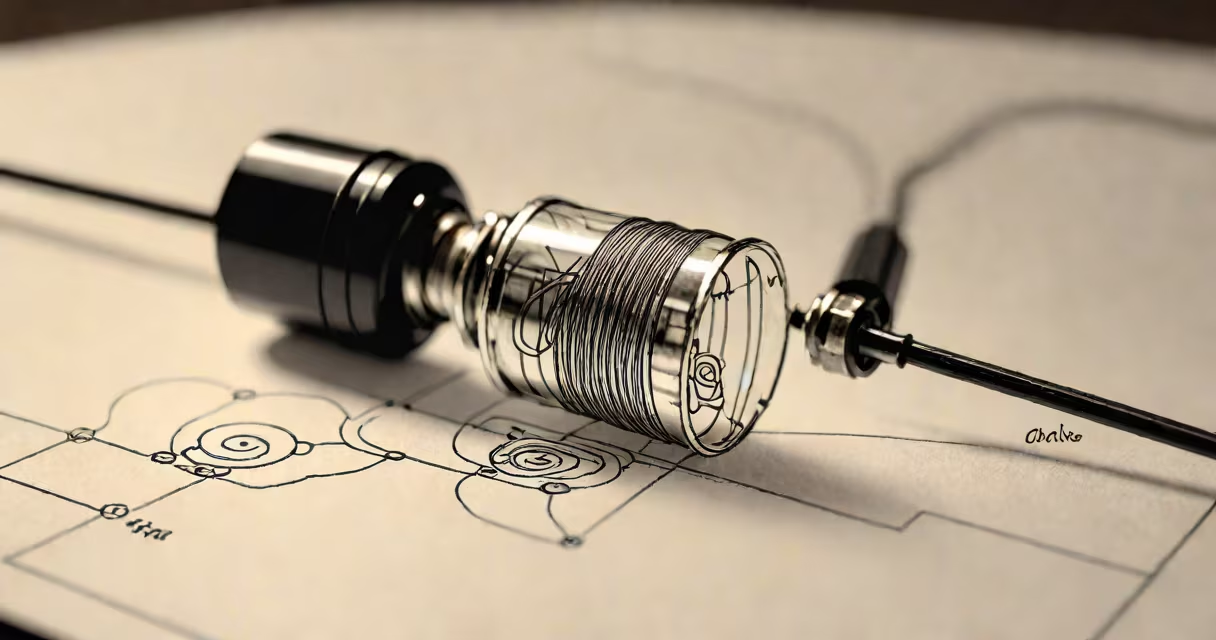
A light dependent resistor (LDR) is a passive electronic component whose electrical resistance decreases when exposed to light. It functions as a variable resistor controlled by light intensity, making it ideal for detecting changes in ambient illumination.
LDRs operate on the principle of photoconductivity. In darkness, the material inside the LDR-typically cadmium sulfide (CdS)-has few free electrons, resulting in high resistance (often above 1 MΩ). When light strikes the surface, photons excite electrons, allowing current to flow more easily. Resistance can drop to below 1 kΩ under bright light. This change is non-linear and varies with wavelength, peaking around visible green light.
These components are inexpensive, easy to integrate into circuits, and require no external power supply to function. They are commonly used in automatic lighting systems, burglar alarms, camera exposure controls, and solar-powered devices. Their response time is slow-typically hundreds of milliseconds-making them unsuitable for rapid light detection but well-suited for steady-state monitoring.
An LDR is a two-terminal device with no polarity. When connected in series with a fixed resistor in a voltage divider circuit, the output voltage changes predictably with light levels. For example, in a 5V system with a 10kΩ fixed resistor and a 10kΩ LDR in darkness, the voltage at the midpoint is approximately 2.5V. Under bright light, the LDR's resistance drops to 1kΩ, shifting the output voltage to ~0.45V. This analog signal can be read by a microcontroller or compared with a threshold using a comparator.
The relationship between light intensity and resistance is logarithmic. A typical CdS-based LDR may have a resistance of 1 MΩ in complete darkness and 100 Ω under direct sunlight. This wide changing range allows detection across multiple lighting conditions-from dim indoor settings to full daylight-but requires calibration for precise measurements.
Temperature affects performance. CdS LDRs degrade slightly at temperatures above 60°C, reducing sensitivity. Some models include protective coatings or epoxy encapsulation to improve durability. However, they are sensitive to moisture and UV degradation over time, limiting long-term reliability in harsh environments.
While CdS is the most common material, other semiconductors are used in specialized applications:
| Material | Response Range | Common Use | Advantage |
|---|---|---|---|
| Cadmium Sulfide (CdS) | 400-700 nm (visible spectrum) | General lighting control, night lights | High sensitivity to visible light |
| Cadmium Selenide (CdSe) | 500-1100 nm (near-infrared) | Industrial sensors, IR detection | Better response in low-light or IR conditions |
| Lead Sulfide (PbS) | 1000-3500 nm (far-infrared) | Thermal imaging, gas detection | Operates in infrared range |
CdS LDRs dominate consumer electronics due to their cost-effectiveness and broad spectral match with human vision. CdSe variants are less common but offer faster response times and better stability in fluctuating light conditions. PbS types are rare in hobbyist projects due to higher cost and toxicity concerns.
Physical form varies. Most LDRs are flat, disc-shaped components with two metal leads. Some come in axial or through-hole packages. Surface-mount versions exist but are less common. The sensing area is usually a thin film deposited on a ceramic substrate.
LDRs are frequently used in automatic streetlights, dusk-to-dawn switches, and solar garden lights. In a basic dusk detector circuit, the LDR triggers a relay or transistor when light falls below a set threshold, turning on a lamp. These systems often include a potentiometer to adjust sensitivity.
They are not suitable for measuring absolute light levels. Unlike digital light sensors (e.g., BH1750), LDRs do not provide calibrated lux readings. Their output depends on both intensity and color temperature. A red LED may produce a lower reading than a white LED at the same brightness due to spectral mismatch.
A common mistake is assuming LDRs work instantly. Response times range from 100 ms to 500 ms depending on the model. This delay prevents accurate detection of flashing lights or rapid motion. For such tasks, photodiodes or phototransistors are preferred.
Another misconception is that LDRs can replace photodiodes in optical communication. They lack the speed and linearity required for data transmission. Photodiodes respond in nanoseconds and support modulation frequencies up to MHz, while LDRs are limited to Hz-range operation.
Build a simple night light using a 5V Arduino Nano, a 10kΩ fixed resistor, a CdS LDR, and an LED. Connect the LDR and resistor in series between 5V and GND. Tap the midpoint to analog pin A0. Use a 10kΩ potentiometer to set a threshold via the analogRead() function.
// Arduino sketch for LDR-controlled night light
const int ldrPin = A0;
const int ledPin = 13;
int ldrValue = 0;

void setup() {
  pinMode(ledPin, OUTPUT);
}

void loop() {
  ldrValue = analogRead(ldrPin);
  if (ldrValue < 300) { // Adjust threshold based on environment
    digitalWrite(ledPin, HIGH);
  } else {
    digitalWrite(ledPin, LOW);
  }
  delay(100);
}
In a test room with ambient light at ~100 lux, the LDR read ~250. When a flashlight was shone directly on it, the value rose to ~800. Setting the threshold at 300 reliably turned the LED on at dusk and off at dawn. This circuit runs on 5V and draws less than 10 mA, making it energy efficient.
I built this circuit during a weekend project and found that placement matters. Mounting the LDR behind a translucent diffuser reduced false triggers from nearby lamps. I also added a 100nF capacitor across the LDR-resistor junction to filter noise from fluorescent lighting.
Light dependent resistors are simple, low-cost sensors that respond to changes in light. They are not precision instruments but serve well in basic automation tasks. Always pair them with a voltage divider and calibrate thresholds for consistent behavior. For high-speed or accurate light measurement, consider digital alternatives.