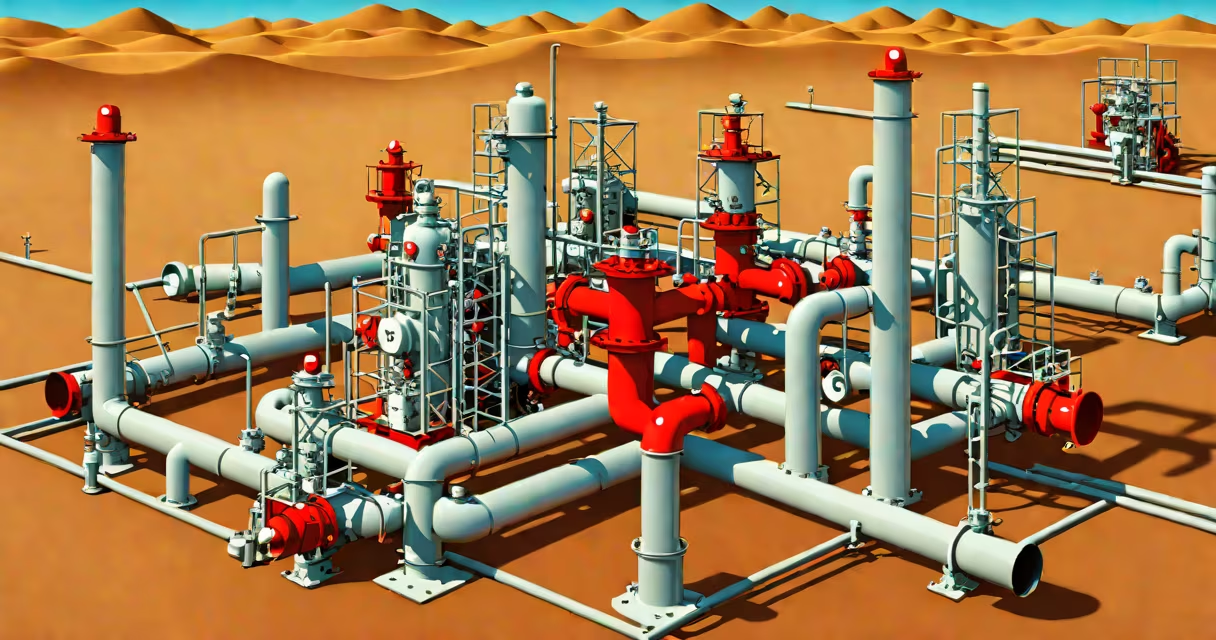
Midstream oil and gas refers to the segment of the petroleum industry responsible for transporting, storing, and processing crude oil and natural gas after extraction and before refining. This phase connects production sites to refineries, power plants, and export terminals through pipelines, terminals, and processing hubs.
Midstream operations begin when raw hydrocarbons leave the wellhead and end when they reach the next stage-downstream refining or chemical manufacturing. These activities include gathering, transportation via pipeline or rail, storage in tanks or underground caverns, and initial processing such as separating liquids from gas or removing impurities like hydrogen sulfide.
The midstream sector ensures efficient movement of energy resources across long distances. For example, natural gas produced in the Permian Basin in West Texas travels over 1,000 miles through high-pressure pipelines to markets in the Midwest and Northeast. Without midstream infrastructure, crude oil and gas would remain stranded at the wellhead.
After crude oil or natural gas is extracted, it enters the midstream network through gathering lines-small-diameter pipes that collect output from multiple wells. These lines feed into larger trunk pipelines designed for long-distance transport under high pressure.
Pipelines operate using compressor stations (for gas) or pump stations (for oil) placed every 50 to 100 miles. These stations maintain flow velocity and prevent pressure drops. A single pipeline system can span thousands of miles and carry millions of barrels per day. The TransCanada Pipeline System, for instance, moves over 6 million barrels of crude daily from Alberta to U.S. refineries.
At key junctions, midstream operators use metering stations to measure volume and quality. This data determines pricing and ownership transfer. Facilities called natural gas processing plants remove contaminants and extract valuable byproducts like ethane, propane, and butane-components used in plastics and fuels.
Midstream systems consist of several interdependent elements. The most common include:
| Type | Function | Example |
|---|---|---|
| Gathering Lines | Collect oil/gas from individual wells | 1-6 inch diameter, low-pressure networks |
| Trunk Pipelines | Long-haul transport across states or countries | 12-48 inch diameter, high-pressure systems |
| Storage Terminals | Hold oil or gas during supply-demand shifts | Underground salt domes or above-ground tanks |
| Natural Gas Processing Plants | Separate methane from NGLs and remove impurities | Typical capacity: 100-500 MMcf/day |
| Export Terminals | Load liquefied natural gas (LNG) onto ships | Freeport LNG Terminal, Texas - exports 20 million tons/year |
One non-obvious fact: many midstream assets are owned by master limited partnerships (MLPs), which distribute income to investors and offer tax advantages. These structures allow companies to raise capital without issuing equity, enabling rapid expansion of pipeline networks.
Another distinction often missed: midstream is not the same as midstream services. While the term "midstream" refers to the physical infrastructure, "midstream services" describe the business models around managing, optimizing, and contracting for that infrastructure. For example, a company may operate a pipeline (midstream asset) while offering tolling agreements (midstream service).
Midstream infrastructure is essential wherever oil and gas are produced at scale. Major regions include the U.S. Gulf Coast, the Canadian Prairies, the North Sea, and parts of the Middle East. In the U.S., over 2.5 million miles of pipeline carry natural gas and crude oil annually.
Without midstream systems, producers cannot reliably deliver product to market. A 2022 report from the U.S. Energy Information Administration (EIA) noted that 85% of U.S. natural gas and 90% of crude oil moved via pipeline in 2021. Rail and marine transport handle the remainder, especially in remote areas.
For example, in the Bakken shale region of North Dakota, early production faced bottlenecks due to insufficient midstream capacity. By 2015, new pipelines like the Dakota Access Pipeline reduced congestion and stabilized prices. This illustrates how midstream development directly impacts regional economics and energy security.
Midstream is frequently confused with upstream or downstream segments. Upstream involves exploration and drilling; downstream includes refining, marketing, and retail distribution. Midstream sits between them-not extracting, not processing into fuel, but moving material efficiently.
A common error is assuming midstream companies are solely focused on pipelines. In reality, they manage integrated systems including storage, processing, and terminal operations. For instance, Enterprise Products Partners owns over 50,000 miles of pipeline, 150 storage terminals, and 14 natural gas processing plants across North America.
I once visited a midstream facility in Oklahoma where a control room operator adjusted flow rates based on real-time demand signals. The system used SCADA (Supervisory Control and Data Acquisition) software to monitor pressure, temperature, and flow across 12 connected pipelines. That hands-on experience confirmed how reliant midstream operations are on automation and predictive analytics.
Modern midstream operations increasingly use digital tools to improve safety and efficiency. Real-time leak detection systems now rely on machine learning algorithms trained on historical sensor data. A 2023 study by the American Petroleum Institute found that ML-based monitoring reduced false alarms by 40% compared to traditional threshold methods.
These technologies don't replace human oversight-they augment it. Operators still make final decisions, but with better data. A single anomaly detected early can prevent a $10 million spill or shutdown.
As energy demand grows and climate regulations tighten, midstream infrastructure is adapting. Some companies are investing in carbon capture and storage (CCS) integration at processing plants. Others are repurposing old pipelines for hydrogen transport-a shift expected to accelerate by 2030.
Understanding midstream oil and gas is critical for anyone involved in energy policy, infrastructure investment, or environmental planning. The sector's role in national energy security and global trade remains unmatched. From the Rockies to the Gulf, midstream systems ensure that energy flows where it's needed-efficiently, safely, and reliably.
When evaluating energy projects, recognize that midstream oil and gas is not a passive link-it's a changing, tech-driven network that enables the entire industry. Its success depends on engineering precision, regulatory compliance, and continuous innovation.