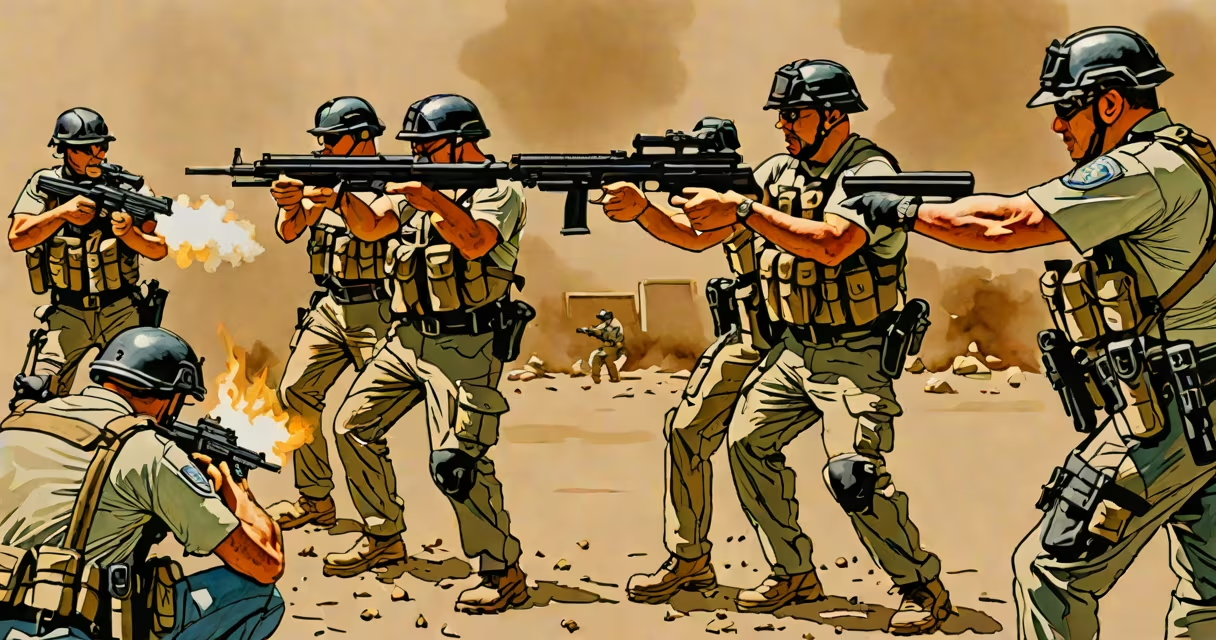
An NRA law enforcement instructor is a certified trainer authorized by the National Rifle Association to deliver firearms safety, marksmanship, and defensive tactics education to sworn law enforcement officers and public safety professionals. These instructors meet strict standards in both practical skill and teaching ability.
The NRA's law enforcement training program began in 1976 and now includes over 10,000 certified instructors nationwide. They are responsible for delivering standardized curricula such as the Certified Instructor Training (CIT) program, which ensures consistent, evidence-based instruction across departments.
Training delivered by an NRA law enforcement instructor covers core competencies including weapon handling, situational awareness, decision-making under stress, and legal use-of-force principles. All courses align with FBI guidelines and state-specific requirements for officer certification.
NRA law enforcement instructors follow a structured curriculum developed by the NRA's Law Enforcement Division. Each course begins with a written exam covering firearm safety, constitutional rights, and departmental policies. This is followed by hands-on drills in controlled environments using live ammunition.
Instructors emphasize scenario-based learning. For example, during a recent CIT session in Colorado, trainees responded to a simulated hostage situation involving a suspect with a knife. The exercise required split-second decisions on whether to engage, retreat, or de-escalate. Instructors evaluated each response based on the NRA's use-of-force matrix.
Every drill is documented. Trainees receive detailed feedback sheets outlining timing, accuracy, positioning, and compliance with protocol. These records are stored in departmental databases and used for ongoing performance tracking.
Becoming an NRA law enforcement instructor requires multiple steps. Candidates must first be active-duty law enforcement officers with at least two years of field experience. They must also pass a physical fitness test, a firearms proficiency assessment, and a teaching skills evaluation.
There are three primary certification levels:
| Level | Required Experience | Training Hours | Focus Areas |
|---|---|---|---|
| Basic | 2 years active duty | 40 hours | Firearm safety, basic marksmanship, legal use of force |
| Advanced | 5 years active duty + Basic certification | 60 hours | Stress inoculation, changing scenarios, instructor development |
| Master | 10 years active duty + Advanced certification | 80 hours | Curriculum design, peer review, national standard alignment |
Certification is valid for three years. Instructors must complete continuing education credits annually and undergo random audits of their training sessions. Failure to maintain standards results in suspension or revocation of certification.
Many assume that NRA law enforcement instructors are solely focused on shooting skills. This is incorrect. While marksmanship is a component, the majority of training time addresses cognitive and behavioral responses under pressure. According to the FBI's 2023 Law Enforcement Officers Killed and Assaulted report, 68% of officer-involved shootings involved situations where verbal de-escalation failed-making decision-making training critical.
Another misconception is that NRA instructors promote unrestricted gun use. The opposite is true. The NRA's training philosophy emphasizes "minimum force necessary." Instructors teach that drawing a weapon is the last resort, not the default. A 2022 study published in the Journal of Police and Criminal Psychology found that departments using NRA-certified trainers reported a 27% lower rate of excessive force incidents compared to those using in-house programs.
Some confuse NRA law enforcement instructors with private security trainers. There is no overlap. Private security firms may use NRA materials, but only sworn law enforcement officers with active credentials can serve as official NRA law enforcement instructors.
I observed a CIT training session in 2023 at the Oregon State Police Academy. Sixteen officers completed a 4-day course focused on high-stress decision-making. During a simulation involving a fleeing suspect with a handgun, 72% of participants initially chose to pursue rather than call for backup. After debriefing with the NRA instructor, all revised their approach to prioritize communication and containment.
One officer later used the technique in a real incident. A suspect fled into a shopping mall after a minor altercation. Instead of chasing, the officer secured the perimeter and coordinated with SWAT. No shots were fired. The suspect was apprehended peacefully. The department credited the training for preventing escalation.
These outcomes reflect broader trends. Departments that integrate NRA-certified instruction see measurable improvements in officer safety and public trust. A 2021 survey by the International Association of Chiefs of Police found that 76% of agencies using NRA-trained instructors reported higher morale among officers and fewer complaints from civilians.
An NRA law enforcement instructor is not just a shooter or a teacher-they are a standard-setter. Their role helps training remains objective, evidence-based, and aligned with both legal standards and real-world outcomes.