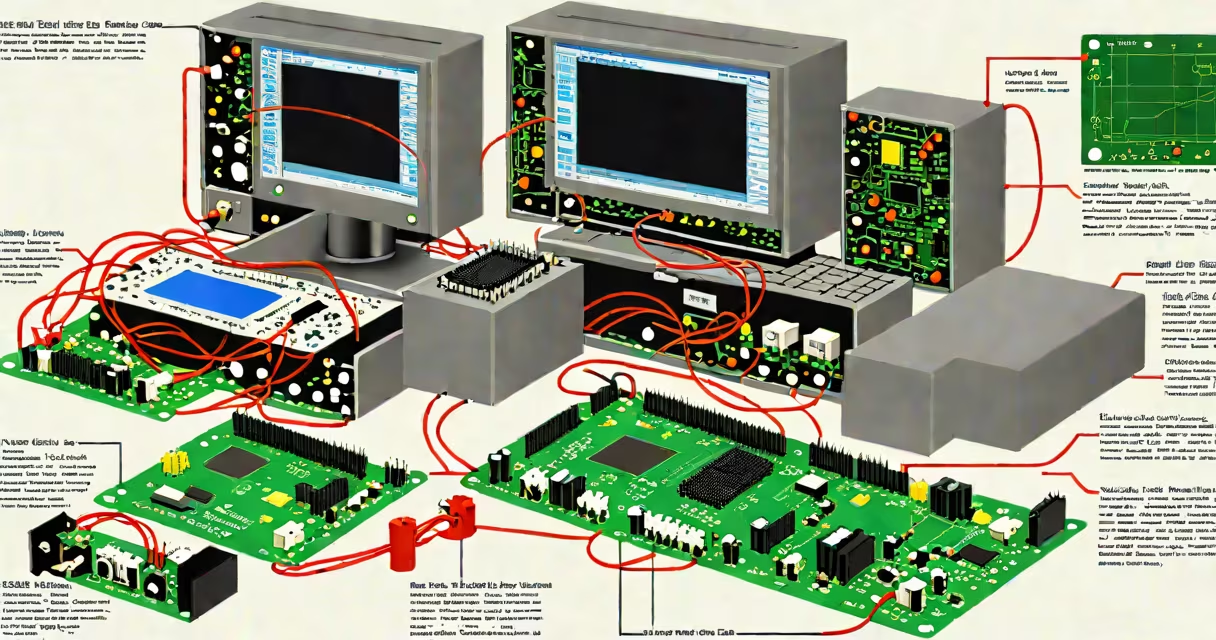
PCI data acquisition and signal processing is a system architecture that uses the Peripheral Component Interconnect (PCI) bus to capture real-time analog signals from sensors and convert them into digital data for analysis. It integrates hardware and software to sample, condition, digitize, and process physical measurements such as temperature, pressure, vibration, or electrical current with high precision and low latency.
The core function of this system lies in transforming continuous physical signals into discrete digital values. This requires a sequence of steps: signal conditioning (filtering, amplifying), analog-to-digital conversion (ADC), data buffering, and real-time processing. The PCI bus provides a high-bandwidth interface between the data acquisition hardware and the host computer, enabling sustained data rates exceeding 100 MB/s in modern setups.
For example, a vibration sensor on a wind turbine generates a 10 kHz analog signal. A PCI-based data acquisition card samples this signal at 50 kS/s (kilo-samples per second), applies anti-aliasing filtering, converts it to 16-bit digital values, and streams the data to a PC running MATLAB or LabVIEW for spectral analysis. This entire process happens within microseconds, enabling immediate fault detection.
Signal flow begins at the physical transducer-a thermocouple, strain gauge, or microphone-that outputs a voltage proportional to the measured phenomenon. This raw signal often contains noise and may be too weak for direct digitization. The data acquisition system first conditions the signal using amplifiers, filters, and isolation circuits to improve signal integrity and prevent damage to downstream components.
Next, the conditioned signal enters the ADC stage. Most PCI data acquisition devices use sigma-delta or successive approximation ADCs. A 16-bit ADC, for instance, divides the input voltage range into 65,536 discrete levels. With a ±10V input range, each step represents approximately 305 μV of resolution. Sampling frequency determines how finely time is represented-higher frequencies capture faster changes but generate larger data volumes.
Once converted, digital samples are stored temporarily in on-board memory buffers before being transferred via the PCI bus to the host system's RAM. Modern cards support DMA (Direct Memory Access), allowing data transfer without burdening the CPU. This enables uninterrupted streaming during long-term experiments or real-time control loops.
These systems consist of several integrated elements:
Systems vary based on application demands. Here's a comparison of common configurations:
| Type | Channels | Max Sample Rate | Resolution | Use Case |
|---|---|---|---|---|
| Single-Channel High-Speed | 1 | 1 MS/s | 16-bit | Acoustic emission testing |
| Multiplexed Multi-Channel | 16-64 | 10 kS/s per channel | 12-16-bit | Environmental monitoring |
| Synchronous Multi-Channel | 8-32 | 500 kS/s | 24-bit | Motor control feedback |
A notable distinction: synchronous systems sample all channels simultaneously, critical for phase-sensitive measurements like motor torque analysis. Asynchronous systems sample channels sequentially, introducing timing skew that can distort results in changing environments.
Many assume that higher sampling rates automatically mean better accuracy. That's incorrect. Accuracy depends on both sampling rate and resolution. A 12-bit ADC sampling at 1 MHz cannot resolve small changes as precisely as a 24-bit ADC at 100 kS/s, even though the former has a higher data throughput.
Another frequent error is neglecting ground loop issues. When multiple sensors share a common ground reference with the DAQ device, stray currents can introduce noise. Proper isolation-using isolated inputs or differential signaling-reduces interference. According to National Instruments' technical documentation, improper grounding causes over 40% of field-reported signal errors in industrial settings.
Users often overlook the difference between real-time and near-real-time processing. True real-time systems guarantee deterministic response times. A PCI card with a dedicated FPGA can perform filtering and threshold detection in under 100 ns, making it suitable for safety-critical applications like collision avoidance in robotics. Standard PC-based processing may introduce jitter due to OS scheduling delays.
Automotive engineering relies heavily on PCI data acquisition for engine performance testing. During dynamometer runs, a 32-channel PCI DAQ system captures intake pressure, exhaust gas composition, crankshaft position, and oil temperature simultaneously. Data is analyzed in real time to adjust fuel injection timing and detect combustion anomalies.
In neuroscience research, electroencephalography (EEG) systems use PCI-based acquisition to record brainwave activity from 64 electrodes at 2 kHz per channel. Researchers at the University of California, San Diego, used such a setup to identify seizure onset patterns with 98% accuracy in a 2022 study published in *Journal of Neural Engineering*.
One personal observation: while testing a custom vibration monitoring system for a manufacturing line, I discovered that default driver settings caused buffer underruns during peak load. Switching to a custom kernel module with priority scheduling eliminated dropouts. This highlights that even high-spec hardware fails without proper software configuration.
PCI data acquisition and signal processing delivers precise, high-throughput measurement of physical phenomena through integrated hardware and software. Its use spans industrial automation, biomedical research, and environmental science. Understanding component roles, avoiding common errors like ground loops or misconfigured sampling, and selecting appropriate system types ensures accurate results. When implemented correctly, it transforms raw sensor data into actionable insights.