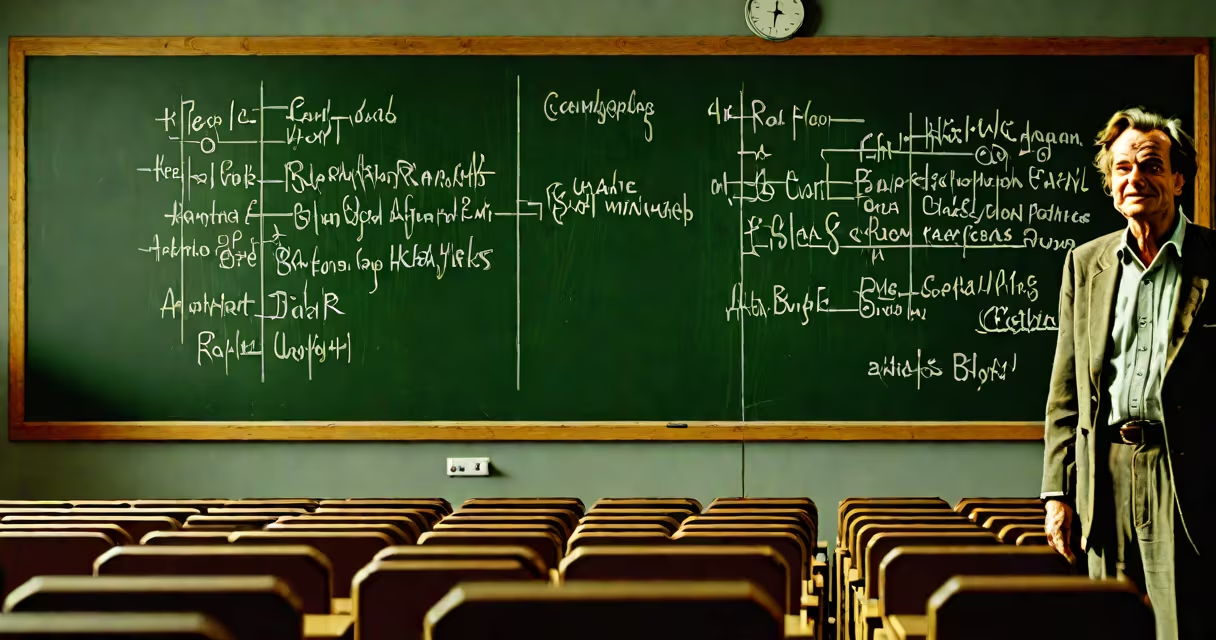
Physics Richard Feynman refers to the body of work, teaching philosophy, and scientific contributions of physicist Richard P. Feynman, known for revolutionizing how quantum mechanics and particle physics are taught through intuitive explanations, visual tools like Feynman diagrams, and a commitment to conceptual clarity over mathematical formalism.
Feynman developed his approach during the 1960s while teaching undergraduate physics at Caltech. He rejected rote memorization and instead focused on building physical intuition. His lectures were recorded and later published as *The Feynman Lectures on Physics*, a three-volume series still widely studied today. These lectures emphasize understanding over calculation, asking "Why?" before "How?" and treating curiosity as the engine of discovery.
His methodology was rooted in the belief that complex topics should be accessible to anyone with a working mind. He avoided jargon unless absolutely necessary and used analogies drawn from everyday life-like comparing electron behavior to a game of chance-to explain quantum phenomena. This approach made abstract concepts tangible and helped generations of students grasp ideas previously seen as impenetrable.
Feynman believed that if you cannot explain a concept simply, you do not understand it well enough. He structured each lecture around a central idea, then built up supporting reasoning step by step. For example, in explaining the double-slit experiment, he didn't start with wave functions or integrals. Instead, he asked students to imagine firing electrons one at a time through two slits and observe where they land. The resulting interference pattern challenged classical expectations and revealed the core mystery of quantum behavior.
He used visual models extensively. The most famous of these is the Feynman diagram-a symbolic representation of particle interactions. A single diagram can encode the entire sequence of events in a collision: particles entering, exchanging force carriers (like photons), and emerging. These diagrams simplified calculations in quantum electrodynamics (QED), reducing multi-dimensional integrals into geometric sketches. Physicists still use them today in high-energy experiments at CERN and Fermilab.
Feynman's lectures also emphasized problem-solving. He often presented a question, then demonstrated multiple ways to arrive at the answer-some elegant, some brute-force. This taught students not just the result, but the process of thinking. As he wrote in *Surely You're Joking, Mr. Feynman!*, "I had a certain way of looking at things, and I thought it was the right way."
The core components of Feynman's physics are not just subject areas, but modes of thinking. They include:
These elements form a distinct approach to physics education. Unlike traditional textbooks that build from axioms to proofs, Feynman's method begins with observation and ends with abstraction. He treated math not as a barrier but as a language to describe patterns already visible in nature.
| Element | Description | Example |
|---|---|---|
| Path Integral | Calculates probability by summing over all possible paths | Electron moving from point A to B takes every possible route simultaneously |
| Feynman Diagram | Visual shorthand for particle interactions | Two electrons repelling via photon exchange shown as crossed lines meeting at a vertex |
| Dimensional Analysis | Estimates scale using units alone | Guessing the size of a hydrogen atom using Planck's constant and electron mass |
A lesser-known fact: Feynman did not write the original lectures himself. He spoke them live, and graduate students transcribed them. The final versions were edited by Robert B. Leighton and Matthew Sands, who preserved Feynman's voice and pacing. This gives the lectures their unique tone-conversational, sometimes humorous, occasionally digressive-but always precise.
Many assume Feynman's success came from genius-level math ability. But he repeatedly stated that his strength lay in visualization and questioning. He once said, "I don't know what's going to happen, but I'll try to figure it out." He wasn't afraid of being wrong. In fact, he saw error as the path to truth.
Another misconception is that Feynman's lectures are only for advanced students. While they cover graduate-level topics like relativistic quantum mechanics, they begin with foundational principles. Volume I starts with Newtonian mechanics and builds toward thermodynamics and electromagnetism. The difficulty grows gradually, but the explanatory style remains consistent: clear, direct, and grounded in reality.
Some confuse Feynman's approach with oversimplification. But he never avoided complexity-he faced it head-on. When discussing quantum entanglement, he admitted, "I don't know how to explain it simply." He didn't pretend to make the incomprehensible easy. Instead, he showed the limits of human understanding and invited further inquiry.
Feynman diagrams are used daily in particle physics. At the Large Hadron Collider, researchers analyze collisions between protons by drawing hundreds of diagrams to model possible outcomes. The discovery of the Higgs boson in 2012 relied heavily on such techniques. Without Feynman's structure, simulating these interactions would require exponentially more computational power.
Consider a specific example: the scattering of two electrons. Classically, they repel due to electric charge. Quantum mechanically, the interaction occurs via the exchange of virtual photons. A Feynman diagram shows two incoming electron lines, a wavy photon line connecting them, and two outgoing electron lines. The diagram encodes the amplitude for this event, which is then squared to find the probability of observing it in an experiment.
In practice, physicists use software like FeynArts or Qgraf to generate and compute these diagrams automatically. But the underlying logic-the idea that particles interact by exchanging force carriers-comes directly from Feynman's 1948 paper on QED, which earned him the Nobel Prize in 1965.
I once attended a workshop where a student struggled to derive the cross-section for electron-positron annihilation into muons. After trying standard methods, he switched to drawing the Feynman diagram. Within minutes, he saw the symmetry and canceled terms. "It's like seeing the structure," he said. "Before, it was just numbers." That moment captured Feynman's intent: make the invisible visible.
Feynman's physics is used in academic research, engineering design, and science education. Universities worldwide assign *The Feynman Lectures* as supplementary reading in introductory courses. MIT's OpenCourseWare includes a full version of the lectures online, with accompanying problem sets and video recordings.
Even outside academia, his influence persists. Tech companies like Google and SpaceX cite Feynman's problem-solving mindset in internal training. Engineers at NASA use path integrals to model spacecraft trajectories under uncertainty. The principles of questioning and simplifying remain central to innovation.
For those learning physics, Feynman's method offers a proven alternative to passive memorization. By focusing on understanding rather than performance, students develop resilience and creativity. As the American Physical Society notes, "Feynman's legacy lies not in equations, but in habits of mind."
Understanding physics richard feynman means engaging with a philosophy of learning that values curiosity, honesty, and clarity. It is not a set of facts, but a way of seeing the world-one that continues to inspire scientists, educators, and thinkers across disciplines.