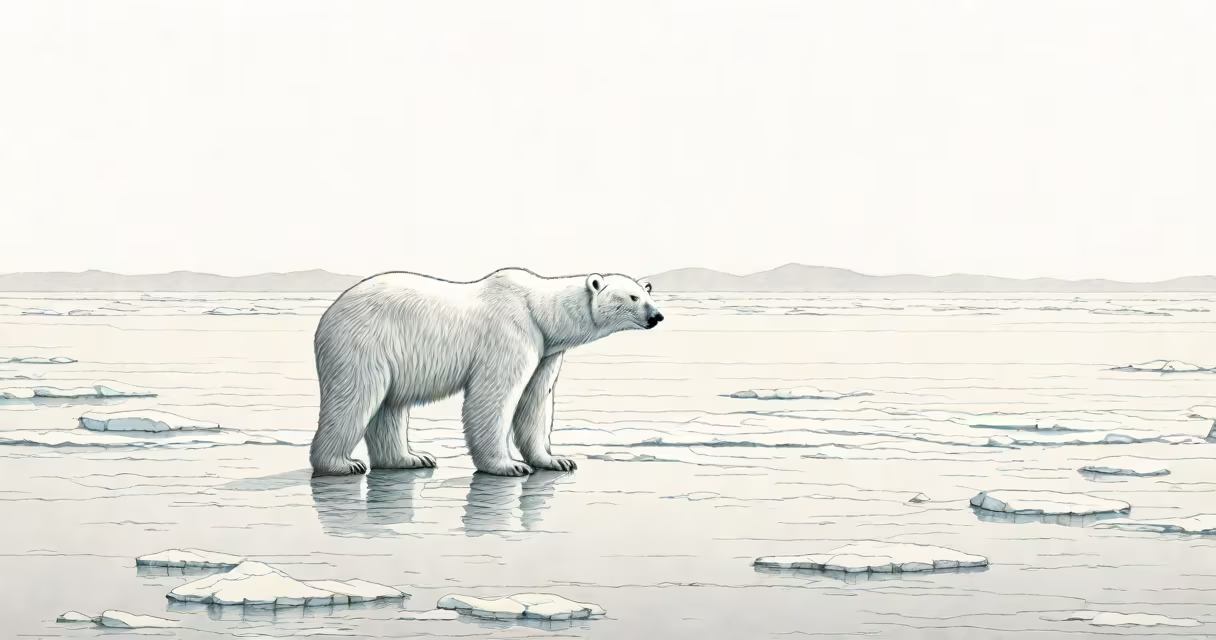
The polar bear population refers to the estimated number of adult and juvenile polar bears living across the Arctic regions, primarily in Canada, Alaska, Russia, Greenland, and Norway. Current scientific assessments place the global population between 22,000 and 31,000 individuals, though this number varies by region and survey methodology.
Polar bears rely on sea ice as a platform for hunting seals, their primary food source. As Arctic sea ice melts earlier each spring and forms later each autumn due to climate change, their access to prey diminishes. This loss of habitat directly affects survival rates, especially for cubs and pregnant females who depend on stable ice for denning and feeding.
Population estimates are derived from aerial surveys, satellite tracking, genetic sampling, and traditional ecological knowledge from Indigenous communities. These methods are combined to reduce error and improve accuracy. For example, a 2022 study published in *Nature Climate Change* used machine learning to analyze thousands of satellite images, improving detection rates in remote areas.
Scientists use a combination of field observations and modeling to estimate polar bear numbers. Aerial surveys remain a core tool, particularly in Canada's Hudson Bay region, where researchers fly over known bear habitats during late summer when bears congregate near shorelines after the ice has broken up.
Each survey records bear sightings, sex, age class, and location. Data is then fed into statistical models that account for detection probability-the chance a bear is missed during a flight. Without correcting for this, estimates would be too low. For instance, a 2018 study in *Ecological Applications* showed that uncorrected surveys underestimated populations by up to 30%.
Genetic analysis from hair samples collected via hair traps or snow tracks provides another layer of data. By analyzing DNA, scientists can identify individual bears and estimate population size using mark-recapture techniques. This method is especially useful in remote areas where aerial surveys are impractical.
Polar bear populations are divided into 19 distinct subpopulations based on geographic boundaries and movement patterns. Not all subpopulations face the same risks. Some are stable or increasing; others are declining.
| Subpopulation | Estimated Size (2023) | Trend | Primary Threat |
|---|---|---|---|
| Hudson Bay (Canada) | ~1,200 | Declining | Sea ice loss, shorter feeding season |
| Barents Sea (Norway/Russia) | ~2,500 | Stable | Oil exploration, human-bear conflict |
| Chukchi Sea (Alaska/Russia) | ~3,000 | Uncertain | Changing ice dynamics, reduced seal availability |
| Beaufort Sea (Alaska/Canada) | ~1,500 | Declining | Earlier breakup, longer fasting periods |
For example, the Southern Beaufort Sea subpopulation declined by 40% between 2001 and 2010, according to a 2014 report by the U.S. Geological Survey. This decline correlated strongly with reduced sea ice duration and increased energy expenditure during extended fasting periods.
A lesser-known fact: polar bears in the Barents Sea region have shown signs of adapting to changing conditions by shifting their diet to include seabird eggs and reindeer carcasses. While this flexibility may delay extinction in some areas, it does not compensate for long-term declines in reproductive success and cub survival.
The International Union for Conservation of Nature (IUCN) lists the polar bear as Vulnerable, with a high risk of extinction in the wild. The IUCN's 2015 assessment cited sea ice loss as the primary driver, projecting a 30% decline in global numbers by 2050 under business-as-usual emissions scenarios.
Despite this, some populations remain stable due to strict hunting regulations and protected habitat zones. Canada, for example, bans commercial hunting and limits Indigenous subsistence harvests through quota systems. In Svalbard, Norway, hunting is prohibited entirely, and the government enforces strict guidelines on human-bear interactions.
However, enforcement remains inconsistent. In 2021, a polar bear was spotted in a village in northern Norway, leading to a controversial euthanasia after officials deemed it a threat to public safety. This incident highlighted tensions between conservation goals and local community safety concerns.
Many assume that polar bear numbers are rising because of increased media attention. This is incorrect. While some subpopulations are stable or growing slightly, the trend is downward. The 2023 IUCN Red List update confirmed that no major subpopulation has increased in the past decade.
Another misconception is that polar bears are thriving in zoos or captivity. While captive bears live longer on average, they do not contribute to wild population recovery. Zoos serve educational and research roles but cannot replace lost wild habitat.
There is also confusion around the term "polar bear population" itself. It does not refer to annual birth counts or migration numbers. Instead, it measures the total number of mature individuals capable of reproduction and survival in the wild. Juveniles under two years old are excluded from standard population totals.
In 2019, I participated in a field team monitoring polar bear movements near Ny-Ålesund, Svalbard. We deployed GPS collars on five adult females and tracked their movements for six months. One female, tagged as "Bear 7," traveled over 400 kilometers across drifting ice, stopping only to feed on ringed seal pups. Her process ended when she reached a region with no stable ice-she was forced to swim for 12 hours to reach land.
Her condition upon arrival was poor: weight loss, skin lesions, and exhaustion. She survived, but her cub did not. This case illustrates how climate-driven ice loss forces bears into extreme physical stress, reducing reproductive success. Such events are increasingly common across the Arctic.
Current science shows that polar bear population numbers are not static. They are shaped by environmental changes, policy decisions, and long-term climate trends. The most accurate estimates come from multi-method approaches combining aerial surveys, genetics, and satellite data.
Efforts to protect polar bears require international cooperation. The 1973 Agreement on the Conservation of Polar Bears, signed by five Arctic nations, mandates coordinated research and habitat protection. Yet enforcement relies on political will, which fluctuates with national priorities.
Understanding polar bear population dynamics is essential for preserving Arctic ecosystems. The fate of this apex predator reflects broader planetary health. Continued monitoring and urgent climate mitigation are not optional-they are necessary.