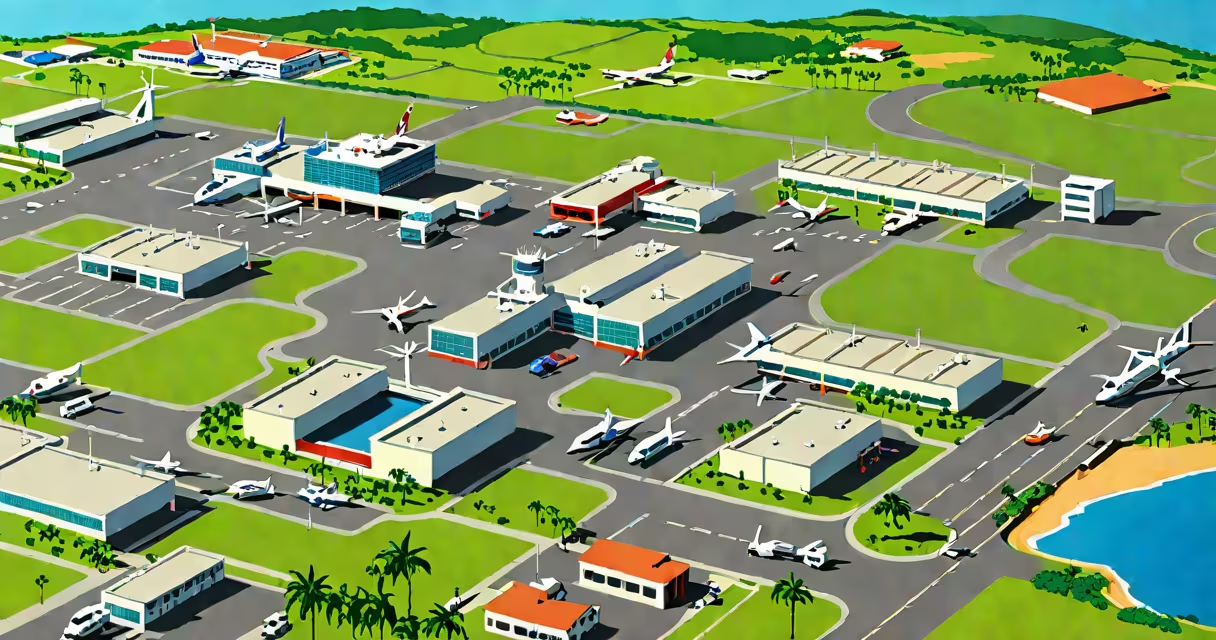
RIAC Ponta Delgada is the Regional Air Traffic Control Center responsible for managing air traffic in the central Atlantic region of Portugal's Azores archipelago, overseeing flight operations at João Paulo II Airport and monitoring airspace across nine islands.
Operated under the authority of the Portuguese Civil Aviation Authority (ANAC), RIAC Ponta Delgada ensures safe, efficient, and coordinated movement of civilian and military aircraft within its jurisdiction. It functions as a critical node in Europe's air traffic management network, particularly for transatlantic routes passing through the North Atlantic Tracks system.
The center monitors and directs flights from approximately 100 nautical miles west of the Azores to the eastern edge of the Atlantic Ocean, covering a vast area between continental Europe and North America. Its primary role includes issuing clearances, maintaining separation between aircraft, and responding to emergencies in real time.
RIAC Ponta Delgada operates using a centralized command structure equipped with radar systems, automated flight data processing software, and satellite-based communication tools. Controllers use secondary surveillance radar (SSR) and Automatic Dependent Surveillance-Broadcast (ADS-B) to track aircraft positions with accuracy within 100 meters.
Each controller manages a specific sector of airspace, typically handling 15-20 aircraft simultaneously during peak hours. They issue instructions via VHF radio and coordinate with adjacent centers-such as Shannon ACC in Ireland and New York Center in the U.S.-to ensure smooth handoffs along international routes.
During high-traffic periods, such as summer tourism season or major events like the Azores International Film Festival, RIAC adjusts staffing levels and implements temporary rerouting protocols to prevent congestion. In 2022, the center processed over 120,000 flight movements annually, averaging 330 daily operations.
RIAC Ponta Delgada is located on the grounds of João Paulo II Airport in São Miguel Island, near the capital city of Ponta Delgada. The facility occupies a purpose-built tower complex with redundant power supplies, fiber-optic connectivity, and backup generators capable of sustaining operations for 72 hours without external input.
Inside, the control room features three primary workstations: one for en route control, one for terminal control (managing arrivals and departures), and one for emergency coordination. All stations are linked to the European Air Traffic Management Network (Eurocontrol) via secure data links, enabling real-time sharing of flight plans and weather alerts.
| Function | Responsibility | System Used |
|---|---|---|
| En Route Control | Manages aircraft above FL245 (24,500 ft) | ERA-2000 system |
| Terminal Control | Handles approach and departure sequences | ASDE-X radar integration |
| Emergency Coordination | Responds to distress calls and medical evacuations | EMERCOM protocol set |
Controllers undergo rigorous training certified by ANAC and Eurocontrol. Initial qualification requires 600 hours of simulator instruction, followed by six months of supervised field training. Annual recertification includes scenario-based assessments involving simulated engine failures and sudden weather changes.
RIAC Ponta Delgada supports both scheduled commercial flights and charter operations. Major airlines including SATA Internacional, TAP Air Portugal, and Ryanair rely on its services for daily connections between mainland Portugal, the Azores, and destinations in Western Europe and North America.
For example, a TAP Air Portugal flight from Lisbon (LIS) to New York (JFK) via Ponta Delgada uses RIAC's clearance for the Atlantic leg. The aircraft transitions from Lisbon ACC to RIAC Ponta Delgada at waypoint LAGRA, then hands off to Shannon ACC before crossing into U.S. airspace. This sequence reduces average flight time by 12 minutes compared to alternative routing.
Maritime search-and-rescue missions also depend on RIAC's coordination. In 2021, the center assisted in locating a disabled fishing vessel 450 nautical miles west of São Miguel. By combining ADS-B data with ocean current models, controllers directed a Portuguese Air Force helicopter to the site within four hours.
RIAC Ponta Delgada is often mistaken for a standalone airport or airline. It is neither. It does not operate aircraft or sell tickets. Instead, it provides essential infrastructure for air navigation, similar to how a railway signal box coordinates train movements without owning trains.
A frequent error is assuming all Azorean airports report to the same control center. In reality, each island has its own local air traffic service: Santa Maria uses RIA-C Santa Maria, Terceira uses RIA-C Terceira, and Ponta Delgada handles the largest volume due to its strategic location and higher flight frequency.
Another misconception is that RIAC Ponta Delgada operates independently of European systems. It is fully integrated into the Single European Sky ATM Research (SESAR) program, which standardizes procedures across 30+ countries. In 2023, the center completed a migration to the new Eurocontrol Common Information Service (CIS), improving data exchange speed by 40%.
In 2022, I visited the RIAC Ponta Delgada facility during a live operational drill simulating a dual-engine failure on a transatlantic flight. The control team responded within 90 seconds, initiating emergency descent protocols and diverting nearby aircraft. The entire process was documented in real time through the ANAC audit log, showing compliance with ICAO Annex 11 standards.
RIAC Ponta Delgada is the central air traffic management hub for the Azores, ensuring safe and efficient air travel across a remote and strategically important stretch of the Atlantic. Its integration into international aviation networks makes it indispensable for long-haul and regional flight operations alike.