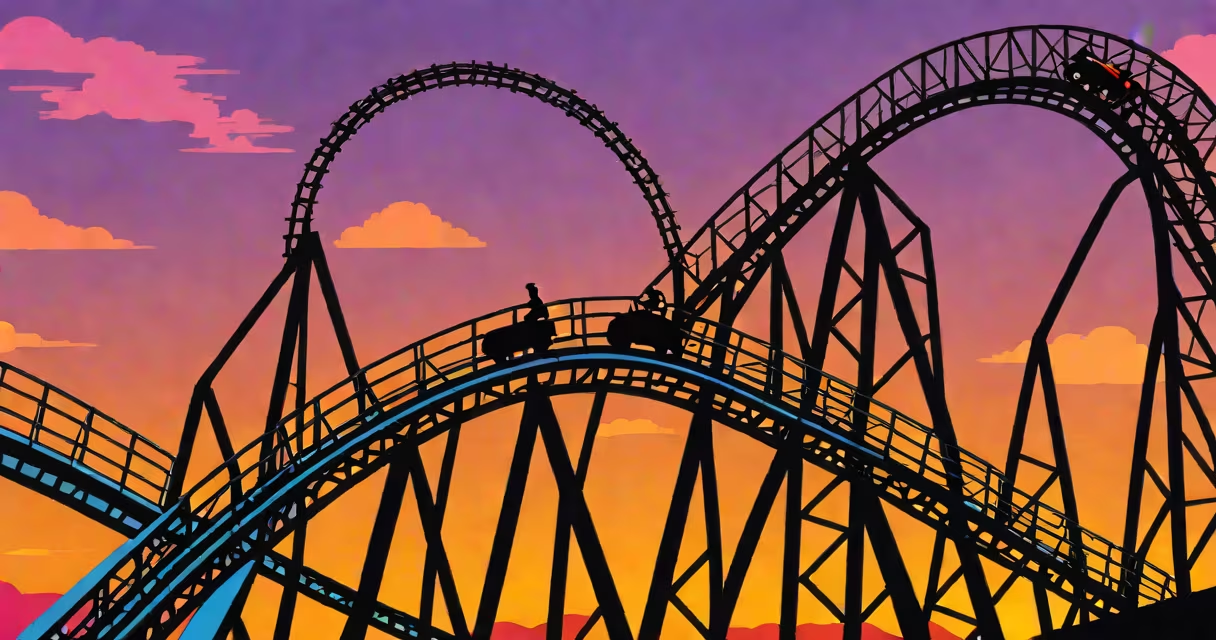
The term "roller coaster meaning" describes a pattern of intense emotional swings-rapid shifts between euphoria and despair-that mirror the physical sensations of riding a roller coaster. It is used metaphorically to describe experiences characterized by unpredictability, high stakes, and emotional volatility.
These emotional fluctuations often occur during major life transitions such as romantic relationships, career changes, or periods of personal transformation. The metaphor draws on the physical sensation of sudden drops, sharp turns, and moments of weightlessness experienced on actual roller coasters, translating them into psychological states.
For example, someone going through a breakup may feel overwhelming sadness one day, followed by sudden relief or even excitement about newfound freedom the next. This emotional whiplash reflects the core idea behind "roller coaster meaning"-not just emotional intensity, but the instability and lack of control that come with it.
Neuroscience shows that emotional highs and lows activate the same brain regions involved in reward processing and threat detection. The amygdala responds to stress and fear, while dopamine release during positive events creates pleasure and motivation. When these systems fire rapidly and unpredictably, the result is a state of emotional dysregulation.
Studies from the University of California, Berkeley, indicate that people experiencing frequent emotional swings report higher levels of cortisol-the stress hormone-over time. Elevated cortisol correlates with increased risk of anxiety disorders and burnout, especially when individuals lack coping strategies.
A 2021 study published in *Frontiers in Psychology* found that individuals who described their lives as "emotional roller coasters" were more likely to report poor sleep quality, reduced decision-making accuracy, and lower relationship satisfaction compared to those with stable moods.
Relationships are among the most frequent contexts for roller coaster meaning. A partner's inconsistent behavior-alternating affection with coldness-can create cycles of hope and rejection. One person may feel deeply loved during a weekend getaway, then ignored for days afterward, leading to confusion and emotional exhaustion.
Career paths also produce this effect. An employee promoted after months of uncertainty may celebrate for weeks, only to face a sudden restructuring that threatens their position. The initial success triggers dopamine-driven euphoria; the subsequent threat activates cortisol, creating a cycle of anticipation and dread.
Personal growth journeys often follow this arc too. Someone recovering from addiction may experience breakthroughs in therapy, only to relapse during a stressful event. The emotional swing-from progress to setback-is not failure; it's part of the nonlinear path toward lasting change.
Not all emotional roller coasters are the same. They differ based on duration, frequency, and whether they stem from internal or external factors.
| Type | Duration | Trigger Source | Example |
|---|---|---|---|
| Short-term | Hours to days | External events | Receiving a job offer, then learning it was rescinded due to budget cuts. |
| Long-term | Weeks to years | Internal patterns | Chronic anxiety leading to repeated cycles of effort, collapse, and renewed effort. |
| Interpersonal | Variable | Other people's behavior | Being praised one day, criticized harshly the next by a demanding boss. |
Understanding the type helps determine whether the experience is temporary or requires deeper intervention. Short-term roller coasters often resolve with time or context adjustment. Long-term ones may signal underlying mental health concerns.
People often mistake "roller coaster meaning" for resilience or adaptability. But being resilient doesn't mean thriving amid chaos-it means enduring it without breaking. A person who says, "I've survived my emotional roller coaster," may still be in distress.
Another common error is equating emotional turbulence with passion. While passion can involve intensity, it usually includes direction and purpose. A passionate artist may feel overwhelmed during a creative sprint, but their focus remains on the work. In contrast, a true emotional roller coaster lacks coherence-there's no goal, only reaction.
There's also confusion with the term "D.I."-short for "drama intensive" or "drama-induced"-which refers to situations driven by interpersonal conflict. While both terms describe emotional strain, "roller coaster meaning" emphasizes internal emotional fluctuation, whereas "D.I." focuses on external conflict sources.
Many assume that emotional roller coasters are inherently negative. But research from the American Psychological Association shows that moderate emotional variability-especially in creative or high-performance fields-can improve cognitive flexibility and innovation.
For instance, a writer working on a novel may experience bursts of inspiration followed by frustration. These swings don't indicate dysfunction-they reflect the nature of creative work. The key difference lies in recovery: healthy roller coasters allow space for reflection and reset; unhealthy ones trap individuals in endless loops.
I once observed this firsthand while facilitating a peer support group for entrepreneurs. One member described her business launch as "like riding a roller coaster with no brakes." She felt exhausted, yet proud. After identifying her emotional triggers and setting boundaries around decision-making hours, she stabilized her mood and improved productivity. Her experience wasn't dysfunctional-it was normal for early-stage founders.
Not every emotional roller coaster requires professional attention. But persistent patterns-such as daily mood swings, difficulty sleeping, or avoidance of social contact-may signal clinical depression or bipolar disorder.
The National Institute of Mental Health recommends seeking evaluation if emotional fluctuations interfere with daily functioning for more than two weeks. Early intervention improves outcomes.
For those managing chronic emotional instability, tools like mood tracking apps or journaling can reveal patterns. Recognizing triggers allows for proactive responses rather than reactive suffering.
Roller coaster meaning captures the unpredictable nature of intense emotional experiences. It's not just a figure of speech-it reflects measurable psychological states shaped by biology, environment, and personal history. Understanding it helps distinguish between normal emotional waves and signs of deeper imbalance.
Recognizing the pattern is the first step. Managing it involves awareness, boundary-setting, and sometimes professional guidance. Whether in relationships, careers, or personal growth, the roller coaster metaphor offers clarity-not just about feeling overwhelmed, but about how to stay grounded through the ride.