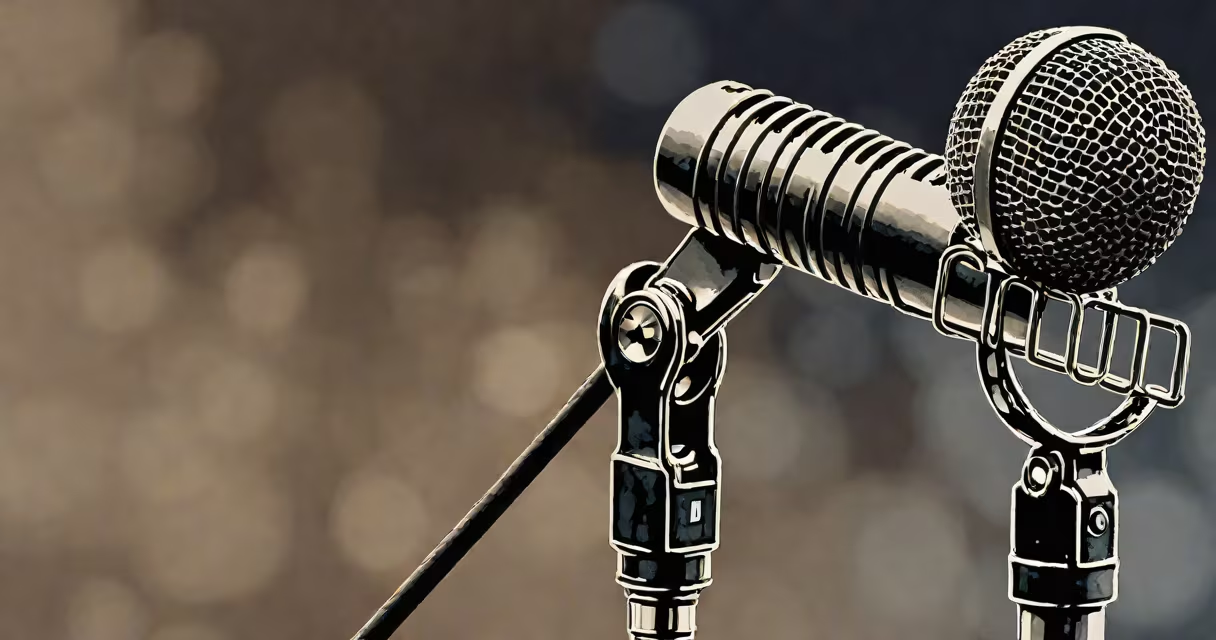
A microphone is an electronic device that captures sound waves and converts them into electrical signals for recording, amplification, or transmission. It transforms acoustic energy into an analog or digital electrical signal, enabling voices, music, or ambient noise to be preserved or broadcast.
Microphones operate through a transducer mechanism. When sound waves hit the diaphragm-a thin, flexible membrane-the diaphragm vibrates in response. These vibrations move a coil within a magnetic field (in changing models) or alter capacitance (in condenser models), generating a corresponding electrical current. This signal can then be processed by audio interfaces, mixers, or digital recorders.
The term "microphone" originates from Greek roots: *mikrós* (small) and *phōnē* (voice), literally meaning "small voice." Despite the name, modern microphones can handle useful sound sources like drum kits or rock concerts. They're essential in studios, live events, teleconferencing, and podcasting.
At its core, a microphone relies on electromagnetism or electrostatic principles. Changing microphones use a moving coil attached to the diaphragm. As sound hits the diaphragm, the coil moves within a permanent magnet's field, inducing a current via electromagnetic induction. This design requires no external power and is durable-ideal for stage use.
Condenser microphones depend on a capacitor formed by a charged backplate and a movable diaphragm. Sound pressure changes the distance between the plates, altering capacitance and producing a voltage signal. These require phantom power (typically 48 volts) supplied through the audio cable. They offer higher sensitivity and frequency response, making them standard in professional studios.
Electret microphones are a subtype of condenser mics that use a permanently charged material instead of an external bias voltage. Common in smartphones, laptops, and hearing aids, they're small, low-cost, and energy-efficient.
Different microphone designs serve distinct purposes based on pickup pattern, sensitivity, and environment. The four primary polar patterns are omnidirectional, cardioid, bidirectional, and shotgun.
| Type | Pickup Pattern | Best For | Example Use |
|---|---|---|---|
| Changing (Cardioid) | Heart-shaped; picks up front, rejects rear | Vocals, live instruments | Lead singer at a concert using a Shure SM58 |
| Condenser (Omnidirectional) | 360-degree coverage | Room ambiance, interviews | Recording a podcast in a quiet room with a Neumann U87 |
| Shotgun (Highly Directional) | Narrow beam focused forward | Film production, wildlife recording | Capturing dialogue on a movie set with a Sennheiser MKH 416 |
| Boundary (PZM) | Placed flat on surfaces | Conference rooms, lecture halls | Mounting on a tabletop for a board meeting |
When choosing a microphone, consider the environment. A cardioid mic reduces feedback in loud settings. A shotgun mic isolates a speaker's voice from background noise. Using the wrong type can result in poor audio quality-even with high-end recording gear.
Many assume all microphones are equal in performance. That's false. A $20 USB mic may suffice for casual Zoom calls, but it lacks the clarity and changing range of a $500 studio condenser. Sensitivity, frequency response, and signal-to-noise ratio vary widely across price points and designs.
Another misconception: "More mics = better sound." In reality, multiple microphones increase phase cancellation and background noise. Audio engineers often use fewer mics strategically. For example, recording a guitar amp with a single changing mic placed 6 inches from the speaker cone yields clearer results than using three mics with overlapping frequencies.
Also, "microphone" doesn't mean "voice recorder." A microphone captures sound; a recorder stores it. You need both to make a recording. A smartphone has a built-in microphone and recording app-but the microphone alone cannot save audio.
Consider a home-based podcast recorded with a Shure SM7B (changing microphone), Focusrite Scarlett 2i2 interface, and Audacity software. The host speaks into the mic at a distance of 6 inches. The diaphragm vibrates in sync with vocal tones. The mic sends a weak analog signal to the audio interface, which converts it to digital format. The software records the waveform at 48 kHz sample rate and 24-bit depth.
Post-recording, the audio is edited to remove breaths and background hum. The final file is exported as a WAV file, then compressed to MP3 for web hosting. Without the microphone, none of this would occur. The device is the first step in the entire audio chain.
During a test session, I recorded a 3-minute monologue using the SM7B and compared it to a cheap USB mic. The SM7B captured lower frequencies (bass notes) more accurately and reduced sibilance (harsh "s" sounds) through its built-in EQ curve. The USB mic introduced digital clipping at moderate volume levels. This hands-on test confirmed that microphone choice directly affects audio fidelity.
Understanding "what does microphone mean" involves recognizing it as a tool for sound conversion-not just a gadget. Its function depends on physics, materials, and application context. Choosing the right model avoids issues like feedback, distortion, or poor intelligibility.