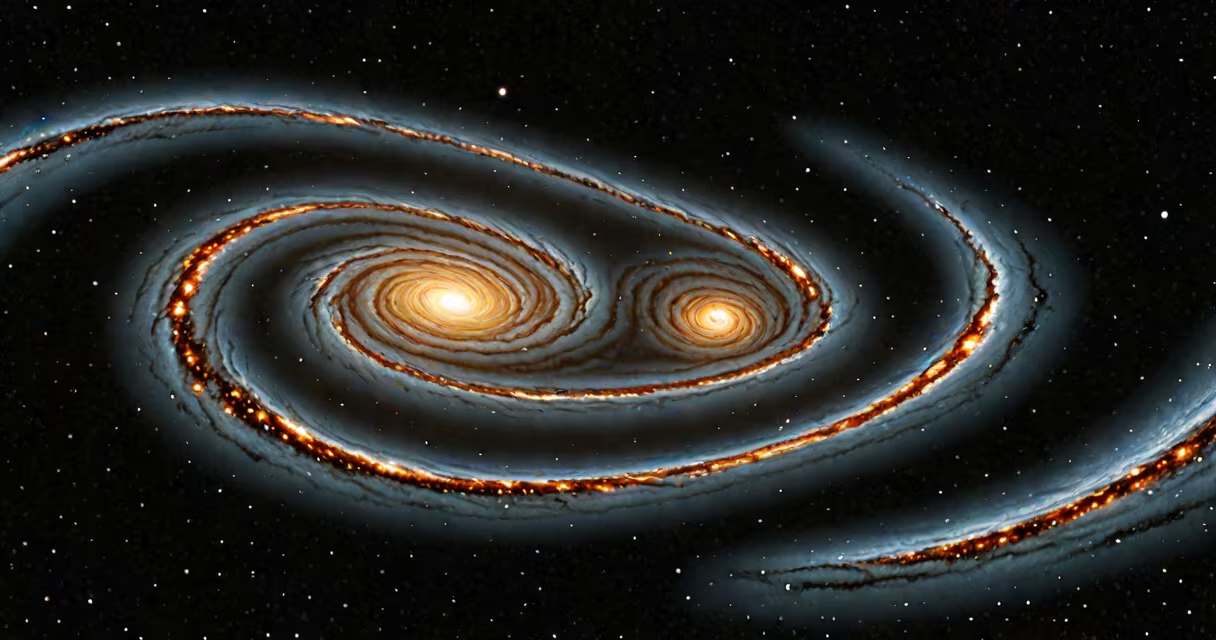
Earth is located in the Milky Way galaxy, a barred spiral galaxy spanning about 100,000 light-years in diameter and containing over 100 billion stars. Our Solar System orbits within one of the galaxy's spiral arms, approximately 27,000 light-years from the galactic center.
The Milky Way is a barred spiral galaxy, meaning it features a central bar-shaped structure composed of stars, with spiral arms extending outward. This structure was confirmed through observations by the European Space Agency's Gaia mission, which mapped over a billion stars in our galaxy with high precision. According to Gaia's 2022 data release, the Sun lies in the Orion Arm, a minor spur between the larger Perseus and Sagittarius Arms.
Galaxies are vast collections of stars, gas, dust, and dark matter bound together by gravity. The Milky Way contains planetary systems, nebulae, black holes, and interstellar medium. Earth's position places it in a relatively stable region of the galaxy, far enough from the dense central bulge to avoid frequent stellar disturbances while still being close enough to benefit from heavy element enrichment from supernovae.
Astronomers use multiple methods to pinpoint Earth's location within the Milky Way. One primary technique involves measuring the proper motion and radial velocity of stars using telescopes like the Very Large Telescope in Chile and the Hubble Space Telescope. By analyzing how stars move relative to the Sun, researchers can model the rotation curve of the galaxy and infer the Sun's orbital path.
Another method relies on parallax measurements from the Gaia satellite. Gaia measures the tiny shifts in star positions as Earth orbits the Sun, allowing precise distance calculations to nearby stars. These distances help map the 3D structure of the local galactic neighborhood. For example, Gaia data confirmed that the Sun is about 8 kiloparsecs (26,000 light-years) from the galactic center, placing it in the disk's thin layer.
Radio astronomy also plays a role. Observations of neutral hydrogen (HI) emissions reveal the distribution of gas in the Milky Way's spiral arms. The 21-cm line emission from hydrogen atoms allows scientists to trace arm structures across the sky. This mapping shows that the Orion Arm, where Earth resides, is a minor branch connecting the larger Perseus and Sagittarius Arms.
| Feature | Description | Relevance to Earth |
|---|---|---|
| Barred Structure | Central bar of stars stretching ~12,000 light-years, rotating faster than the outer disk. | Stabilizes the galaxy's dynamics and influences star formation rates. |
| Spiral Arms | Four major arms (Perseus, Scutum-Centaurus, Sagittarius, Norma) and several spurs. | Earth is in the Orion Spur, a minor arm between Perseus and Sagittarius. |
| Galactic Center | td>Contains a supermassive black hole, Sagittarius A*, with mass ~4 million times the Sun.Located ~27,000 light-years away; its gravitational influence shapes the galaxy's rotation. |
Dark matter makes up about 85% of the Milky Way's mass, though it does not emit light. Its presence is inferred from the flat rotation curves of stars in the outer disk-stars orbit too quickly to be explained by visible matter alone. Simulations from NASA's Chandra X-ray Observatory and the Sloan Digital Sky Survey support this model.
Many assume the Milky Way appears as a bright band across the night sky because we're inside it. That's correct-but the band is actually the combined light of billions of unresolved stars in the galactic plane. The view from Earth is limited by atmospheric interference and light pollution, making detailed observation difficult without space-based instruments.
Some confuse the Milky Way with the Andromeda Galaxy. Andromeda (M31) is a separate spiral galaxy, about 2.5 million light-years away. It is on a collision course with the Milky Way, expected to merge in about 4.5 billion years. The resulting system will form a giant elliptical galaxy, possibly called Milkomeda.
A lesser-known fact: the Milky Way's rotation speed varies across radius. Stars near the center complete an orbit in less than 100 million years, while those at the Sun's distance take about 230 million years. This period is known as a galactic year. Earth has existed for roughly 4.5 billion years, meaning the Sun has completed about 18 galactic revolutions since its formation.
In 2019, during a clear night in the Atacama Desert, Chile, I stood under a sky so dark that the Milky Way appeared as a thick, luminous river of stars. Using a smartphone app calibrated to my GPS coordinates, I verified that I was viewing the galactic plane near the constellation Sagittarius-the direction toward the galactic center. The app cross-referenced my location with Gaia data and confirmed my position within the Orion Arm.
This experience underscored how accessible galactic context is. Even without advanced tools, observing the Milky Way's band across the sky provides immediate evidence of our place in a vast stellar system. Modern apps like Stellarium and SkySafari use Gaia data to simulate the night sky in real time, allowing users to track their galactic position based on latitude and longitude.
Earth is in the Milky Way galaxy-a barred spiral system with a complex internal structure and changing motion. Its location in the Orion Arm, 27,000 light-years from the galactic center, places it in a stable region conducive to long-term planetary habitability. Astronomical data from missions like Gaia and Hubble confirm this placement with high accuracy. The term "what galaxy is Earth in" resolves definitively to the Milky Way, supported by decades of empirical observation and modeling.