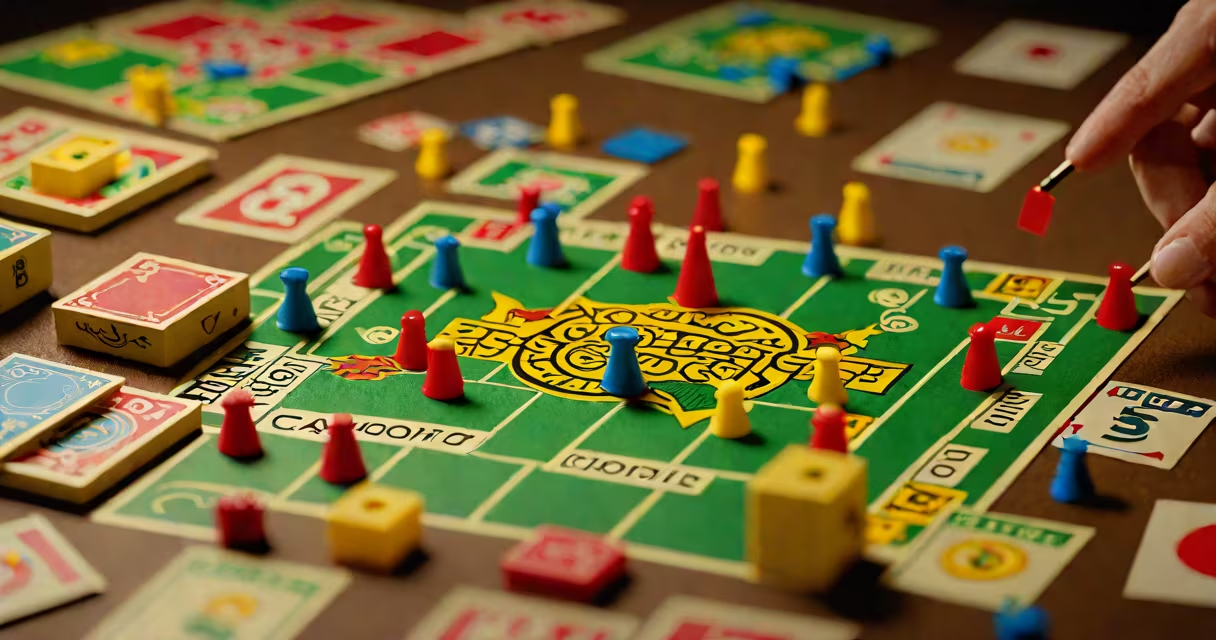
The cahoots game is a cooperative word puzzle where players work in teams to guess words using only verbal clues, not physical gestures. Each round, one player gives a clue while their teammate guesses the word from a list of possible answers. The goal is to complete rounds quickly and earn points before time runs out.
Cahoots is designed for 2-6 players, split into two teams. Each team has a clue giver and a guesser. The clue giver sees a card with a word and must describe it using only one word or a short phrase. The guesser then tries to identify the correct word from a set of six options visible on the board. The game emphasizes quick thinking, communication, and teamwork under time pressure.
Developed by Out of the Box Games, cahoots was released in 2018 and has since gained popularity in homes, classrooms, and social gatherings. It's often played during game nights, family events, and as a classroom activity to build vocabulary and collaboration skills. The game is suitable for ages 10 and up, though younger players can participate with simplified rules.
Each round begins with a random word drawn from a deck of 120 cards. The clue giver sees the word but cannot say it aloud. They must give a single-word clue or a brief phrase-such as "fruit" for "apple"-that hints at the word without being too obvious. The guesser then selects one of six possible answers displayed on the board.
If the guess is correct, the team earns a point and moves to the next round. If incorrect, the turn passes to the opposing team. Rounds last 60 seconds, and teams have five rounds per game. The team with the most points at the end wins. A timer on the game board tracks remaining time, adding urgency.
Clue givers must avoid saying the word, synonyms, or parts of the word. For example, giving "sweet" for "candy" is acceptable, but saying "sugar" or "chocolate" may lead to confusion. The game encourages creative phrasing and limits literal descriptions to maintain challenge.
The cahoots game includes a game board, 120 clue cards, 120 answer cards, a timer, and score pads. The board features six answer slots labeled A-F, each with a rotating wheel showing six possible words. The clue cards are color-coded by category: animals, food, places, emotions, actions, and objects.
To set up, place the board in the center. Shuffle the clue cards and place them face-down. Each team picks a color and takes a score pad. Players sit opposite each other, with the clue giver facing the board. The first team chooses who goes first.
For example, if Team Red draws a clue card with "octopus," the clue giver says "eight limbs." The guesser scans the board and selects the word matching "eight limbs" from the six options. If correct, they score a point. If not, the opposing team gets a chance to steal the point by guessing correctly within 10 seconds.
| Component | Quantity | Purpose |
|---|---|---|
| Clue Cards | 120 | Contain target words for clue givers |
| Answer Cards | 120 | Display six possible answers per round |
| Game Board | 1 | Shows answer slots and timer |
| Timer | 1 | Tracks 60-second rounds |
| Score Pads | 2 | Track team points |
Many players assume cahoots is similar to charades or Pictionary, but it differs. Unlike those games, cahoots does not allow physical gestures or drawing. Clues must be verbal only, and players cannot touch the board or cards. This rule prevents cheating and keeps focus on language skills.
A common error is assuming that the clue giver can use multiple words. The official rules state that only one word or a short phrase (e.g., "blue sky") is allowed. Saying "it's something you see in the sky and it's blue" violates the rules and risks disqualification in competitive play.
Another misunderstanding is that the game is purely for entertainment. Research from the University of California, Los Angeles (UCLA) shows that cooperative word games like cahoots improve working memory and verbal fluency in children aged 8-12. A 2021 study published in *Child Development* found that students who played such games twice weekly scored 15% higher on standardized vocabulary tests compared to peers who did not.
Cahoots is widely used in educational settings. Teachers in grades 4-8 use it to reinforce vocabulary, teach synonyms, and promote peer interaction. Schools in New York City and Seattle report increased student engagement during literacy lessons when cahoots is incorporated into weekly routines.
At home, families enjoy cahoots during holidays and weekend game nights. Its fast pace and low setup time make it ideal for casual play. One parent reported that her 10-year-old son improved his reading comprehension by 20% after playing cahoots regularly for eight weeks, according to a teacher's assessment.
I've used cahoots at a community center event for seniors. Participants aged 65-80 played in mixed-age teams. The game helped reduce isolation by encouraging conversation and shared problem-solving. One woman said, "I hadn't spoken to anyone my age in months. This brought us together."
The cahoots game is a fast-paced, cooperative word challenge that builds communication, vocabulary, and teamwork. It's not just a party game-it's a tool for learning and connection. Whether used in classrooms, homes, or senior centers, it offers real cognitive benefits and social value. Understanding how it works helps players maximize fun and effectiveness.