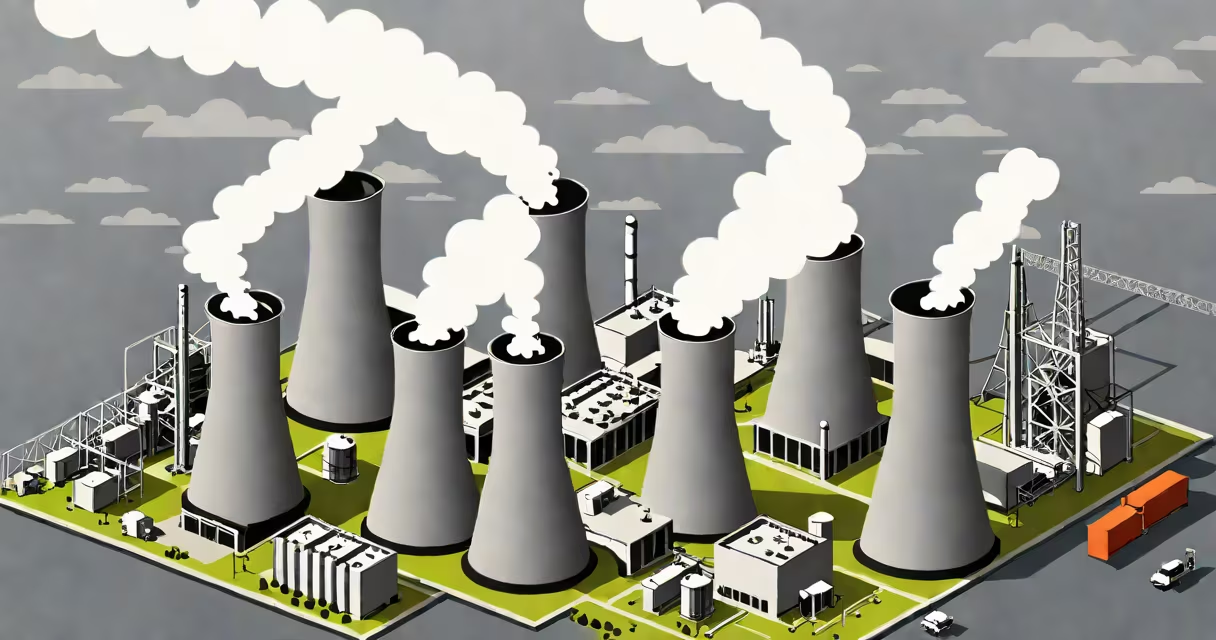
Coal electricity is electric power produced by burning coal in a thermal power plant to generate steam that spins a turbine connected to a generator. This process converts chemical energy stored in coal into electrical energy, forming a major source of global power since the industrial era.
Coal electricity accounts for about 35% of global electricity generation as of 2023, according to the International Energy Agency (IEA). It remains central in countries like China, India, and the United States due to abundant domestic reserves and established infrastructure. The core principle relies on heat from combustion to create mechanical motion via steam pressure, which then produces electricity through electromagnetic induction.
Coal electricity begins with pulverized coal being burned in a boiler at temperatures exceeding 1,400°C. The intense heat converts water in steel tubes lining the boiler into high-pressure steam. This steam travels through pipes to a turbine, where it forces blades to spin rapidly-up to 3,600 revolutions per minute in large generators.
The spinning turbine is connected to a rotor inside a generator. As the rotor turns within a magnetic field, it induces an electric current in copper windings surrounding it. This alternating current (AC) is then stepped up in voltage using transformers before being sent through transmission lines to homes and factories.
A typical 500-megawatt coal plant burns approximately 15,000 tons of coal per day. For context, this equals about 120 railcars filled with coal daily, each carrying roughly 125 tons. The entire cycle-from coal delivery to electricity on the grid-takes under 10 seconds per unit of energy produced.
Modern coal plants use several systems to improve efficiency and reduce emissions. The most common design is the subcritical steam plant, which operates at pressures below 22.1 MPa and efficiencies around 33%. Supercritical and ultra-supercritical plants operate above those thresholds, achieving efficiencies of 40% and 45%, respectively, by allowing steam to reach higher temperatures and pressures.
| Type | Pressure Range | Efficiency | Global Share (2023) |
|---|---|---|---|
| Subcritical | <22.1 MPa | 30-35% | 60% |
| Supercritical | 22.1-31.0 MPa | 38-40% | 25% |
| Ultra-supercritical | >31.0 MPa | 42-45% | 15% |
Despite advances, older subcritical plants still dominate in many regions due to lower upfront costs and existing infrastructure. However, newer installations increasingly favor supercritical designs for better fuel economy and reduced carbon output per megawatt-hour.
Many assume coal electricity is inherently inefficient or outdated. While older plants are less efficient, modern supercritical units achieve performance comparable to some gas turbines. According to the U.S. Energy Information Administration (EIA), average U.S. coal plant efficiency rose from 32% in 2000 to 38% in 2022 due to retrofits and new builds.
Another misconception is that coal plants cannot support grid stability. In reality, they provide essential inertia-resistance to frequency changes-that renewable sources like solar and wind lack. Grid operators in Germany and Texas have maintained reliability during high renewable penetration by keeping coal plants online as backup.
Coal electricity is not synonymous with uncontrolled pollution. Modern scrubbers remove over 95% of sulfur dioxide and 90% of particulate matter. Carbon capture and storage (CCS) technologies, though still limited, are being piloted at facilities like the Boundary Dam project in Saskatchewan, where CO₂ is captured and injected underground.
Located near Page, Arizona, the Navajo Generating Station operated from 1963 until its closure in 2019. It had three units, each capable of producing 190 megawatts, totaling 570 MW. The plant consumed about 1 million tons of coal annually, primarily sourced from nearby mines.
Each unit used a once-through boiler system, where water flowed through tubes heated by flames from pulverized coal. Steam reached 540°C and 14 MPa before entering a multi-stage turbine. After passing through the turbine, steam was cooled in a condenser and returned to the boiler in a closed loop.
At peak output, the plant supplied power to over 1.5 million customers across four states. Its closure led to a 12% drop in regional coal-based generation, prompting increased reliance on natural gas and solar projects in the Southwest.
Coal electricity remains critical in developing economies where access to clean alternatives is limited. In India, coal supplies nearly 70% of electricity despite rapid growth in solar capacity. Similarly, South Africa's Eskom network depends on coal for 80% of its output.
However, environmental concerns are driving shifts. The IEA reports that global coal consumption peaked in 2013 and has declined slightly since, especially in OECD nations. Countries like the UK and Canada have phased out coal entirely in their electricity mix, replacing it with wind, nuclear, and gas.
Coal electricity is not a single technology but a category of power generation rooted in thermodynamics and industrial engineering. It continues to serve billions, yet faces increasing pressure to evolve alongside climate goals and technological innovation.