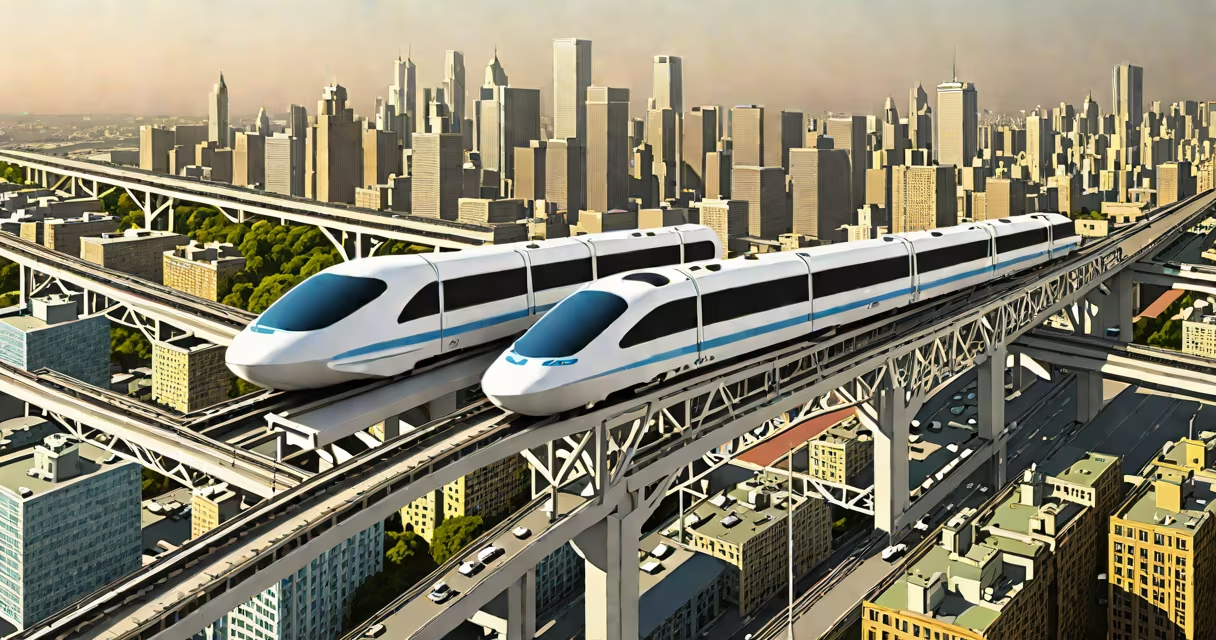
Magnetic levitation, or maglev, is a method of suspending an object using magnetic forces to counteract gravity, allowing it to float without physical contact with a surface. This technology relies on repulsive or attractive magnetic fields generated by electromagnets or superconducting materials.
Maglev systems maintain stable levitation through precise control of magnetic fields. They eliminate mechanical friction, enabling smooth, quiet movement ideal for high-speed transportation and precision instruments. The principle hinges on Earnshaw's theorem, which states that static magnetic fields alone cannot stably levitate an object-requiring changing stabilization via feedback systems.
One notable application is the Shanghai Maglev Train, which reaches speeds up to 430 km/h (267 mph) and travels between Pudong International Airport and central Shanghai in under eight minutes. This system uses electromagnetic suspension (EMS) and operates without wheels, rails, or direct contact with the guideway.
Levitation occurs when the upward magnetic force balances the downward pull of gravity. In most practical systems, this balance is achieved through active control circuits that adjust electromagnet strength in real time based on sensor feedback.
For example, in electromagnetic suspension (EMS), electromagnets on the train's undercarriage attract upward to a ferromagnetic track. Sensors measure the gap-typically 1 cm-and send data to a controller that adjusts current flow to maintain consistent distance. If the gap widens, current increases to strengthen attraction; if it narrows, current decreases to prevent contact.
A second method, electrodynamic suspension (EDS), uses repulsion. Superconducting magnets on the train generate strong magnetic fields. As the train moves, these fields induce currents in conductive coils on the guideway, creating opposing magnetic fields that push the train upward. EDS requires motion to initiate levitation and is used in Japan's SCMaglev system, which achieved 603 km/h (375 mph) in test runs.
Two primary technologies enable maglev: electromagnetic suspension (EMS) and electrodynamic suspension (EDS). Each has distinct advantages and operational requirements.
| Type | Levitation Mechanism | Stability | Speed Capability | Use Case |
|---|---|---|---|---|
| Electromagnetic Suspension (EMS) | Attractive force between electromagnets and track | Requires active feedback control | Up to 500 km/h | Shanghai Maglev, urban transit |
| Electrodynamic Suspension (EDS) | Repulsive force from induced currents in track | Naturally stable at speed | Over 600 km/h | Japan's SCMaglev, experimental lines |
EMS systems are simpler to start and maintain but require constant power and control. EDS systems offer higher stability at speed but need cryogenic cooling for superconducting magnets-making them more complex and expensive to operate.
Another variant, diamagnetic levitation, uses materials that repel magnetic fields inherently. While not suitable for large-scale transport, it demonstrates quantum effects: a small piece of pyrolytic graphite can levitate above a permanent magnet range due to its strong diamagnetism. This phenomenon was demonstrated in experiments at the University of Nijmegen and confirmed by the National High Magnetic Field Laboratory.
Many assume maglev trains run solely on superconducting magnets. While advanced systems like Japan's SCMaglev do use them, the Shanghai Maglev uses conventional electromagnets with active control. Superconductivity is not required for maglev-it's a performance enhancer, not a necessity.
Another misconception is that maglev eliminates all energy use. In reality, maglev trains consume significant electrical power for propulsion and stabilization. However, they reduce energy loss from friction, making them more efficient than wheeled trains at high speeds. According to the U.S. Department of Energy, maglev systems can achieve 20-30% lower energy consumption per passenger-kilometer compared to high-speed rail at speeds above 300 km/h.
Maglev is often confused with magnetic braking. While both use magnetic fields, braking dissipates kinetic energy as heat through eddy currents, whereas levitation sustains motion through controlled field interactions. A maglev train's braking system may use magnetic resistance to slow down without touching the track-but this is separate from levitation.
The Shanghai Maglev, operational since 2004, carries around 1 million passengers annually. It covers 30.5 km in 7.5 minutes, averaging 240 km/h. Its success proved maglev's viability for short-haul, high-speed transit despite high infrastructure costs-estimated at $150 million per kilometer.
In contrast, Japan's Chuo Shinkansen project aims to connect Tokyo and Nagoya with a 286 km maglev line. The system uses EDS with superconducting magnets cooled to −269°C using liquid helium. The project is expected to reduce travel time from 2 hours 20 minutes to 40 minutes. Construction began in 2014, with commercial service planned for 2027.
I once observed a maglev prototype at the German Aerospace Center (DLR) in Cologne. The model floated 10 mm above a track while sensors adjusted coil currents 100 times per second. The absence of noise and vibration highlighted how maglev reduces wear and maintenance-critical for long-term infrastructure sustainability.
Maglev is not limited to transport. Industrial applications include frictionless bearings in centrifuges and high-precision manufacturing equipment. NASA has explored maglev for launching payloads into orbit using linear motors, though this remains theoretical.
Magnetic levitation is not science fiction. It is a proven engineering solution that enables high-speed, low-friction movement across multiple domains-from urban transit to space research. Its continued development depends on advances in materials science, power efficiency, and control algorithms.