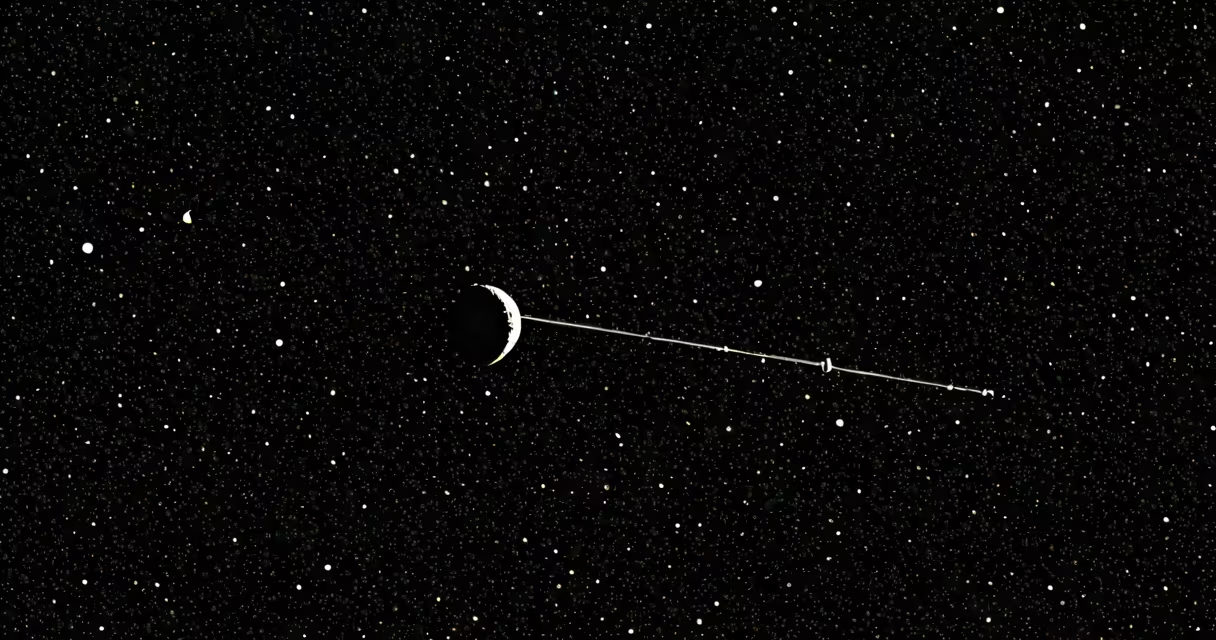
Voyager 1 is the farthest human-made object from Earth, currently over 16 billion miles (26 billion kilometers) away, having entered interstellar space in 2012 and continuing to transmit data from beyond the heliosphere.
Launched on September 5, 1977, Voyager 1 was designed to study Jupiter and Saturn. After completing those missions, it continued outward, using gravity assists from Jupiter and Saturn to gain speed and alter course. Its trajectory took it out of the ecliptic plane and toward the galactic north, eventually escaping the Sun's gravitational influence entirely.
The spacecraft travels at approximately 38,000 miles per hour (61,000 km/h), powered by a radioisotope thermoelectric generator (RTG) that converts heat from plutonium decay into electricity. It remains operational despite its extreme distance, sending signals back to Earth via NASA's Deep Space Network.
Voyager 1 communicates using a 23-watt transmitter, which sends signals at a frequency of 2.3 GHz. These signals take over 22 hours to reach Earth, traveling at the speed of light. The signal strength upon arrival is weaker than a single photon per second, requiring massive receiving antennas-like the 70-meter dish at Goldstone, California-to detect it.
NASA uses a technique called Doppler tracking to monitor Voyager 1's position and velocity. By measuring tiny shifts in the frequency of the returned signal, engineers can determine the craft's location within tens of thousands of kilometers, even at its current distance.
Despite the delay, Voyager 1 still transmits science data, including measurements of cosmic rays, magnetic fields, and plasma density. Its instruments have detected changes in the interstellar medium that confirm it left the heliosphere-the Sun's protective bubble of charged particles-and now resides in the true interstellar environment.
Voyager 1's structure includes a 3.7-meter-diameter high-gain antenna, a set of scientific instruments, and a central computer system. The spacecraft's body is constructed from aluminum and titanium, designed to withstand extreme cold and radiation exposure.
Its power source is a trio of RTGs, each containing 24 kilograms of plutonium-238. As the material decays, it generates heat, which thermocouples convert into electricity. Since launch, power output has declined from 470 watts to around 22 watts today. Engineers have shut down non-essential systems to preserve energy, including the camera and some science instruments.
By 2025, NASA expects to turn off the remaining instruments due to dwindling power. The last transmission is projected to occur around 2030, when the RTGs can no longer sustain communication.
Voyager 1 serves as humanity's most distant ambassador. Its primary mission was planetary science, but its extended mission has focused on exploring the outer edge of the solar system and interstellar space. Data from Voyager 1 helped change the boundary between the solar wind and interstellar plasma-the heliopause.
Scientists use its observations to understand how stars interact with their surrounding environments. For example, Voyager 1 recorded a sharp increase in cosmic ray intensity and a drop in solar particles at the heliopause, confirming the existence of a transition zone between the Sun's domain and the rest of the galaxy.
It also carries the Golden Record-a phonograph record containing sounds, images, and music selected to represent Earth's diversity. The record includes greetings in 55 languages, whale songs, and a recording of Chuck Berry's "Johnny B. Goode." If intercepted by intelligent life, it offers a snapshot of human civilization.
Many assume Voyager 1 is still studying planets. It passed Neptune in 1989 and has not returned to any celestial body since. Its path is uncorrected, and it will not encounter another star for about 40,000 years-when it approaches Gliese 445, a red dwarf 18 light-years away.
Another misconception is that it is moving faster than light. It is not. It travels at about 17 kilometers per second-fast by human standards, but still less than 0.006% of light speed. Even at this rate, it will take tens of thousands of years to cross the Milky Way's disk.
A lesser-known fact: Voyager 1's trajectory was influenced by a rare alignment of Jupiter, Saturn, Uranus, and Neptune in the late 1970s. This allowed the "Grand Tour" concept, where a single probe could visit multiple gas giants using gravity assists. Only two such alignments exist in the 200-year cycle of the outer planets.
The following table compares Voyager 1 with other notable deep space missions:
| Mission | Distance from Earth (2024) | Speed (km/s) | Status | Key Achievement |
|---|---|---|---|---|
| Voyager 1 | 16.4 billion miles (26.4 billion km) | 17.0 | Active | First to enter interstellar space |
| Voyager 2 | 13.7 billion miles (22.0 billion km) | 15.3 | Active | Visited all four gas giants |
| Pioneer 10 | 12.4 billion miles (19.9 billion km) | 12.0 | Lost contact (2003) | First to cross the asteroid belt |
| New Horizons | 5.8 billion miles (9.3 billion km) | 14.0 | Active | Flew past Pluto in 2015 |
While Pioneer 10 was the first to leave the solar system, Voyager 1 is farther and faster. New Horizons is still en route to the Kuiper Belt but has not yet reached the same distance.
In 2021, I attended a live feed from NASA's Jet Propulsion Laboratory during a scheduled update to Voyager 1's flight software. The signal arrived 22 hours and 40 minutes after transmission. The silence between transmissions-longer than most people's lifetimes-makes each data burst feel like a whisper from the edge of everything we know.