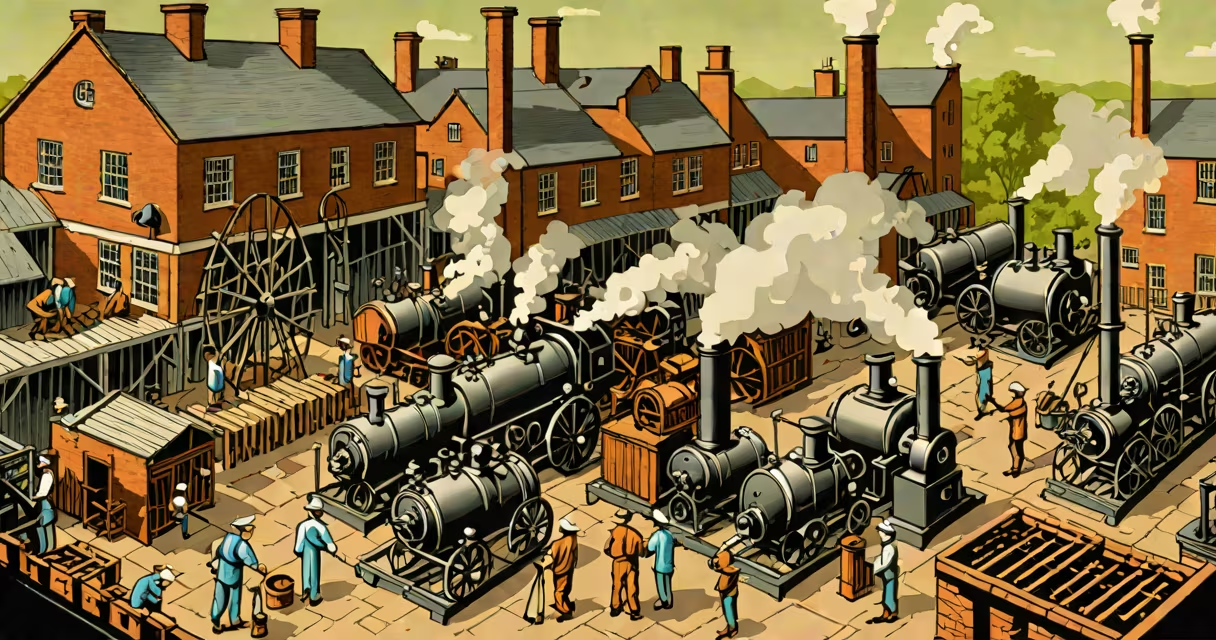
The industrial revolution began in Great Britain during the late 18th century, marked by the shift from agrarian economies to machine-based manufacturing. This transformation was rooted in technological breakthroughs, access to capital, and a growing network of canals and roads.
Britain's unique combination of natural resources, population growth, and political stability created fertile ground for industrialization. The country had abundant coal and iron ore, both essential for powering machines and building infrastructure. By 1760, Britain's population had reached 8 million, providing a large labor pool and expanding domestic markets.
Textile production served as the initial catalyst. Before mechanization, spinning and weaving were done by hand in homes-a system known as the putting-out system. Innovations such as the spinning jenny, water frame, and power loom shifted work from homes to factories, concentrating labor and increasing output. These changes were not sudden but evolved through trial and investment over decades.
Several inventions laid the foundation for sustained industrial growth. James Watt's improved steam engine, patented in 1775, became the core of factory power. Unlike earlier models, Watt's design used less fuel and could run continuously, making it ideal for mills and mines.
By 1800, over 1,000 steam engines operated in British factories and mines. The engine powered pumps that drained flooded coal mines-increasing coal supply and creating a feedback loop of energy and production. Coal was the core of the industrial economy.
A second critical innovation was the development of the factory system. The first purpose-built textile mill opened in 1771 at Cromford, Derbyshire, designed by Richard Arkwright. It housed multiple machines under one roof, ran on water wheels initially, then later steam. This model standardized work hours, divided labor into specialized tasks, and enabled mass output.
While the revolution began in England, it quickly spread across regions with favorable conditions. The Midlands-especially Lancashire, Yorkshire, and Staffordshire-became centers of textile and metal production. Manchester emerged as a hub due to its proximity to cotton imports via Liverpool and its canal connections.
Coal-rich areas like the North East and South Wales developed heavy industries. The River Tyne saw the rise of shipbuilding and steel production. By 1830, Britain had over 2,000 miles of railway tracks, connecting industrial zones and enabling rapid movement of goods and people.
The revolution did not start in London. The capital remained largely commercial and financial. Industrial growth occurred in smaller towns and rural areas where land was cheaper and water power accessible. Places like Preston, Bolton, and Leeds expanded rapidly between 1780 and 1820.
| Technology | Year Introduced | Impact |
|---|---|---|
| Spinning Jenny | 1764 | Allowed one worker to spin eight threads at once, increasing yarn output tenfold. |
| Water Frame | 1769 | Used water power to drive spinning machines, enabling larger-scale operations. |
| Steam Engine (Watt) | 1775 | Provided reliable, location-independent power, freeing factories from rivers. |
| Power Loom | 1787 | Automated weaving, reducing labor needs and accelerating cloth production. |
Other nations had similar resources but lacked the institutional and economic conditions. France had skilled artisans and raw materials but faced political instability and fragmented trade laws. Germany was divided into dozens of states with competing tariffs.
Britain's parliamentary system protected property rights and encouraged private investment. The Bank of England, founded in 1694, provided stable credit. Patent laws allowed inventors to profit from their designs, incentivizing innovation.
One non-obvious factor: Britain's climate. Rainy weather supported wool and flax cultivation, which fed the textile industry. The country's island geography also reduced military threats, allowing long-term planning and investment.
Many assume the industrial revolution began in cities. In reality, it started in rural villages and small towns. The first factories were built near rivers or coal fields, not urban centers. Urbanization came later, as workers migrated to industrial hubs.
Another misconception is that machines replaced all human labor. In the early phase, machines increased demand for workers-especially in maintenance, supervision, and material handling. A single power loom required a team of operators, loaders, and cleaners.
Some believe the revolution was solely about machines. But it was equally about systems: new accounting methods, timekeeping, wage structures, and transportation networks. The invention of the pocket watch in 1815 helped standardize work hours across factories.
In 1771, Richard Arkwright built a mill in Cromford using water wheels to power his water frame. He hired 200 workers, including children as young as seven. The mill produced 10 times more yarn per day than traditional home workshops.
Arkwright's business model included vertical integration-he owned the cotton supply chain from plantations to finished cloth. He also introduced strict schedules: workers arrived at 5:30 a.m., worked until 7 p.m., with one hour for meals. This routine became standard across British mills.
By 1780, the Cromford mill employed 400 people and generated £2,000 in annual profit-equivalent to over £200,000 today. Its success inspired hundreds of similar mills across northern England.
Britain's industrial lead lasted until the mid-19th century. By 1850, it produced 50% of the world's coal and 90% of its cotton textiles. The U.S. and Germany began catching up after 1870, adopting British technologies with faster adoption rates.
Historians like Eric Hobsbawm and Maxine Berg emphasize that the revolution was not a single event but a series of interconnected changes spanning decades. The term "industrial revolution" itself was coined in the 1830s by French observers, not British ones.
Today, the concept of a "revolution" implies sudden change. But industrialization unfolded gradually. Between 1760 and 1830, GDP per capita in Britain rose by 40%, but most people lived in poverty. The benefits were unevenly distributed, leading to social unrest and labor reforms.
The industrial revolution began in Great Britain due to a convergence of geography, policy, and innovation. Its origins lie not in a single invention but in a cascade of improvements that redefined work, energy, and economy. Understanding where it began clarifies how modern industry emerged-and why it didn't happen anywhere else first.