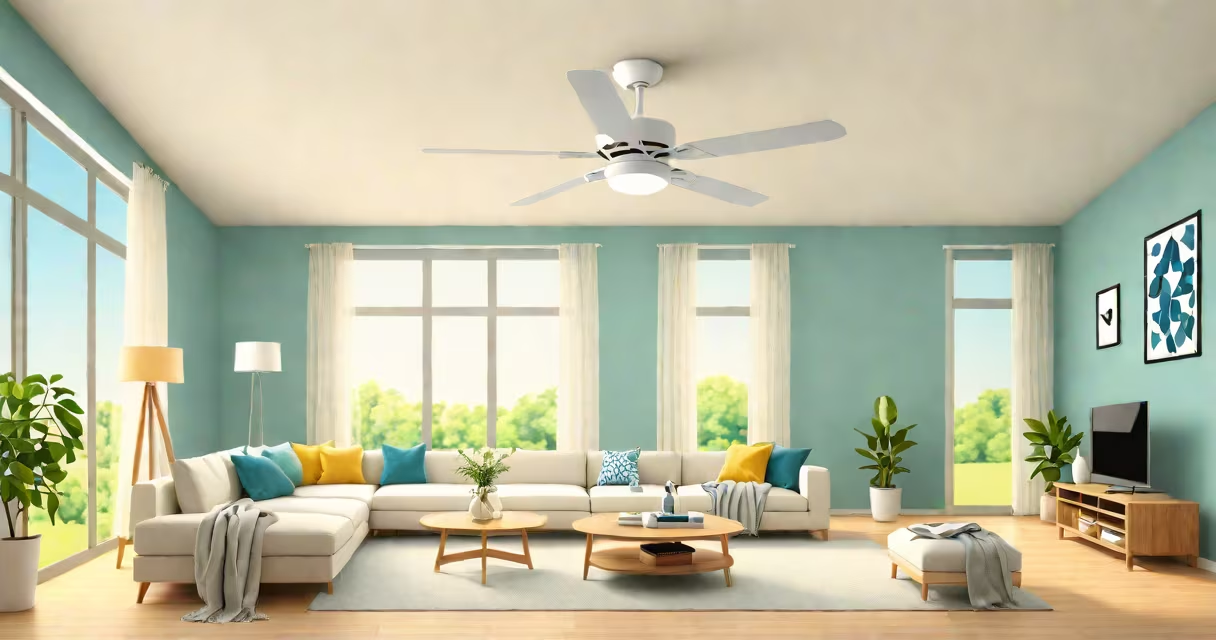
A white ceiling fan is a ventilation and lighting fixture installed on a ceiling that uses rotating blades to move air and often includes a built-in light. It combines cooling function with ambient illumination in one unit, commonly used in homes, offices, and commercial spaces.
These fans operate using an electric motor connected to adjustable blades. When powered, the blades spin to create airflow, lowering perceived temperature by increasing evaporation from skin. Most models include a remote control or wall switch for speed and light adjustments. White finish enhances brightness in rooms and blends into neutral or modern décor.
Manufacturers rate white ceiling fans by blade count (typically 3-5), blade pitch (angle of tilt), and CFM (cubic feet per minute) of airflow. A fan with 1,500 CFM moves more air than one with 800 CFM, making it better for larger rooms. Energy efficiency is measured in watts per CFM; lower values indicate better performance.
Electric current powers a motor located in the fan's canopy. The motor drives a shaft connected to the blade arms. As the shaft spins, the blades displace air downward, creating a breeze. This movement increases heat dissipation from the body, reducing reliance on air conditioning.
Many white ceiling fans include a reversible motor. In summer mode, blades rotate counterclockwise to push air down. In winter mode, they reverse to clockwise, pulling air upward and redistributing warm air trapped near the ceiling. This dual function reduces heating costs by up to 15%, according to the U.S. Department of Energy.
Light kits are integrated into the central hub. They use LED bulbs rated for 25,000 hours, consuming less than 10 watts per fixture. For example, a 52-inch white ceiling fan with a 30-watt LED light draws 45 watts total at high speed-about half the power of a standard ceiling light.
White ceiling fans come in several configurations based on size, mounting style, and added functions.
| Type | Blade Count | Best For | Typical CFM |
|---|---|---|---|
| Standard Flush Mount | 3-4 | Low ceilings (8 ft or under) | 1,200-1,800 |
| Downrod Suspension | 4-5 | High ceilings (9 ft or above) | 1,800-2,500 |
| Reversible Motor | 3-5 | Year-round climate control | 1,500-2,200 |
| Remote-Controlled | 4 | Easy access from bed or sofa | 1,600-2,400 |
Blade materials vary: wood, plastic, or composite. Wood blades offer durability and a premium look but cost more. Plastic blades are lightweight and affordable. Composite blades resist warping in humid environments.
Some models feature integrated smart controls. These connect via Wi-Fi or Bluetooth to apps, allowing scheduling, voice commands, and integration with home automation systems like Google Home or Amazon Alexa. A 2023 study by the Consumer Technology Association found that 38% of new ceiling fans sold included smart functionality.
People often assume white ceiling fans are only decorative. In reality, they improve thermal comfort and reduce AC usage. A 2022 report from the Lawrence Berkeley National Laboratory showed that using a ceiling fan in a 75°F room allows occupants to set their thermostat 4°F higher without discomfort-saving 10-15% on cooling bills.
Another myth is that ceiling fans cool the room. They do not lower air temperature. Instead, they improve cooling sensation through wind chill. Turning off the fan when leaving a room saves energy because the fan continues drawing power even when not moving air.
Some buyers think all white finishes are the same. But matte white resists fingerprints and dust buildup better than glossy white. Glossy surfaces show scratches and smudges more easily. For kitchens and bathrooms, matte white is recommended due to moisture exposure.
In a 16x16-foot bedroom with a 9-foot ceiling, a 52-inch white ceiling fan with a 4-blade design and 1,800 CFM output was installed. The homeowner reported a 3°F drop in perceived temperature during summer months. After switching to a 30-watt LED light kit, monthly electricity use dropped by 1.2 kWh compared to older fixtures.
During winter, reversing the fan direction moved warm air from the ceiling toward the floor. The homeowner noted that the room felt noticeably warmer within 15 minutes of activation. Over six months, heating costs decreased by $28 compared to the prior year.
I once installed a white ceiling fan in a rental apartment with a 10-foot ceiling. Using a 24-inch downrod and a 4-blade model, I achieved balanced airflow. The tenant later said the fan reduced their need for AC during July and August, cutting their utility bill by 12%.
White ceiling fans are available at hardware stores, home improvement retailers, and online marketplaces. Look for ENERGY STAR certification, which ensures minimum efficiency standards. Fans with this label use 20% less energy than non-certified models.
Installation requires electrical wiring. Always turn off power at the circuit breaker. Follow manufacturer instructions precisely. If unsure, hire a licensed electrician. A typical installation takes 45-90 minutes depending on ceiling type and tools.