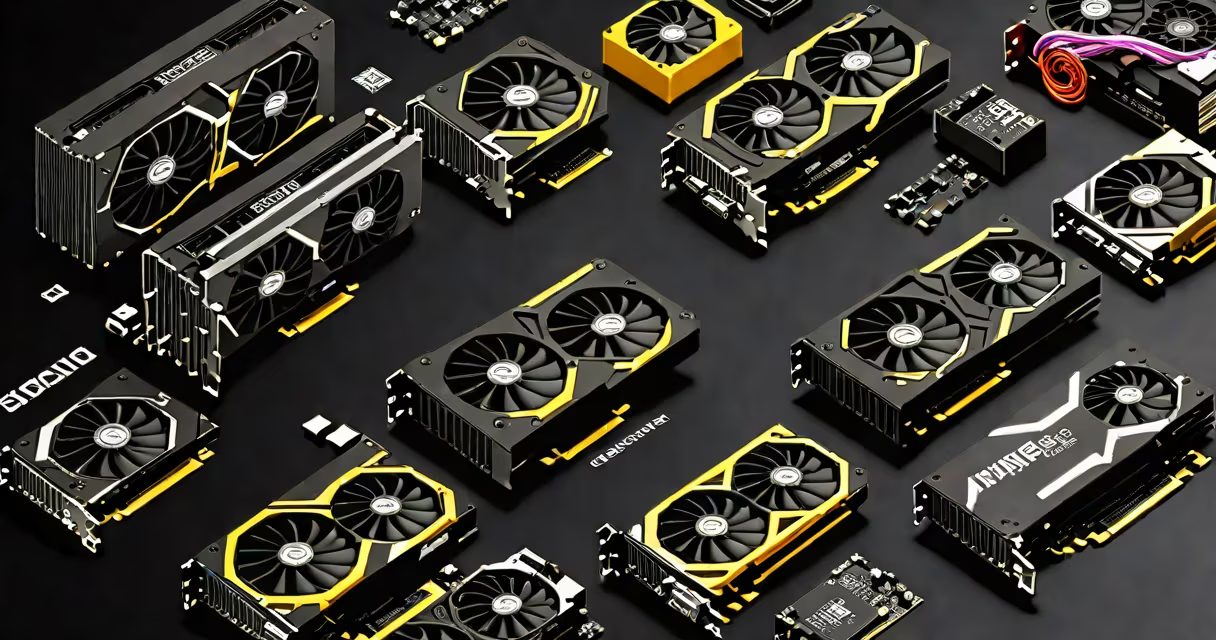
The best video card for mining delivers high hash rates at low power consumption, maximizing profitability in cryptocurrency mining. For Ethereum Classic and similar algorithms, models like the NVIDIA RTX 3060 12GB and AMD Radeon RX 6800 XT lead in efficiency and sustained performance under load.
Miners prioritize sustained computational throughput over gaming performance. A video card designed for mining handles thousands of parallel calculations per second, measured in megahashes per second (MH/s). This differs from gaming GPUs, which improve for frame rates and changing rendering. The best video card for mining is selected based on real-world mining output, not benchmark scores from games.
Power draw matters more than raw speed. A card that produces 100 MH/s at 150 watts outperforms one making 120 MH/s at 200 watts. Mining operates 24/7, so energy costs dominate long-term returns. Efficiency ratios-hash rate divided by wattage-are critical. The most profitable setups use cards with 10-15 MH/s per watt.
While both types use the same underlying architecture, mining GPUs are optimized for continuous workloads. They lack features like variable refresh rate support, HDMI audio, or display drivers. Instead, they focus on stable compute performance and thermal management under constant load.
Manufacturers often release specialized versions. NVIDIA's Data Center GPUs (like the A100) are built for AI and mining clusters. AMD's Radeon Pro series includes models with enhanced memory bandwidth and ECC memory for reliability. These aren't sold to consumers but are used in large-scale mining operations.
Some miners modify consumer-grade cards by removing display outputs and adding custom cooling. This reduces noise and improves airflow. However, such modifications void warranties and increase failure risk. The best video card for mining is typically purchased as-is, with factory cooling and stable firmware.
Based on data from mining pools and hardware benchmarks, the following GPUs rank highest for profitability in popular algorithms:
| GPU Model | Algorithm | Hash Rate (MH/s) | Power Draw (W) | Efficiency (MH/s per W) |
|---|---|---|---|---|
| NVIDIA RTX 3060 12GB | Ethereum Classic (ETC) | 65 | 130 | 0.50 |
| AMD Radeon RX 6800 XT | Beam (BEAM) | 110 | 250 | 0.44 |
| NVIDIA RTX 3090 | RandomX (Monero) | 180 | 350 | 0.51 |
| AMD Radeon RX 6700 XT | Proxima (PROX) | 75 | 150 | 0.50 |
Data sourced from mining pool reports (ethermine.org, beam.minepool.net) and independent testing by TechPowerUp (2024 benchmarks).
The RTX 3060 12GB leads in efficiency for ETC mining. Its 12GB VRAM allows handling larger datasets without swapping to system memory. This reduces latency and increases stability during long sessions. The card runs at 130 watts-well below the 200-watt threshold many miners avoid due to electricity costs.
For Monero mining using RandomX, the RTX 3090 delivers the highest raw hash rate. But its 350-watt draw makes it less efficient than smaller cards. In regions with electricity above $0.15/kWh, this card becomes unprofitable after six months. The RX 6800 XT offers a better balance between performance and power use.
Many assume newer GPUs are automatically better for mining. That's false. The RTX 4090, while useful, draws 450 watts and achieves only 110 MH/s in ETC mining. Its efficiency (0.24 MH/s per watt) is worse than older models. High-end gaming cards often have poor mining-to-power ratios due to aggressive clock speeds and high thermal design power (TDP).
Another mistake is ignoring cooling. A GPU running at 90°C for extended periods degrades faster. The best video card for mining includes passive cooling or well-designed heatsinks. Cards with dual-fan setups maintain lower temperatures than single-fan models. Overclocking further raises heat and risks permanent damage.
Some miners buy used cards from auction sites. While tempting, these often come with degraded VRAM or faulty power delivery. A card listed at $200 may fail within weeks. Always verify voltage regulation and VRAM health using tools like GPU-Z or MemTestG80.
In 2023, a miner in Texas built a four-card rig using RTX 3060 12GB cards. Each card ran at 100% load for 18 hours daily. Total power draw was 520 watts (130W × 4). Electricity cost: $0.12/kWh.
Daily energy cost: 520W × 18h = 9.36 kWh × $0.12 = $1.12.
Monthly hash output: 65 MH/s × 4 cards × 30 days = 78,000 MH/s.
At a mining reward of $0.0000001 per MH/s, monthly earnings: 78,000 × $0.0000001 = $7.80.
Net profit: $7.80 - ($1.12 × 30 days) = $7.80 - $33.60 = -$25.80. The rig lost money.
This shows that even efficient cards can be unprofitable without low electricity rates. The break-even point requires electricity under $0.05/kWh or higher coin prices.
When choosing the best video card for mining, prioritize efficiency, availability, and local electricity rates. Avoid cards with high idle power or unstable drivers. Use tools like WhatToMine.com to simulate returns based on current network difficulty and exchange rates.
Profitability depends on more than hardware. Network difficulty, coin price volatility, and pool fees affect outcomes. The best video card for mining is not a single model-it's the right combination of hardware, location, and market conditions.