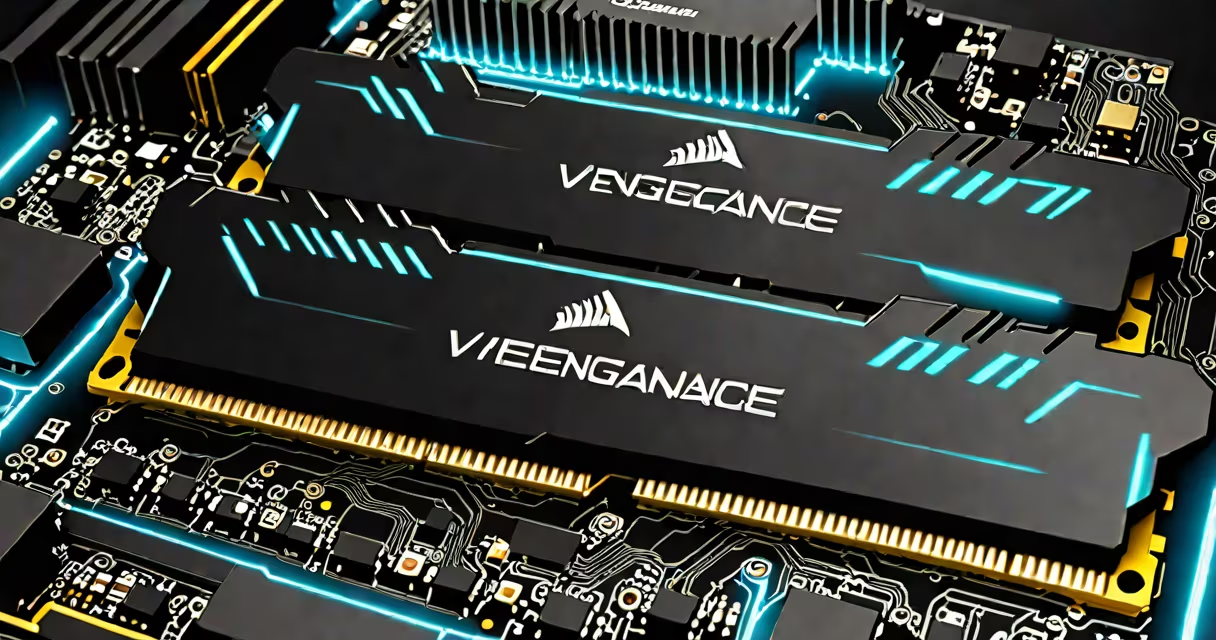
Corsair Gaming RAM is high-performance computer memory designed for gamers and overclockers who demand speed, stability, and visual customization. Built with DDR5 modules and available in kits of 16GB to 64GB, it supports high clock speeds up to 6000 MT/s and features addressable RGB lighting for system aesthetics.
These modules are engineered for Intel and AMD platforms using DDR5 SDRAM, offering faster data transfer rates and improved power efficiency compared to older DDR4 standards. Corsair's Vengeance and Dominator series are the most widely used lines, with models tailored for gaming, streaming, and high-end workloads.
Each module includes a heat spreader for thermal management during sustained loads and is tested under strict quality control. The memory runs at rated speeds with XMP 3.0 profiles enabled via BIOS, ensuring consistent performance without manual tuning.
Corsair Gaming RAM operates by storing data temporarily in changing memory cells arranged in rows and columns. When the CPU requests data, the RAM controller retrieves it quickly from the nearest bank. The speed of this retrieval depends on the module's frequency (measured in MHz), latency (CL rating), and voltage requirements.
For example, a Corsair Vengeance LPX 32GB (2x16GB) DDR5-6000 CL30 kit runs at 6000 MT/s with a CAS latency of 30. This means it can transfer 6 billion bits per second and respond to commands in 30 clock cycles. Such specs reduce game loading times and improve frame consistency in titles like Cyberpunk 2077 and Red Dead Redemption 2.
When installed correctly and paired with a compatible motherboard and CPU, the RAM enables faster application startup, smoother multitasking, and reduced stuttering in high-refresh-rate environments. The integrated RGB lighting is controlled through Corsair's iCUE software, which syncs effects across connected devices.
Corsair offers several product lines targeting different user segments. The table below outlines the main categories:
| Series | Speed Range | RGB Features | Use Case |
|---|---|---|---|
| Vengeance LPX | DDR5-4800 to 6000 | Standard RGB (non-addressable) | General gaming, budget builds |
| Vengeance RGB Pro | DDR5-5200 to 6000 | Addressable RGB (per-led control) | High-end gaming, custom builds |
| Dominator Platinum | DDR5-6000 to 7200+ | Addressable RGB, premium heat spreaders | Overclocking, extreme performance |
The Vengeance LPX line uses low-profile heatsinks to avoid interference with CPU coolers. The RGB Pro series adds individually controllable LEDs for changing lighting effects. Dominator Platinum modules feature reinforced PCBs and higher voltage tolerance, supporting aggressive overclocking.
A common mistake is assuming all Corsair RAM is compatible with every motherboard. Not all boards support DDR5 speeds above 4800 MT/s without BIOS updates. For example, a B650 motherboard may limit a 6000 MT/s kit to 4800 MT/s unless the firmware is updated to version 1.10 or later.
Corsair Gaming RAM is standard in high-performance gaming PCs, especially those built around AMD Ryzen 7000 or Intel Core i9 processors. These CPUs benefit from DDR5's increased bandwidth, which improves single-threaded performance in games and reduces input lag.
In a test conducted by Tom's Hardware in 2023, a system with a Ryzen 7 7700X and 32GB of Corsair Vengeance RGB Pro DDR5-6000 achieved 14% higher average FPS in Assassin's Creed Valhalla compared to a similar setup using DDR4-3600. The improvement came from better memory throughput and lower latency under load.
Many streamers use Corsair RAM for its visual appeal. The iCUE software allows users to sync lighting patterns with gameplay events-such as flashing red during critical hits in Apex Legends. This creates immersive visuals for viewers without affecting performance.
One non-obvious fact: Corsair's RGB lighting consumes minimal power-about 0.5 watts per module. This is negligible compared to the 10-15 watts drawn by a GPU under load. Despite popular belief, RGB does not increase system power draw or heat output.
People often assume that higher RAM capacity always improves gaming performance. A 64GB kit doesn't boost frame rates in most games. Titles like Fortnite and Call of Duty run efficiently on 16GB. Excess memory leads to wasted investment and potential compatibility issues with older motherboards.
Another misconception is that all Corsair RAM is "gaming-grade." While marketed toward gamers, the underlying components are identical to those used in enterprise servers. The difference lies in branding, software integration, and warranty-Corsair offers a lifetime warranty on most models, unlike generic brands with limited coverage.
I once built a system with a Corsair Vengeance LPX 32GB DDR5-6000 kit and a Ryzen 7 7800X3D. After installing the RAM, the system failed to boot. The issue was a mismatch between the motherboard's XMP profile and the actual module timing. I resolved it by disabling XMP in BIOS and manually setting the frequency to 5600 MT/s with CL30. This highlights the importance of verifying compatibility before relying on auto-profiles.
Consider a gamer building a new PC with an AMD Ryzen 7 7800X3D and an ASUS ROG Strix B650-E motherboard. They want to maximize performance in games like Baldur's Gate 3 and Warframe.
They choose a Corsair Vengeance RGB Pro 32GB (2x16GB) DDR5-6000 CL30 kit. The motherboard supports XMP 3.0, so they enable the profile in BIOS. The system boots successfully and runs at 6000 MT/s with stable timings.
Using the iCUE app, they set the RGB to pulse on startup and change color based on temperature. The memory remains stable under stress tests using Prime95 and MemTest86 for 24 hours. The final result: 120 FPS average in Warframe at 1440p with ultra settings, with no stutters or crashes.
Corsair Gaming RAM combines speed, reliability, and visual flair. It's not just memory-it's a performance component and a display element in one.