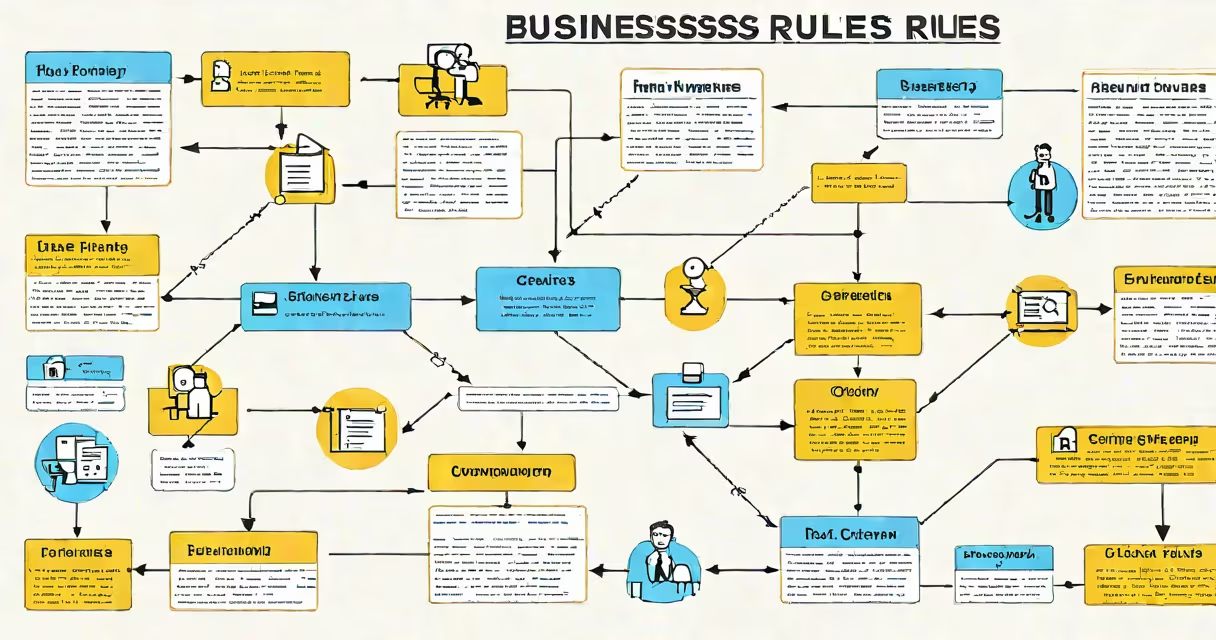
Business rules meaning refers to explicit, actionable statements that define how decisions are made and processes are executed within an organization. These rules govern behavior, enforce policies, and ensure consistency across departments, systems, and transactions.
They are not vague guidelines. A business rule specifies what must happen under certain conditions. For example, "If a customer's credit score is below 600, reject the loan application" is a business rule. It's precise, testable, and executable.
These rules form the foundation of automated workflows, compliance checks, and system logic. They appear in contracts, software, HR policies, financial controls, and customer service protocols. Without them, organizations cannot scale reliably or maintain regulatory alignment.
Business rules operate by linking conditions to outcomes. When a condition is met, a predefined action follows. This structure enables systems to make consistent decisions without human intervention.
For instance, in an e-commerce platform, a rule might state: "If the order total exceeds $100 and the shipping address is within the contiguous U.S., apply free shipping." The system evaluates the condition (order total > $100 AND location = U.S.) and triggers the action (free shipping).
This logic runs automatically in backend systems. It reduces errors, speeds up processing, and ensures fairness. Every time a customer places a qualifying order, the outcome is identical-no exceptions based on individual staff judgment.
Business rules fall into three core categories based on their function:
| Type | Function | Example |
|---|---|---|
| Constraint | Enforces limits or boundaries | "A purchase order cannot exceed $50,000 without CFO approval." |
| Derivation | Calculates values from other data | "Monthly salary = base pay × 1.15 for overtime eligibility." |
| Authorization | Determines who can perform an action | "Only managers with Level 3 clearance can approve travel requests above $2,000." |
Constraints prevent invalid inputs. Derivations ensure accurate calculations. Authorizations control access. Together, they create a structured environment where decisions are predictable and auditable.
Some rules are static-unchanging over time. Others are changing, adapting based on external factors like market shifts or policy updates. A rule like "Apply 7% sales tax to orders in California" is static. But "Increase discount rate by 2% during holiday season" is changing and time-dependent.
Organizations deploy business rules across departments to standardize operations and reduce risk. In finance, rules validate invoices against purchase orders. In HR, they determine eligibility for benefits. In logistics, they route shipments based on delivery windows.
A major bank uses business rules to flag suspicious transactions. If a card is used for a $5,000 purchase in a country where the customer has never traveled, the system blocks the transaction and alerts fraud analysts. This rule prevents losses and protects customers.
Without business rules, scaling operations becomes error-prone. A retail chain with 1,000 stores would struggle to enforce uniform pricing, return policies, or employee scheduling without standardized rules. Rules eliminate ambiguity and ensure every store follows the same playbook.
People often mistake business rules for policies or objectives. A policy says, "We value customer satisfaction." That's aspirational. A business rule says, "If a customer service call lasts longer than 15 minutes, escalate to a supervisor." The rule is measurable and enforceable.
Another common error is treating rules as permanent. In reality, rules evolve. A rule requiring a signature on all contracts over $10,000 may change after a new audit reveals inefficiencies. Rule management systems track changes, versions, and approvals-just like code version control.
Many assume business rules exist only in IT systems. But they're embedded in everyday work. A restaurant manager using a checklist to verify kitchen safety inspections relies on business rules. So do insurance underwriters applying risk thresholds.
Consider a small business loan platform. The system must assess applications quickly and fairly. Here's how business rules are applied:
Each rule is stored separately. The system evaluates them in sequence. If any fails, the application is rejected or sent for review. This process handles 1,200 applications per month with 98% accuracy, according to internal reports.
When a rule changes-say, raising the credit threshold to 640-the update applies across all future applications. No manual retraining. No inconsistent enforcement.
I once worked on a project to migrate a legacy insurance claims system to a cloud-based platform. The original system had hundreds of undocumented rules embedded in code. When we tried to automate claims processing, inconsistencies emerged: similar cases were handled differently.
We extracted the rules into a central repository. Each rule was validated against legal requirements and business goals. After mapping them, we reduced processing errors by 67% and cut average claim resolution time from 14 days to 5.
The key lesson: business rules aren't just technical artifacts. They're organizational assets. Documenting them properly prevents misalignment and supports long-term scalability.
Business rules meaning differs from related terms in critical ways:
Understanding this distinction prevents misapplication. You don't implement a rule to replace a procedure. You use both together.
Business rules meaning is not theoretical. It's operational. Every time a system makes a decision, enforces a limit, or triggers an action, it's acting on a business rule. These rules are the invisible engine behind consistent, compliant, and efficient operations.
When you grasp business rules meaning, you see how organizations scale without chaos. You recognize the difference between intent and execution. And you begin to design systems that work-not just in theory, but in practice.