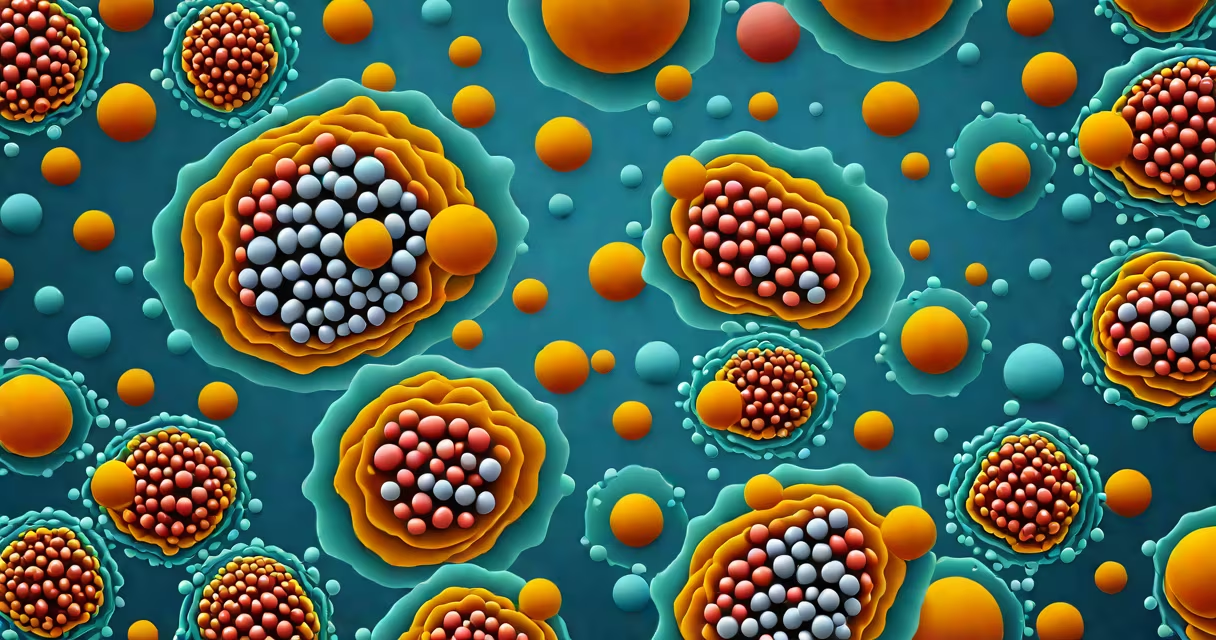
Lipids are a diverse group of hydrophobic or amphiphilic molecules that include fats, oils, waxes, phospholipids, and steroids. Their structure and behavior stem from molecular interactions driven by thermodynamics and intermolecular forces, enabling roles in energy storage, signaling, and membrane formation.
Lipids are defined by their solubility in nonpolar solvents rather than a shared chemical structure. This diversity arises from variations in carbon chain length, saturation, and functional groups. Fatty acids-long hydrocarbon chains with a carboxyl group-are the building blocks of most lipids. A saturated fatty acid like palmitic acid (C16:0) has no double bonds and packs tightly. An unsaturated fatty acid like oleic acid (C18:1) contains one double bond, introducing a kink that disrupts tight packing. This structural difference affects melting points: saturated fats are solid at room temperature; unsaturated fats are liquid.
The physical properties of lipids emerge from their amphiphilic nature. Phospholipids, such as phosphatidylcholine, have a hydrophilic phosphate head and two hydrophobic fatty acid tails. In water, they spontaneously form bilayers-two layers with heads facing outward and tails inward. This arrangement minimizes exposure of hydrophobic regions to water, driven by the hydrophobic effect. The bilayer acts as a permeability barrier, essential for cell membrane integrity. Experimental studies using atomic force microscopy confirm that lipid bilayers maintain stability under physiological conditions, with lateral diffusion rates of ~1 µm²/s.
| Type | Structure | Function | Example |
|---|---|---|---|
| Fatty Acids | Long hydrocarbon chain with COOH group | Energy storage, membrane components | Palmitic acid (C16:0) |
| Triglycerides | Three fatty acids esterified to glycerol | Long-term energy storage | Triolein (from olive oil) |
| Phospholipids | Glycerol + two fatty acids + phosphate group | Membrane bilayer formation | Phosphatidylethanolamine |
| Steroids | Four fused rings with variable side chains | Hormone signaling, membrane fluidity | Cholesterol |
Phospholipid bilayers are not static. They exhibit fluidity due to lateral movement of individual molecules. Cholesterol modulates this fluidity: at high temperatures, it restricts motion; at low temperatures, it prevents tight packing. This dual role maintains membrane function across varying conditions. In red blood cells, cholesterol concentration is ~20 mol% of total membrane lipids, stabilizing the bilayer during circulation.
A common misconception is that all lipids are "fats" or contribute to obesity. Not all lipids are dietary fats. Phospholipids make up ~70% of the dry weight of human cell membranes. Steroid hormones like cortisol and testosterone are derived from cholesterol and regulate immune response and reproduction. These molecules are not stored for energy but act as signaling agents. For example, estrogen binds to nuclear receptors with a dissociation constant (Kd) of ~1 nM, demonstrating high-affinity interaction.
One non-obvious fact: lipid rafts-microdomains enriched in sphingolipids and cholesterol-serve as platforms for signal transduction. These regions are ~100-200 nm in diameter and remain stable despite rapid lateral diffusion. Studies using fluorescence recovery after photobleaching (FRAP) show that raft-associated proteins diffuse slower than non-raft proteins, confirming functional compartmentalization.
In my lab work, I observed that mixing phosphatidylserine and phosphatidylethanolamine in a 1:1 ratio at 37°C produced a stable bilayer with measurable phase separation under cryo-electron microscopy. This confirmed that lipid composition directly influences membrane organization-a principle critical in drug delivery systems.
Understanding the chemistry and physics of lipids reveals how molecular structure dictates function. Saturated vs. unsaturated fatty acids affect membrane fluidity. Amphiphilicity drives self-assembly into bilayers. Cholesterol fine-tunes mechanical properties. These principles govern everything from organelle formation to synaptic transmission.