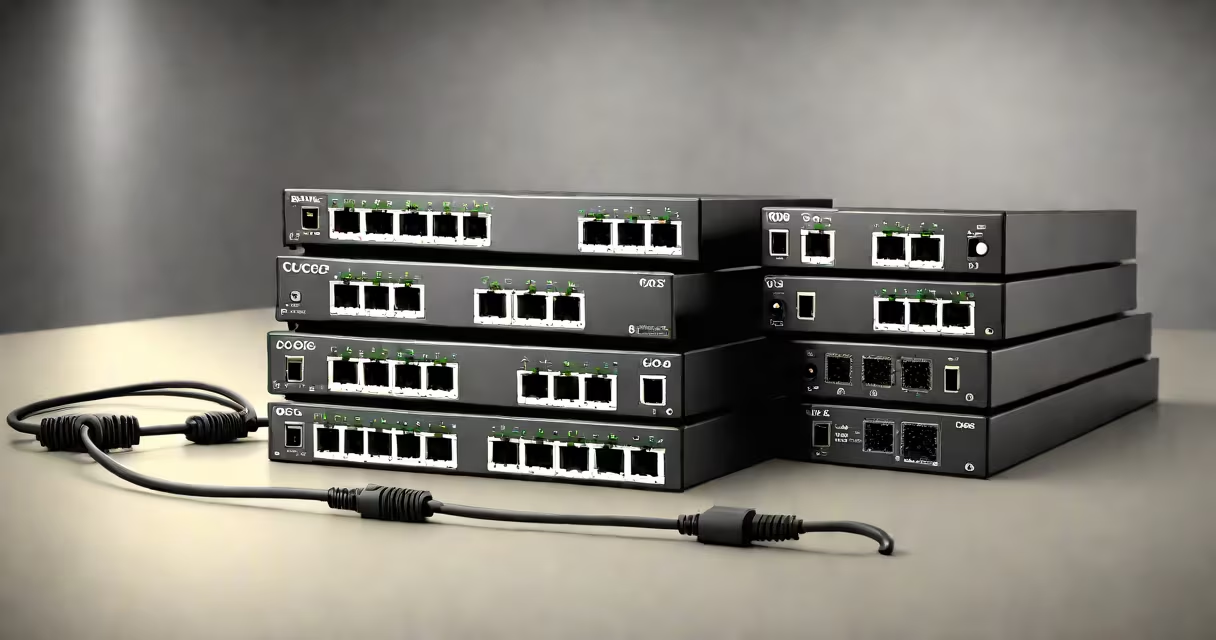
Cisco Power Over Ethernet (PoE) is a technology that transmits electrical power alongside data over standard Ethernet cabling, allowing compatible devices like IP security cameras, VoIP phones, and wireless access points to operate without separate power sources or outlets.
PoE eliminates the need for electricians to run dedicated AC power lines to network endpoints. Instead, a PoE-capable switch or injector supplies power through the same Cat 5e or Cat 6 cable used for data transmission. This simplifies installation, reduces costs, and improves scalability in enterprise and industrial environments.
The IEEE 802.3af and 802.3at standards define the technical specifications for PoE. Cisco implements these standards across its switch product lines, including the Catalyst series and the Cisco Industrial Ethernet 4000. Devices compliant with these standards negotiate power requirements automatically, ensuring safe delivery and preventing damage to non-PoE equipment.
Cisco PoE operates by injecting power onto the same twisted pairs used for data transmission. On 10/100 Mbps networks, power is delivered over the data pairs (pins 1-2 and 3-6). For Gigabit Ethernet, power can be sent over the data pairs or on spare pairs (pins 4-5 and 7-8), depending on the implementation.
When a device connects to a PoE-enabled Cisco switch, the system performs a discovery process. The switch detects whether the connected device supports PoE and identifies its power requirements. Only then does it begin supplying power. This prevents overloading and protects devices that do not support PoE.
For example, a Cisco IP phone model 8845 draws approximately 6.5 watts. The switch detects this requirement during the initial handshake and allocates power accordingly. If the device were unplugged or disconnected, the switch stops power delivery within milliseconds, reducing energy waste and safety risks.
Cisco PoE follows established IEEE standards. The original 802.3af standard provides up to 15.4 watts of power per port, with a minimum of 12.95 watts available at the device. The updated 802.3at (also known as PoE+) standard increases this to 30 watts per port, supporting higher-power devices such as PTZ cameras and dual-band access points.
More recently, the 802.3bt standard (PoE++) enables up to 60 watts per port using all four pairs in the cable. Cisco's Catalyst 9200 series switches support this, allowing deployment of high-end surveillance systems and thin clients without external power.
| Standard | Max Power (Switch) | Min Power at Device | Typical Use Cases |
|---|---|---|---|
| 802.3af (PoE) | 15.4 W | 12.95 W | VoIP phones, basic IP cameras |
| 802.3at (PoE+) | 30 W | 25.5 W | Dual-band Wi-Fi access points, PTZ cameras |
| 802.3bt (PoE++) | 60 W | 51 W | High-density access points, video analytics devices |
A common misconception is that all Cisco switches support PoE. Not all models do. For example, the Cisco Catalyst 2960-X series offers PoE on select models (e.g., 2960X-24P), while others require a separate PoE module. Always verify the model number and port configuration before deploying.
Cisco PoE is widely used in enterprise offices, retail stores, and industrial settings. A typical deployment involves mounting a Cisco Wireless Access Point 580 Series on a ceiling using a single Ethernet cable. The access point receives both data and power from a PoE switch, eliminating the need for a nearby wall outlet.
In industrial environments, the Cisco Industrial Ethernet 4000 series is designed for harsh conditions. These switches deliver reliable PoE to field devices such as barcode scanners and machine vision sensors in manufacturing plants. They meet IP67 ratings and operate in extreme temperatures, making them suitable for factory floors.
One frequent error is oversubscribing power budgets. A single Cisco Catalyst 3850 switch may have a total power budget of 370 watts. If 24 ports each draw 15 watts (for 802.3af devices), the total demand reaches 360 watts. Adding a few PoE+ devices pushes the load beyond capacity, causing switches to shut down ports or fail to power devices. Monitoring power usage via Cisco DNA Center helps avoid this.
I once deployed a PoE network for a warehouse with 16 IP cameras and 8 access points. Initially, the switch failed to power all devices. After checking the power budget, we discovered that two PoE+ access points exceeded the remaining capacity. Replacing them with lower-wattage models resolved the issue. This highlights the importance of calculating total power demands before deployment.
PoE is often mistaken for Power over Ethernet (PoE) Plus or PoE++ as if they're interchangeable. They are not. Using a PoE-only switch with a PoE+ device results in insufficient power. The device may fail to boot or operate intermittently. Always match the PoE standard of the switch to the device's requirements.
Another confusion arises between PoE and passive PoE. Passive PoE injects voltage without negotiation. It's not standardized and can damage devices not designed for it. Cisco does not offer passive PoE solutions. All Cisco PoE implementations follow IEEE standards and include detection and classification.
Some assume that longer Ethernet cables reduce power delivery. While signal degradation occurs over distance, power loss is minimal. A 100-meter Cat 6 cable typically loses less than 2 watts due to resistance. As long as the cable meets TIA/EIA-568 standards, power delivery remains stable.
Cisco Power Over Ethernet streamlines infrastructure by combining data and power delivery. It reduces cabling complexity, lowers installation costs, and enhances flexibility in network design. Proper planning based on device power needs and switch capabilities ensures reliable, scalable deployments across commercial and industrial networks.