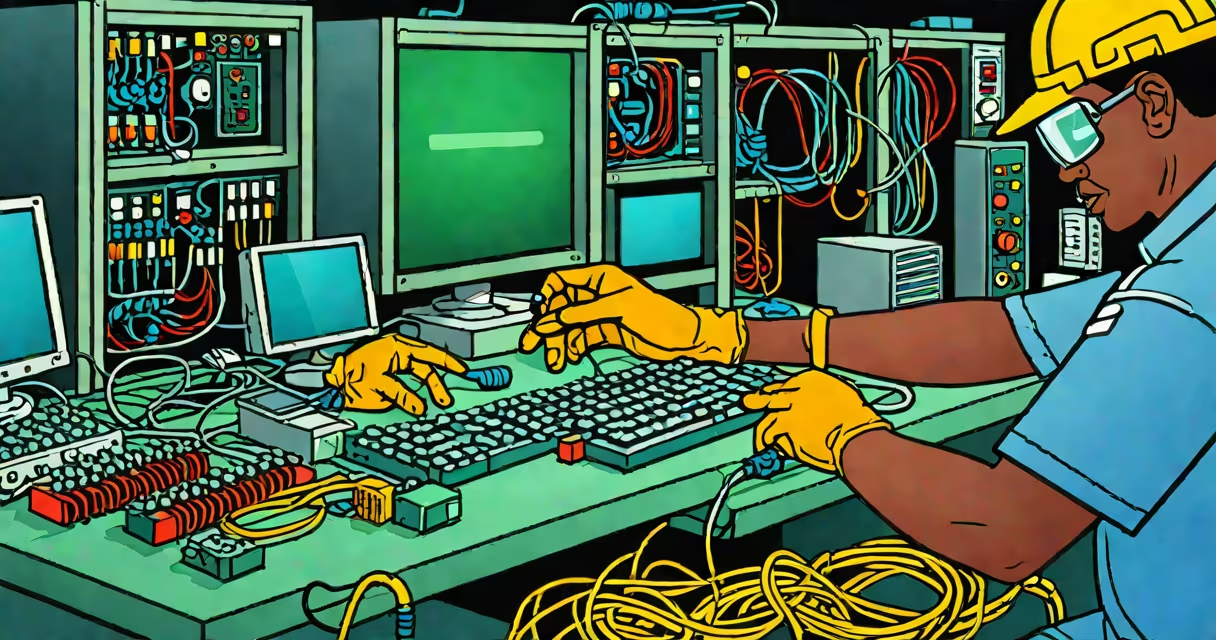
Computer service technician training equips individuals with the technical knowledge and practical skills needed to install, maintain, repair, and troubleshoot computer systems, networks, and peripheral devices. This training combines classroom instruction with hands-on lab work to prepare learners for entry-level roles in IT support and hardware maintenance.
Training programs focus on core competencies such as diagnosing hardware failures, configuring operating systems, managing local area networks (LANs), and handling customer service interactions. Most curricula include modules on electrical safety, component identification, BIOS/UEFI setup, and data backup procedures. Programs typically last between six months and two years, depending on intensity and delivery format-on-campus, online, or hybrid.
According to the U.S. Bureau of Labor Statistics, demand for computer support specialists, including service technicians, is projected to grow 8% from 2022 to 2032-faster than average for all occupations. This growth stems from increasing reliance on digital infrastructure across industries, from healthcare to finance.
Effective training blends theory with practice. Learners begin with foundational topics like digital logic, memory architecture, and power supply functions. They then progress to installing and upgrading components such as CPUs, RAM, SSDs, and GPUs. Each session includes guided disassembly and reassembly of desktop systems to build muscle memory and reduce error rates during real repairs.
Labs simulate common failure scenarios. For example, students may be tasked with restoring a system that fails to boot due to a corrupted bootloader. They learn to use diagnostic tools like POST beep codes, multimeters, and firmware update utilities. These exercises teach systematic troubleshooting rather than guesswork.
A real-world example: At a community college in Portland, Oregon, students in the computer service technician program were assigned to repair 15 donated laptops within four weeks. Each machine had a different issue-failing hard drives, oxidized ports, or misconfigured BIOS settings. By the end, they documented each fix using a standardized form, which mirrored documentation standards used by enterprise IT departments.
Programs vary in structure and focus. The most common formats include:
| Type | Duration | Focus Areas | Typical Credential |
|---|---|---|---|
| Vocational certificate | 6-12 months | Hardware repair, basic networking, OS installation | CompTIA A+ certification prep |
| Associate degree | 2 years | Advanced diagnostics, security fundamentals, scripting basics | Associate of Applied Science (AAS) |
| On-the-job apprenticeship | 12-24 months | Field service, client interaction, equipment logistics | Employer-issued credential |
CompTIA A+ is widely recognized as the industry benchmark for entry-level IT support. It covers hardware, software, mobile devices, and security. Passing both exams requires demonstrating proficiency in tasks like replacing a CMOS battery or resolving a network connectivity issue caused by a misconfigured DHCP setting.
Non-obvious fact: Many employers prioritize hands-on experience over formal credentials. A 2023 survey by CompTIA found that 67% of hiring managers value practical problem-solving ability over exam scores when evaluating candidates for technician roles.
Computer service technician training is often confused with software development or cybersecurity training. While overlap exists-especially in scripting and system administration-these paths differ in focus. Software developers design applications; technicians maintain existing systems. Cybersecurity professionals defend networks from threats; technicians ensure devices operate reliably.
Another misconception is that training is purely technical. In reality, communication skills are critical. Technicians frequently explain complex issues to non-technical users. A study published in the Journal of Information Technology Education (2022) showed that 44% of service delays stemmed from poor user communication, not hardware faults.
I once observed a student in a live lab session struggle to diagnose a laptop that wouldn't charge. After checking the charger and port, he realized the battery was physically swollen-a sign of degradation. He reported the issue to the instructor, who noted that the student's written report included both technical details and plain-language explanations for a client. That balance is essential in real environments.
Training is delivered through community colleges, trade schools, private technical institutes, and corporate-sponsored programs. Some large organizations, like Dell and HP, offer certified technician training as part of their partner programs. These allow individuals to earn vendor-specific credentials while gaining access to specialized tools and support networks.
Industries that rely heavily on computer service technicians include education, government agencies, healthcare providers, and small-to-midsize businesses. In hospitals, for example, technicians maintain patient record systems and imaging equipment. A single server outage can delay diagnoses, making rapid response essential.
For those entering the field, consistent practice matters. One student in a California program completed 120 hours of lab time over eight weeks. During that period, he repaired 37 individual machines-ranging from desktops to embedded kiosks. His final project involved building a custom workstation for a local nonprofit, which required sourcing parts, assembling the system, and configuring it for accessibility features.
After completing training, graduates often pursue certifications like CompTIA A+, Network+, or Microsoft Certified: Modern Desktop Administrator. These validate skills and improve job prospects. According to the National Center for Education Statistics, 72% of graduates from accredited computer service technician programs secured employment within six months of completion.
Success in the field depends on continuous learning. Technologies evolve rapidly-new chipsets, faster storage formats, and updated security protocols emerge yearly. Staying current through ongoing education, vendor training, and peer collaboration ensures long-term relevance.
Computer service technician training is not a one-time event-it's a foundation for lifelong technical engagement. With consistent effort, learners gain the confidence and competence to solve problems, support users, and maintain the digital infrastructure that powers modern life.