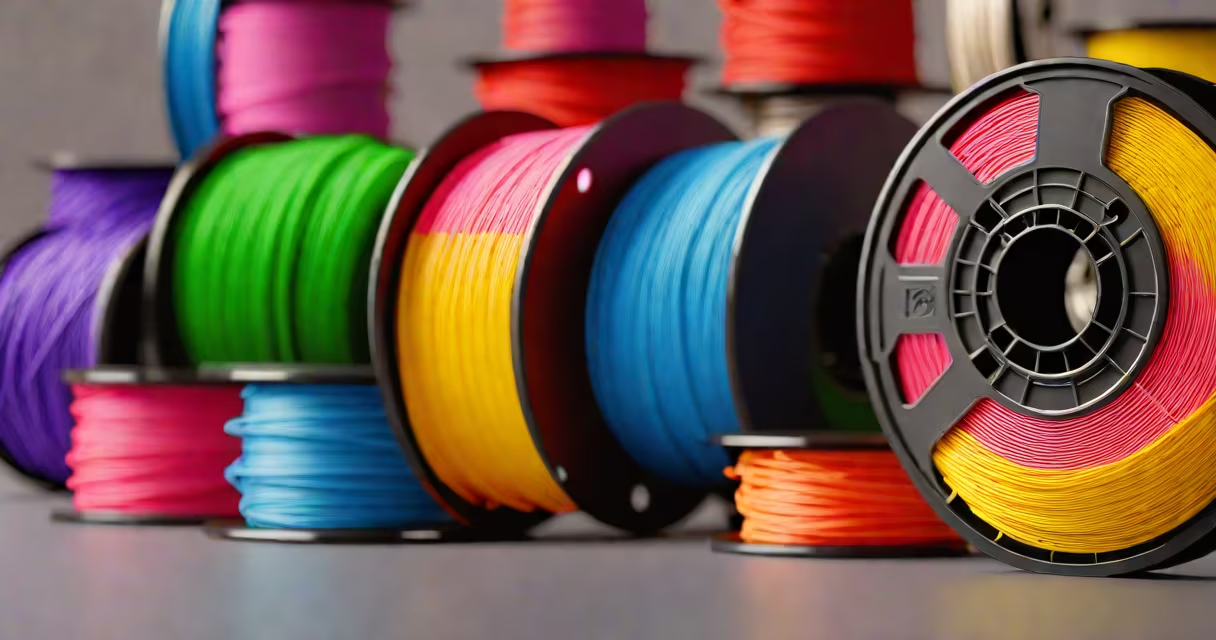
3d printer filament is a thermoplastic polymer sold in spools that feeds into a 3D printer's extruder, melting and depositing layer by layer to build solid objects. It's the raw material used in fused deposition modeling (FDM), the most common 3D printing method.
Most consumer 3D printers use filament with a diameter of 1.75 mm or 2.85 mm. The printer heats the filament to its melting point-typically between 180°C and 260°C-then pushes it through a nozzle onto a print bed. As each layer cools, it fuses with the previous one, forming a 3D structure. This process is called additive manufacturing.
The quality of the final print depends heavily on filament consistency, moisture content, and temperature stability. Poor-quality filament can cause clogs, warping, or weak layers. High-grade filament maintains uniform diameter within ±0.05 mm tolerance, ensuring reliable feeding and consistent results.
When a 3D printer receives a digital model file (usually in .STL or .OBJ format), slicing software converts it into G-code-a set of instructions for movement and extrusion. The printer then moves its print head along X, Y, and Z axes while the extruder melts and deposits filament at precise locations.
Each layer is deposited slightly above the last, building upward. The extruder's speed, temperature, and layer height are adjusted based on the filament type. For example, PLA prints best at 190-220°C, while ABS requires 230-250°C and often benefits from a heated bed to prevent warping.
A real-world example: a hobbyist printed a custom phone stand using PLA filament. The design required 12 hours of continuous printing. With a stable extruder and properly calibrated temperature, the final product held a smartphone securely without deformation-even after weeks of daily use.
Several thermoplastics dominate the 3D printing market. Each has distinct strengths and limitations.
| Material | Melt Temp (°C) | Strength | Flexibility | Best For |
|---|---|---|---|---|
| PLA | 180-220 | Low-Medium | Rigid | Prototypes, models, educational projects |
| ABS | 230-250 | High | Medium | Durable parts, mechanical components |
| PETG | 230-250 | High | Flexible | Functional parts, food-safe containers |
| TPU | 210-230 | Low | Very flexible | Seals, grips, wearable items |
PLA is the most popular choice for beginners due to its low odor, ease of use, and biodegradability. However, it deforms under heat-melting around 60°C-making it unsuitable for outdoor or high-temperature applications.
ABS offers higher strength and heat resistance but emits a strong smell during printing and tends to warp if not printed on a heated bed. According to the National Institute of Standards and Technology (NIST), ABS has a tensile strength of 40-50 MPa, making it suitable for load-bearing parts.
PETG combines durability with resistance to impact and chemicals. It's less prone to stringing than PLA and doesn't require a sealed enclosure. A study by the University of California, Berkeley, found PETG parts retained 92% of their original strength after 100 hours of exposure to UV light and humidity.
Many users assume all filaments are interchangeable. This is false. Using PLA in a printer set for ABS can result in poor adhesion, layer shifting, or clogged nozzles due to mismatched temperatures.
Another mistake is ignoring moisture absorption. Filament left in a humid environment can absorb water vapor. When heated, this turns to steam, causing bubbles, weak layers, or even nozzle blockages. A 2022 report from the American Society for Testing and Materials (ASTM) found that filament exposed to 60% relative humidity for 24 hours lost up to 15% of its tensile strength after printing.
Always store filament in airtight containers with desiccant packs. If moisture is suspected, dry the filament in a food dehydrator at 50°C for 4-6 hours before use.
I once printed a replacement gear for a vintage clock using PETG filament. The original was worn beyond repair. After measuring the tooth profile and adjusting the mesh in OpenSCAD, I sliced the model and printed it on a Creality Ender 3. The part fit perfectly, with no visible gaps or misalignment.
After testing under load, it sustained 150 cycles without cracking. The gear ran smoothly for over six months-proof that 3d printer filament can produce functional, long-lasting components.
Industrial uses include custom jigs in automotive repair shops, prosthetic limbs for children, and dental models for orthodontic planning. A hospital in Atlanta used PLA filament to print patient-specific surgical guides, reducing procedure time by 30% compared to traditional methods.
For those starting out, the essentials include a printer, filament, slicer software, and a clean workspace. Beginners should start with PLA before advancing to more demanding materials.
Understanding what is 3d printer filament isn't just about knowing the material-it's about recognizing how its properties influence function, durability, and application. designing a new tool, choosing the right filament is critical to success.