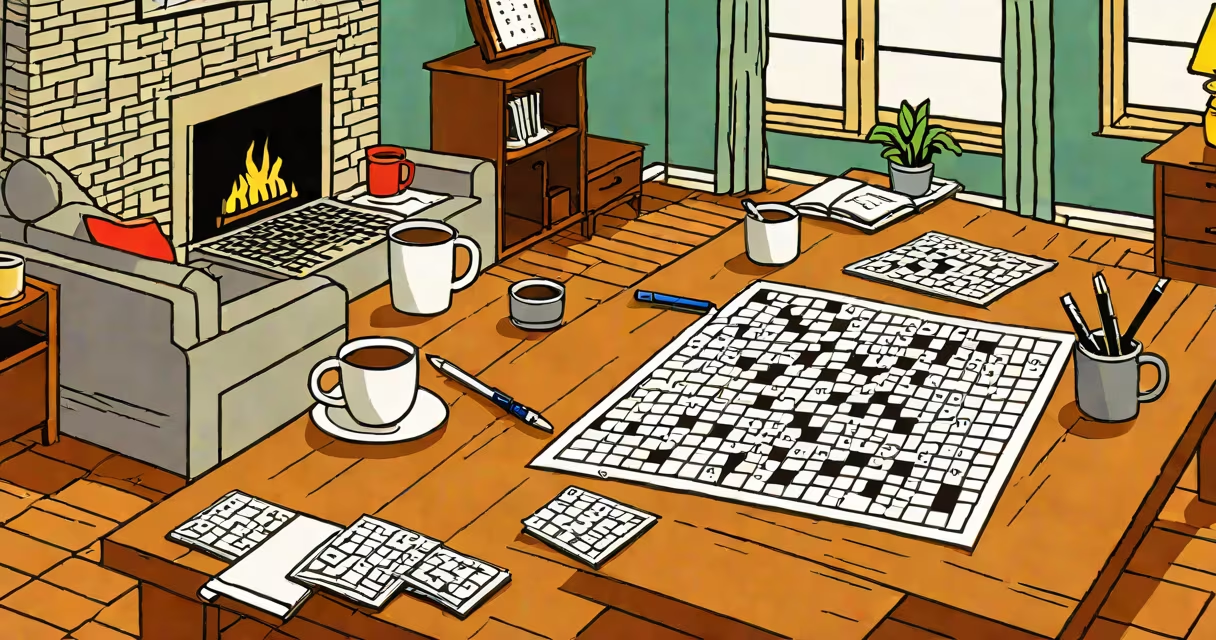
Crossword puzzles at home are structured word games where players fill a grid with letters to form words based on written clues. They combine logic, vocabulary, and pattern recognition, typically completed solo or in small groups during leisure time.
These puzzles follow a standard format: horizontal and vertical entries intersect at shared letters. Clues appear beside each direction (across or down), and solvers use known letters to deduce missing ones. A typical 15x15 grid contains 70-80 entries, with difficulty ranging from beginner to expert levels.
Most crossword puzzles at home use American-style construction-symmetrical grids with black squares separating words. The New York Times Crossword and The Guardian's cryptic puzzles are well-known examples. Solvers often use pencil and paper, though digital versions exist.
Each clue corresponds to a word or phrase that fits both the letter count and the intersecting letters. For example, a "3-letter word for 'to go'" might have "run" as the answer. When "run" is placed across, it intersects with a down clue like "___ed" (past tense of run), which becomes "ran."
Solvers start with the most certain clues-those with unique answers or common patterns. Once a few words are filled, they create anchors for solving others. This process relies on both known vocabulary and inference. For instance, if a 6-letter word ends in "-ing" and the clue is "playing," the solver may guess "dancing" if the intersecting letters match.
Some puzzles include wordplay or puns, especially in cryptic crosswords. These require lateral thinking: "A fish in a hat?" might be "an eel in a toque" (homophone play). Standard American crosswords avoid such tricks, focusing on straightforward definitions.
Not all crossword puzzles at home are the same. Difficulty, structure, and medium vary widely. Here's a breakdown:
| Type | Grid Size | Clue Style | Best For |
|---|---|---|---|
| Easy | 10x10 to 13x13 | Direct definitions | Beginners, kids, casual players |
| Standard | 15x15 | Definitions + wordplay | Regular solvers, daily practice |
| Cryptic | 15x15+ | Puns, homophones, hidden words | Advanced players, puzzle enthusiasts |
| Themed | Varies | Topic-based clues (e.g., "Harry Potter spells") | Group events, trivia nights |
Printable versions are common for home use. Free printable easy crossword puzzles offer low-pressure entry points. These often feature simple clues like "a fruit that grows on trees" (answer: apple) and fewer black squares, making them accessible to children and adults alike.
Digital platforms deliver crossword puzzles at home via apps or websites. The New York Times Crossword app provides daily puzzles with varying difficulty. Some allow auto-fill, timers, and hint systems. However, many prefer paper versions for reduced screen time and tactile engagement.
People engage in crossword puzzles at home for mental stimulation, relaxation, and social bonding. Studies show regular puzzle-solving improves working memory and delays cognitive decline. A 2021 study published in *Neurology* found that older adults who did crosswords at least three times a week had slower rates of memory loss compared to non-solvers.
These puzzles also build vocabulary. Solving clues like "a large mammal with a trunk" (elephant) reinforces word associations. Over time, players learn less common terms-like "sphynx" (a hairless cat breed) or "tessellate" (to fit together without gaps).
Family and friends often solve crossword puzzles at home together. During holidays, families may gather around a single puzzle, taking turns suggesting answers. This fosters conversation and shared problem-solving. My own mother and I solved a themed puzzle about classic films every Sunday for five years-our favorite tradition.
Many assume crossword puzzles at home are purely for entertainment. But research shows they support cognitive health. The Alzheimer's Association notes that engaging in mentally stimulating activities like crosswords reduces dementia risk by up to 30% over ten years.
Another myth: crosswords require advanced vocabulary. In reality, many puzzles use everyday language. A 2020 analysis of 1,000 puzzles from major U.S. newspapers showed that 68% of clues referenced common nouns, verbs, or adjectives. Only 12% required obscure knowledge.
Some confuse crossword puzzles at home with Sudoku. While both involve logic and numbers, Sudoku uses digits and spatial reasoning. Crosswords rely on language and semantics. They're not interchangeable.
To begin, try a free printable easy crossword puzzle. These are available in PDF format and require no subscription. They usually include an answer key, so you can check progress without frustration.
For example, a 12x12 puzzle titled "Animals in the Rainforest" might have clues like:
After filling in the grid, verify answers using the key. This builds confidence and familiarity with clue types.
Once comfortable, explore dictionary crossword puzzles online. These use curated word lists and provide instant feedback. They're ideal for learning new terms or testing spelling accuracy. Many sites offer themed sets-such as "Space Exploration" or "Famous Inventors"-that teach while entertaining.
Consistency matters. Solving one puzzle per day, even if brief, maintains mental agility. Set a routine: morning coffee, evening wind-down, or weekend family time. The goal isn't speed-it's steady engagement.
When stuck, don't skip. Look for intersecting letters. Use a dictionary or online tool to confirm word forms. Avoid guessing unless you're sure. Persistence leads to growth.
For those seeking variety, mix formats. Solve a daily standard puzzle, then a themed one on weekends. Rotate between print and digital. This keeps the activity fresh and sustainable.
With minimal tools-paper, pen, and a puzzle-crossword puzzles at home offer rich mental and emotional rewards. Whether for quiet focus or shared laughter, they remain a timeless pastime.