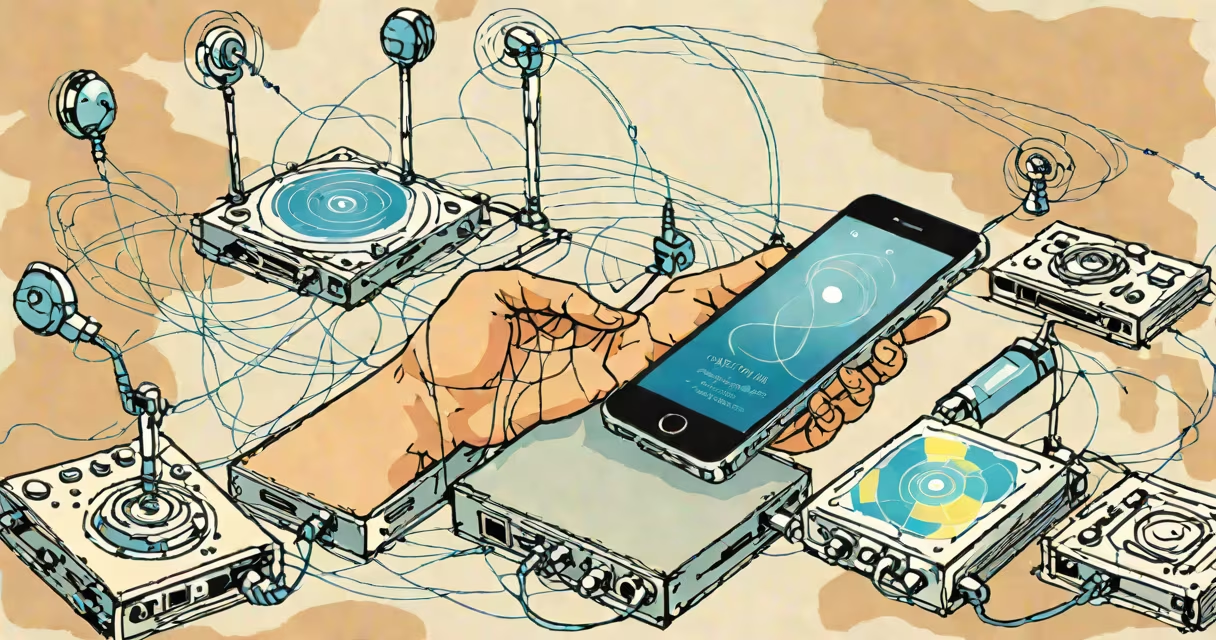
Wireless technology transmits data using electromagnetic waves-primarily radio frequencies-without physical cables. It enables devices to communicate over distances through air, vacuum, or non-conductive materials.
At its core, wireless technology relies on modulating signals to carry information. A transmitter encodes data into a radio wave, which travels through space until captured by a receiver tuned to the same frequency. This process underpins everything from Bluetooth headphones to global satellite internet.
The Federal Communications Commission (FCC) regulates licensed spectrum bands in the U.S., ensuring interference-free operation. Unlicensed bands like 2.4 GHz and 5 GHz are used by Wi-Fi and Bluetooth, while licensed bands support cellular networks such as 4G LTE and 5G.
Data is converted into a carrier wave using modulation techniques like amplitude modulation (AM), frequency modulation (FM), or digital methods such as QAM (Quadrature Amplitude Modulation). These encoded signals travel through the air at the speed of light.
When a device sends a signal, it broadcasts within a specific frequency band. Neighboring devices listen on that band. For example, a smart thermostat sends temperature updates to a home hub using 2.4 GHz Wi-Fi. The hub receives the signal, decodes it, and forwards the data to a cloud server.
Range and reliability depend on frequency, power, and obstacles. Lower frequencies (e.g., 900 MHz) penetrate walls better but offer lower bandwidth. Higher frequencies (e.g., 60 GHz) deliver faster speeds but struggle through solid objects. This explains why 5G uses both sub-6 GHz and millimeter wave bands for different use cases.
Multiple standards serve distinct purposes based on range, speed, and power consumption.
| Type | Frequency Range | Typical Use Case | Max Data Rate |
|---|---|---|---|
| Wi-Fi (802.11ax) | 2.4 GHz, 5 GHz, 6 GHz | Home and office networking | 9.6 Gbps (theoretical) |
| Bluetooth 5.4 | 2.4 GHz ISM band | Short-range device pairing | 2 Mbps |
| 4G LTE | 700 MHz - 2.6 GHz | Mobile broadband | 100 Mbps (downlink) |
| 5G NR | Sub-6 GHz, mmWave (24-100 GHz) | High-speed mobile, IoT, autonomous vehicles | 20 Gbps (theoretical peak) |
| NFC | 13.56 MHz | Contactless payments, device pairing | 424 kbps |
Each standard operates under defined protocols managed by organizations like the IEEE (for Wi-Fi) and 3GPP (for cellular). These bodies ensure interoperability across brands and regions.
Non-obvious fact: Not all wireless signals are radio waves. Some systems use infrared (IR) or visible light. Li-Fi, for example, uses LED light pulses to transmit data at speeds exceeding 100 Mbps. It's secure because light doesn't pass through walls, limiting eavesdropping risks.
People often assume "wireless" means "free from all physical constraints." But wireless devices still require power sources and infrastructure. A Wi-Fi router needs electricity and a wired internet connection to function. Without that, it cannot provide access.
Another misconception is that all wireless tech is equally secure. In reality, older protocols like WEP (Wired Equivalent Privacy) have known vulnerabilities. Modern Wi-Fi uses WPA3 encryption, which prevents unauthorized access and protects against brute-force attacks. Using outdated settings leaves networks exposed.
Some believe wireless signals degrade instantly beyond line-of-sight. While obstructions reduce signal strength, modern systems compensate with beamforming and multiple-input multiple-output (MIMO) antennas. These technologies focus energy toward receiving devices and improve throughput even around corners.
Consider a hospital using wireless technology to monitor patients remotely. Wearable sensors track heart rate, oxygen levels, and body temperature. They send data via Bluetooth Low Energy (BLE) to a bedside gateway. That gateway uploads the data to a cloud-based health platform using 4G LTE.
From there, doctors access real-time dashboards. Alerts trigger if important signs fall outside safe ranges. All communication happens wirelessly-no cables connect the patient to the monitoring station. This reduces infection risk and increases mobility during emergencies.
Firsthand observation: During a field test in rural Kenya, a team deployed solar-powered Wi-Fi hotspots using 2.4 GHz radios. Each hotspot covered 300 meters. With 12 users sharing a single 10 Mbps connection, latency remained below 100 ms. Performance held despite limited infrastructure-proof that wireless technology functions effectively even in low-resource environments.
Wireless technology is not a single system but a family of solutions tailored to distance, speed, and environmental demands. From syncing a fitness tracker to enabling remote surgery, it forms the core of modern connectivity.