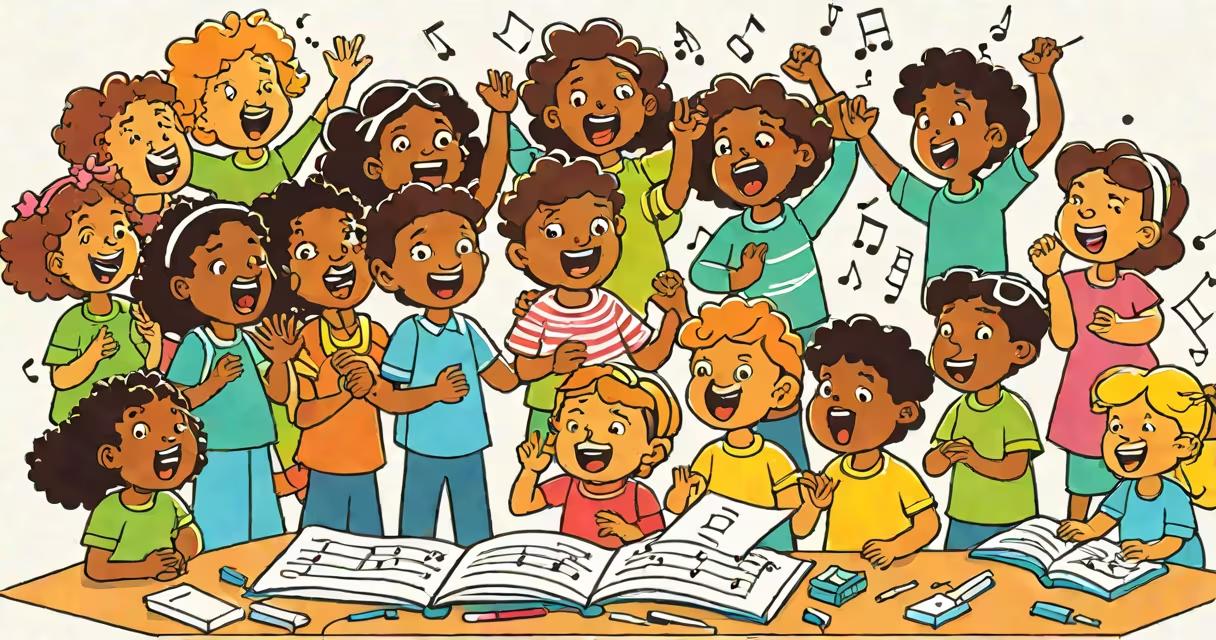
A feelings song for kids is a musical piece designed to help children recognize, name, and express emotions such as happiness, sadness, anger, fear, and calm. These songs use simple lyrics, repetitive melodies, and expressive vocal delivery to build emotional vocabulary and self-awareness in young learners.
Such songs are commonly used in preschools, kindergartens, and home settings to support social-emotional development. They often include actions or gestures that mirror the emotion being described-like clapping for joy or slow rocking for calm-making abstract feelings tangible through movement and sound.
According to the American Psychological Association, early exposure to emotional literacy reduces behavioral issues and improves peer relationships. Feelings songs serve as accessible tools for this skill-building, especially for children under age 7 who are still developing emotional regulation.
These songs function by linking auditory cues with emotional states. The melody's tempo and pitch often reflect the mood-upbeat rhythms for excitement, slower tempos for sadness. Lyrics typically use concrete imagery: "I feel happy when my mom sings my favorite tune" or "I feel sad when the rain falls on my window."
Repetition reinforces memory. A child may hear the same line-"I am calm, I am still"-multiple times across a song, helping internalize the concept. Research from the University of Washington shows that children retain emotional concepts better when paired with music, especially when movement is involved.
For example, a teacher might lead a group in a "happy dance" during a chorus, then pause and ask, "How did your body feel?" This creates a feedback loop between physical sensation, emotional label, and cognitive recognition.
Feelings songs fall into several categories based on purpose and structure:
| Type | Focus | Example |
|---|---|---|
| Emotion Naming | Teaches identification of basic emotions | "The Feeling Song" by Super Simple Songs |
| Regulation & Calming | Supports self-soothing and breath control | "Breathe In, Breathe Out" by Peaceful Parenting |
| Empathy Building | Encourages understanding others' feelings | "How Do You Feel?" by The Kiboomers |
| Problem Solving | Offers strategies for managing big emotions | "When I'm Angry" by Little Learning Songs |
Some songs integrate storytelling. For instance, "The Color Song" uses colors to represent moods-red for anger, blue for sadness-helping children visualize emotional states. Others use animal characters: a lion roaring when angry, a turtle curling up when scared.
One non-obvious distinction: not all songs labeled "feelings songs" actually teach emotional recognition. Some focus only on positive emotions, reinforcing the idea that sadness or frustration are problems to be fixed rather than valid experiences. True emotional education includes naming and validating all feelings equally.
In a classroom setting, teachers often begin the day with a feelings song to check in on students' emotional states. After singing, children raise colored cards or place stickers on a chart to indicate how they're feeling. This routine builds consistency and normalizes emotional expression.
I've used "The Feeling Song" in multiple preschool classrooms. During one session, a child who had been withdrawn all morning began humming along during the "I feel proud" verse. Later, he raised his hand and said, "I felt proud when I helped clean up." That moment showed the song wasn't just entertainment-it was a bridge to self-expression.
Studies from the National Association for the Education of Young Children confirm that regular use of emotionally focused music improves emotional vocabulary by 40% over six weeks. Children who engage with these songs are also more likely to use words like "frustrated" or "excited" in conversation, not just gestures.
Feelings songs are often mistaken for general "happy songs" or nursery rhymes with upbeat tones. But a true feelings song doesn't avoid negative emotions. It acknowledges them. A song that says "I feel sad sometimes" is more effective than one that only celebrates joy.
Another common error is assuming that music alone teaches emotional intelligence. While songs are useful tools, they work best when paired with adult guidance. A teacher asking, "Why do you think the character is crying?" turns a song into a discussion, not just a performance.
Also, many parents assume that singing a song once is enough. But research shows that repeated exposure-over 5-7 sessions-is needed for lasting impact. Consistency matters more than perfection in delivery.
Here is a sample original feelings song used in early childhood programs:
I feel happy when I laugh and play,
I feel sad when I want to stay.
I feel mad when someone takes my toy,
I feel scared when the thunder roars loud.
I feel calm when I close my eyes,
And breathe in deep, and breathe out slow.
I feel proud when I try my best,
And I'm glad I'm me, and I'm doing my best.
This song uses a steady 4/4 beat, simple rhyme scheme, and clear emotional labeling. It can be sung with hand motions: hands open for "happy," hands covering ears for "scared," slow breathing motions for "calm."
Teachers use it during circle time. After each verse, they pause and ask, "Which feeling did we sing about?" or "Can you show me how your body feels when you're sad?" Children respond with facial expressions or movements, building both verbal and nonverbal communication skills.
After consistent use, children begin to apply the language independently. One four-year-old wrote in her journal: "Today I felt angry because my brother took my crayon. So I walked away and breathed slowly. Now I feel calm." She didn't need a grown-up to prompt her-she used the song's structure.
Feelings songs for kids are more than entertainment-they are structured tools for emotional growth. They help children identify inner states, reduce emotional overwhelm, and improve interpersonal communication.
Look for songs that name all emotions equally, include movement, and encourage reflection. Avoid those that only celebrate positivity or skip difficult feelings.