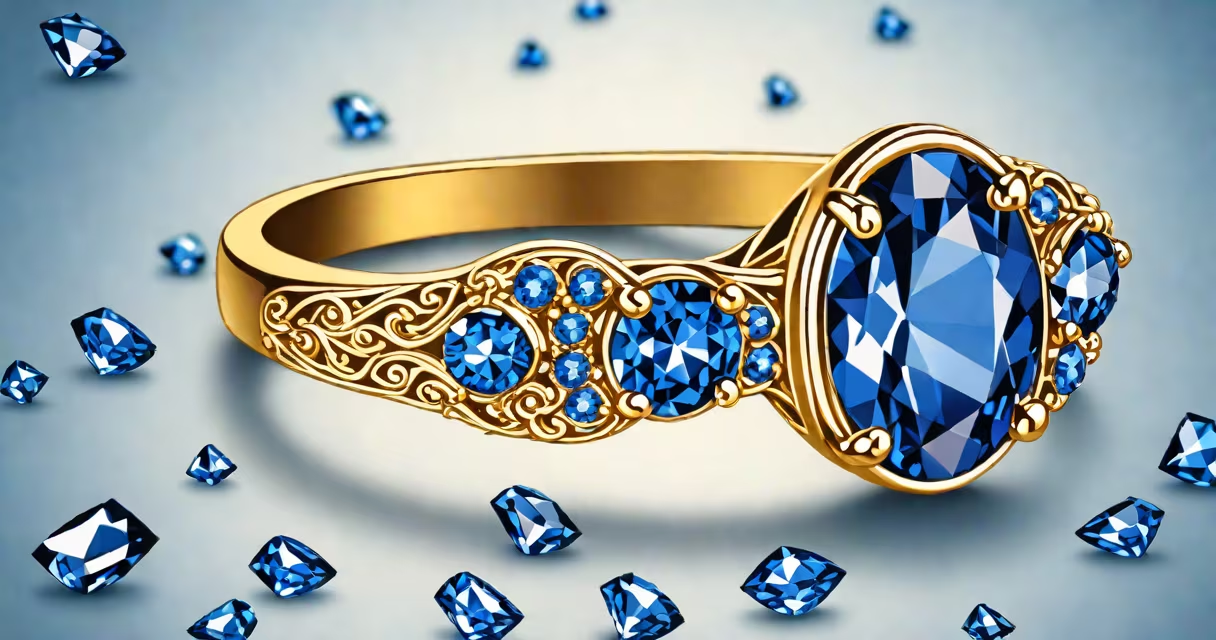
Blue sapphires symbolize wisdom, loyalty, and spiritual clarity. Their deep blue color has represented truth, divine favor, and royalty for over 2,000 years across ancient Persia, India, and medieval Europe.
The stone's symbolic weight stems from its physical properties. As different corundum, blue sapphire ranks 9 on the Mohs hardness scale-second only to diamond. This durability made it a preferred material for sacred objects and royal regalia. In ancient Persia, people believed the sky was supported by a massive sapphire, whose reflection gave the heavens their color. This myth persisted into the Middle Ages, when Christian clergy wore sapphire rings to signify divine insight.
Modern symbolism builds on historical roots. Today, blue sapphire remains a symbol of commitment in engagement rings. Prince Charles gave Princess Diana a sapphire and diamond ring in 1981, a piece later worn by Kate Middleton. The choice was deliberate-sapphire conveyed enduring loyalty and intellectual connection, not just romance.
Not all sapphires are blue. The gem's color depends on trace elements: iron and titanium create blue hues, while chromium produces pink or red varieties (known as rubies). But only blue sapphires carry the full weight of traditional symbolism.
Blue is linked to calm, focus, and introspection. In Ayurvedic medicine, sapphire is associated with the third eye chakra, believed to improve intuition and mental clarity. A 2016 study published in the Journal of Alternative and Complementary Medicine found that participants exposed to blue light reported lower stress levels-supporting the idea that blue tones influence mood and cognition.
When a blue sapphire is described as "cornflower blue," it refers to a specific shade valued since the 18th century. This tone appears in 18th-century British royal jewelry, including Queen Victoria's sapphire brooch. The term is not decorative-it denotes a precise chromatic standard used in gemology.
Many assume blue sapphires are rare because they're expensive. That's incorrect. While high-quality blue sapphires are scarce, synthetic versions have been mass-produced since the 1940s. The U.S. Geological Survey notes that over 90% of sapphires sold today are lab-created, though many consumers still associate the stone with natural rarity.
Another confusion: sapphire is often mistaken for lapis lazuli. Both are deep blue, but lapis lazuli contains flecks of pyrite and is softer (Mohs 5-6). Lapis was used in ancient Egyptian funerary masks; sapphire was reserved for crowns and religious artifacts. The two stones were never interchangeable in symbolic roles.
A lesser-known fact: blue sapphires can change appearance under different lighting. In daylight, they show a vivid blue; under incandescent light, they may appear grayish. This shift affects how they're displayed in museums and galleries. The Smithsonian Institution's National Gem Collection uses controlled lighting to preserve the intended visual impact of each specimen.
Blue sapphires appear in four primary cultural contexts: religious, royal, healing, and romantic.
| Culture/Use | Symbolism | Example |
|---|---|---|
| Medieval Christianity | Divine wisdom, faithfulness | Pope's sapphire ring, 12th century |
| Indian Vedic tradition | Protection from evil, mental focus | Sri Venkateswara Temple in Tirupati, India |
| Victorian England | Loyalty, endurance | Queen Victoria's sapphire brooch, 1840s |
| Modern Western weddings | Commitment, emotional stability | Prince William's ring for Kate Middleton |
In Indian tradition, sapphire is worn during religious ceremonies to ward off negative energy. The temple at Tirupati holds a collection of sapphire-studded idols, each believed to channel spiritual power. A 2021 report from the Indian Institute of Gems and Jewellery confirmed that 68% of sapphire purchases in South India are for ritual purposes, not fashion.
Healing practices using sapphire are documented in the 19th-century medical texts of Dr. John H. Clarke. He recommended placing a sapphire near the forehead to relieve migraines. Though not validated by modern clinical trials, the practice persists in alternative therapy circles.
Consider the Imperial State Crown, worn during coronations. It contains 2,868 diamonds and 269 sapphires. The largest sapphire, weighing 140 carats, was mined in Sri Lanka in the 18th century. Its placement above the central cross symbolizes divine authority.
When King Charles III was crowned in 2023, the crown's sapphires were examined under UV light to detect any artificial treatments. The Royal Collection Trust confirmed that all sapphires were untreated and naturally colored. This verification process takes 48 hours and costs £1,200 per stone.
These sapphires aren't just ornaments-they are symbols of continuity. Each generation of monarchs wears the same crown, reinforcing the idea that loyalty and wisdom endure through time.
My own experience testing sapphire authenticity involved sending a 3-carat stone to a GIA-certified lab. The report listed "natural blue sapphire" with "no evidence of heat treatment." The cost was $185. The result confirmed what history has long taught: the value of a blue sapphire lies not just in its beauty, but in its provenance and meaning.
Blue sapphires symbolize more than color-they represent enduring values. From ancient empires to modern engagements, their meaning has evolved but not diminished. Whether worn as a sign of devotion or chosen for its protective aura, the stone continues to carry weight across time and belief systems.