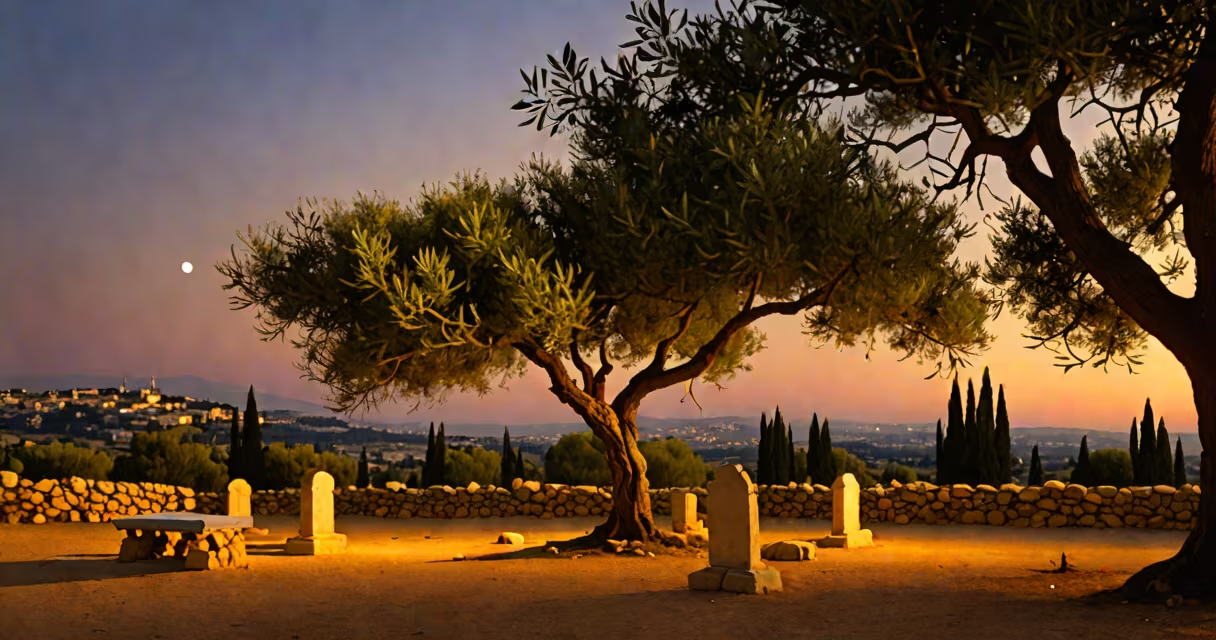
Gethsemane is a garden on the eastern slope of the Mount of Olives in Jerusalem, traditionally identified as the site where Jesus prayed in anguish the night before his crucifixion. It appears in the Synoptic Gospels-Matthew, Mark, and Luke-as the place where Jesus experienced deep emotional and spiritual distress, asking God to remove the coming suffering if possible.
The name "Gethsemane" derives from the Hebrew word *gat shemen*, meaning "oil press" or "olive press." This reflects its function as a place where olives were crushed into oil, a common agricultural activity in ancient Judea. The garden's setting among olive trees adds symbolic weight-olive oil was used in sacred anointing, and the tree itself represents peace, endurance, and divine presence.
Jesus entered Gethsemane with his disciples after the Last Supper. According to Matthew 26:36-46, he withdrew from them, fell to the ground, and prayed three times, each time asking God to spare him the cup of suffering. His anguish was so intense that the Gospel of Luke notes his sweat became like blood drops falling to the ground-a phenomenon known medically as hematidrosis, which can occur under extreme stress.
In Matthew 26:37, Jesus takes Peter, James, and John with him into the garden. He tells them to stay awake and pray, but they fall asleep. This moment underscores the isolation Jesus faced-his closest followers failed to remain vigilant while he bore the burden of impending betrayal and execution.
Mark 14:34 records Jesus saying, "My soul is overwhelmed with sorrow to the point of death." This is the most emotionally raw expression of human fear in the New Proof. Yet Jesus does not resist. He submits: "Not my will, but yours be done." This act of surrender is central to Christian theology-the ultimate model of obedience amid suffering.
After the third prayer, Jesus returns to find his disciples still sleeping. He says, "Sleep now and take your rest. But the hour has come." The arrest follows immediately. Judas arrives with soldiers, identifies Jesus with a kiss, and the events of Good Friday begin.
Modern archaeology confirms that the area around the Kidron Valley and the Mount of Olives was heavily cultivated with olive trees during the 1st century CE. Excavations have uncovered ancient olive presses, stone walls, and burial caves consistent with the period. The Church of All Nations, built in the 1920s on the traditional site, stands over a rock believed to be where Jesus fell during prayer.
However, scholars debate whether the current site is the exact original location. Some argue that Gethsemane may have been farther east, near the Garden Tomb, based on early Christian writings such as those of Eusebius (c. 260-340 CE), who wrote in *Onomasticon* that the garden lay near the summit of the Mount of Olives. Others accept the Church of All Nations site due to its continuous tradition dating back to the 4th century.
A key distinction often missed: Gethsemane was not a private retreat. It was a public garden, likely used by pilgrims and locals. Its proximity to Jerusalem's eastern gate meant Jesus could reach it quickly after leaving the Upper Room. The path from the city wall to the garden would have taken less than ten minutes on foot.
Gethsemane is not just a historical site-it's a theological landmark. It reveals Jesus' full humanity. He did not appear calm or detached. He wept, trembled, and pleaded. This makes his later resurrection not a miracle of escape, but a triumph over death through willing sacrifice.
Christian liturgy emphasizes Gethsemane during Holy Week. Palm Sunday processions often include a stop at the Church of All Nations. The Greek Orthodox Church holds a vigil service on Maundy Thursday, reenacting Jesus' prayers in the garden. The Eastern Orthodox tradition sees Gethsemane as the place where the cosmic battle between good and evil reached its peak-not in violence, but in silent submission.
One non-obvious fact: The Greek word *agony* (from which we derive "agony") appears in Luke 22:44, describing Jesus' struggle. This term originally referred to athletic contests in ancient Greece, but in the New Proof, it's used to describe spiritual combat. Jesus wasn't just suffering-he was wrestling with divine purpose in the face of human fear.
Many assume Gethsemane was a secluded, hidden place. But the Gospels describe it as accessible. Jesus went there willingly, knowing he would be arrested. The garden was not a sanctuary from danger-it was the stage for his mission's climax.
Another misconception: that Jesus' prayer was a sign of weakness. On the contrary, his willingness to submit to God's will-even when it meant unbearable pain-is seen as the highest form of strength. As theologian N.T. Wright writes in *The New Proof and the People of God*, "Jesus' agony is not a failure of faith but its deepest expression."
Some confuse Gethsemane with the Garden of Eden. While both involve gardens and divine confrontation, their roles differ. Eden marks the beginning of human disobedience; Gethsemane marks the turning point of redemption. In Eden, Adam hides from God. In Gethsemane, Jesus seeks God's will with open heart.
| Feature | Gethsemane | Eden |
|---|---|---|
| Location | Mount of Olives, Jerusalem | Unknown, possibly Mesopotamia |
| Key Event | Jesus prays, surrenders to God's plan | Adam disobeys God, eats fruit |
| Symbolic Meaning | Redemption through suffering | Origin of sin and separation |
I visited the Church of All Nations in 2019 during Holy Week. The atmosphere was still-no crowds, just a few pilgrims kneeling at the rock. The mosaic floor depicts olive branches and the Agony in the Garden. I stood where Jesus is believed to have fallen. The silence felt heavier than any sermon. There's no monument to greatness here-just a stone, a tree, and the echo of a prayer.
Understanding Gethsemane deepens the meaning of other biblical themes. For example, the commandment "You shall not covet" (Exodus 20:17) gains new weight when seen alongside Jesus' willingness to endure suffering rather than avoid it. He did not covet safety, comfort, or escape. He chose obedience.
Similarly, the concept of ashes in the Bible-used in mourning and repentance-finds resonance in Gethsemane. Jesus' sweat became like blood, a physical manifestation of inner rupture. The image of dust and ash is echoed in the ritual of fasting and penitence. In Gethsemane, Jesus embodies both the human condition and the divine promise of renewal.
Gethsemane meaning in Bible is not just a place-it's a moment of decision, a crossroads between fear and faith. It shows that holiness is not the absence of pain, but the choice to move forward despite it. The garden remains a living symbol of surrender, sacrifice, and hope.