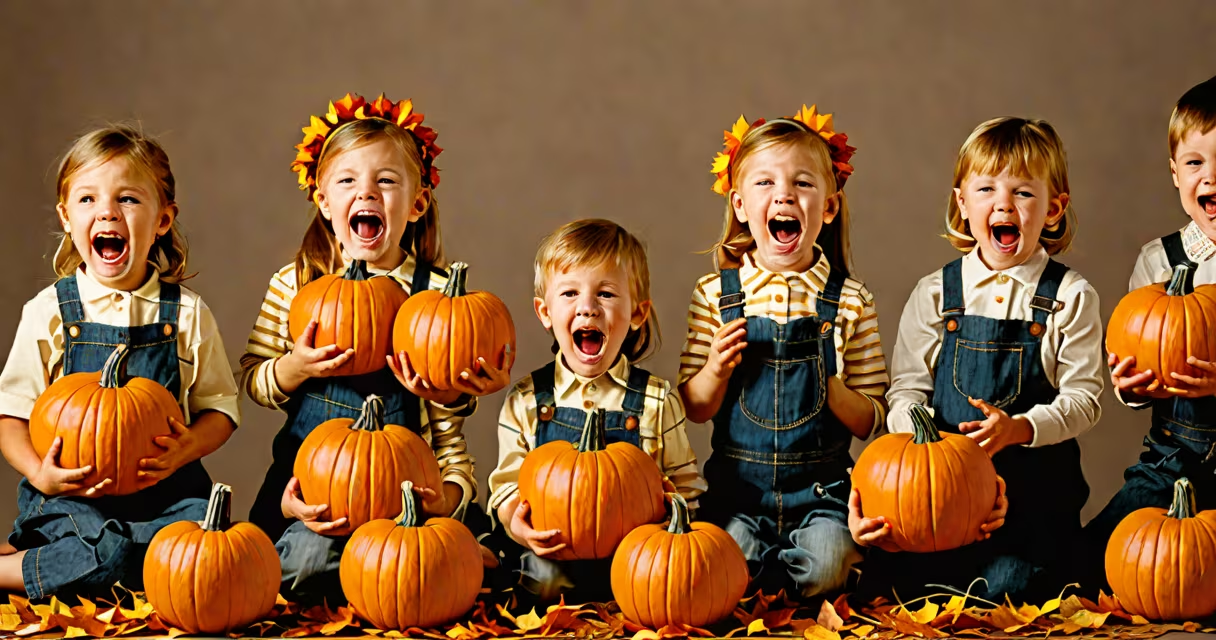
Harvest songs for children are traditional or original songs centered on autumn themes like gathering crops, fall colors, and seasonal change. They use simple melodies, repetitive lyrics, and actions to engage young learners during seasonal celebrations.
These songs are designed for ages 2 to 6, often incorporating movement, clapping, or props like toy vegetables or paper leaves. They reinforce vocabulary related to farming, weather, and family traditions. Most are sung in call-and-response or round format to support group participation and listening skills.
Common themes include corn, apples, pumpkins, and thanksgiving. Songs may reference local harvest festivals or agricultural heritage. They are used in classrooms, childcare centers, and homes during September through November.
Children learn through repetition and pattern recognition. Harvest songs use predictable structures-such as "I picked a red apple, I picked a green apple"-to build memory and language development. Each verse adds a new detail, encouraging attention and sequencing.
Movement is central. A song like "The Apple Tree" includes bending to pick fruit, stomping feet to simulate roots growing, and reaching arms upward to show branches. These physical cues help children internalize concepts like growth, cause and effect, and spatial relationships.
Research from the National Association for the Education of Young Children (NAEYC) confirms that music with action improves motor coordination and social interaction in preschoolers. Children who participate in rhythmic group songs show stronger turn-taking behavior and emotional regulation during transitions.
Harvest songs vary by region and cultural tradition. Some are rooted in American folk music, others in global seasonal practices. The following table outlines common categories and their educational applications.
| Type | Example Song | Use Case | Age Range |
|---|---|---|---|
| Folk/Traditional | "Over in the Meadow" | Teaches animal families and counting | 3-5 |
| Call-and-Response | "Five Little Pumpkins" | Reinforces number sense and subtraction | 2-4 |
| Action-Based | "The Corn Stalk Song" | Develops gross motor skills and rhythm | 3-6 |
| Seasonal Narrative | "Autumn Leaves Are Falling Down" | Builds descriptive language and sensory vocabulary | 4-6 |
Each type supports different developmental goals. Call-and-response songs like "Five Little Pumpkins" are ideal for teaching subtraction through visual and auditory cues. Action-based songs such as "The Corn Stalk Song" involve stretching, squatting, and turning-activities that strengthen balance and body awareness.
A lesser-known fact: many harvest songs were originally passed orally before being written down. The tune of "The Pumpkin Song" appears in 19th-century New England school notebooks, indicating that children have been learning seasonal cycles through music for over 150 years.
Some educators assume harvest songs are only for Thanksgiving. This is incorrect. While Thanksgiving is a common context, these songs are used throughout the fall season-from Labor Day to the first frost. They align with state early learning standards for science (seasonal changes) and math (counting, patterns).
Another misconception is that all harvest songs require costumes or elaborate props. Not true. Simple materials like colored scarves, plastic fruit, or hand-drawn leaf cards are sufficient. A study by the University of Minnesota's Center for Early Childhood Research found that children engaged equally well with low-cost materials as with high-production sets.
Some parents also believe these songs are only for rural communities. However, urban schools use them too. In Chicago public preschools, teachers adapt "Apple Picking" to city parks and community gardens. The core idea-gathering food-is universal, even when the setting changes.
At a preschool in Portland, Oregon, teacher Maria Lopez uses "The Apple Tree" during a unit on seasonal foods. The song goes:
I see a red apple, I see a green apple,
I see a yellow apple, I see a brown apple.
I pick them all and I eat them all,
And I give one to my friend.
She begins by showing real apples and asking children to name the colors. Then she sings the first line slowly, pausing after each color. Children raise hands to match the color they hear. After the second verse, she introduces a small basket and lets each child place a paper apple into it.
By the third verse, children act out picking and eating. One child pretends to bite into a red apple, another waves a green one to a friend. The song ends with a group hug to represent sharing.
Afterward, children draw their favorite apple and label it with color and size. The activity combines music, fine motor practice, and early writing. Over three weeks, 92% of students correctly identified four apple colors and described the process of harvesting.
When asked why she chose this song, Lopez said, "It's not about memorizing lyrics-it's about creating moments where children feel part of something bigger. That's what makes it work."
Harvest songs for children remain relevant because they connect play, culture, and learning. They are not seasonal decorations-they are tools for cognitive, emotional, and physical development.