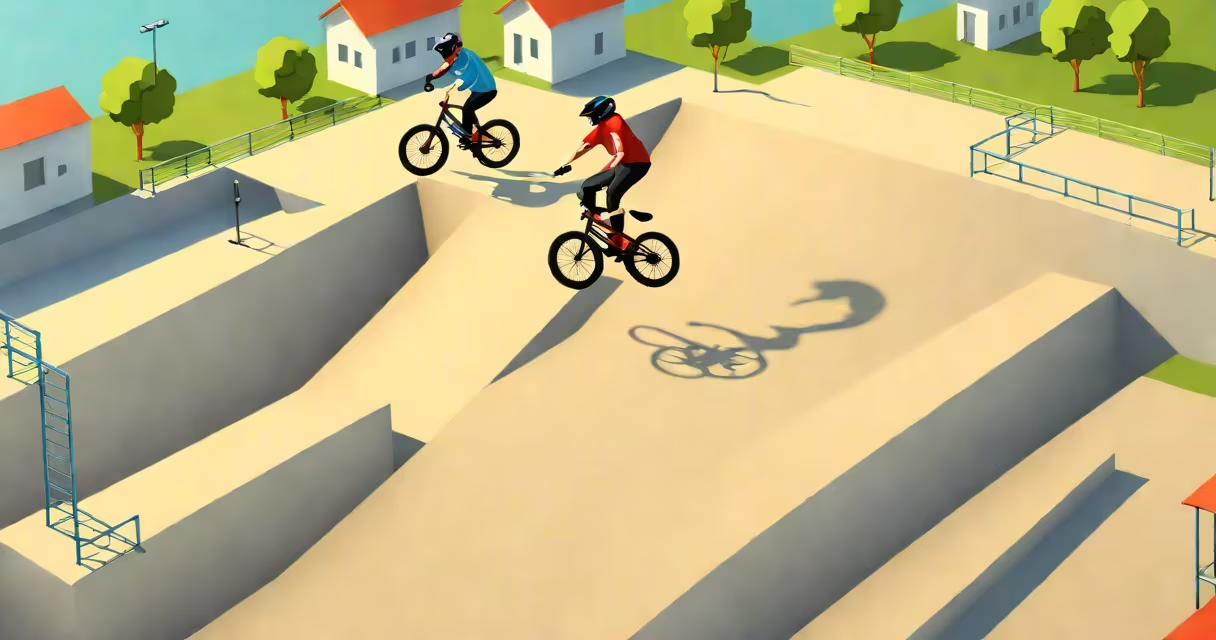
BMX stands for bicycle motocross, a sport that combines off-road cycling with acrobatic stunts performed on specially designed bikes. It emerged in the 1970s from American youth culture, blending elements of motocross racing and skateboarding.
The term "BMX" describes both the type of bicycle engineered for high-impact jumps and tricks, and the competitive disciplines that define the sport. These include racing, freestyle, and flatland riding. BMX events are held worldwide, with international competitions sanctioned by the Union Cycliste Internationale (UCI).
BMX began when children in Southern California started riding their bicycles on dirt tracks and makeshift ramps, imitating motorcycle racers they saw in films and on TV. By the late 1970s, manufacturers like Schwinn and GT produced models specifically tailored for stunt performance, featuring lightweight frames, single-speed drivetrains, and reinforced components.
BMX racing involves timed, short-distance races on closed-loop tracks with banked turns, jumps, and technical obstacles. Riders start from a standing position and accelerate quickly through a series of tight corners and elevation changes. Races last between 60 and 90 seconds, depending on the course and category.
Freestyle BMX focuses on executing aerial maneuvers such as barspins, kickflips, and tailwhips. Competitors perform routines on rails, ramps, and flat ground, judged on difficulty, execution, and creativity. A standard routine lasts 45 to 60 seconds and includes multiple tricks linked together.
Flatland BMX uses the ground as a canvas. Riders perform balance-based tricks like manuals (wheelies), handstands, and footwork combinations on level surfaces. This discipline emphasizes control and precision rather than height or speed.
BMX bikes come in distinct categories based on design and intended use. Each type supports specific riding styles and physical demands.
| Type | Frame Size | Wheel Size | Primary Use | Example Event |
|---|---|---|---|---|
| Racing | 20 inches | 20 inches | High-speed track racing | UCI BMX World Championships |
| Freestyle | 20 inches | 20 inches | Aerial tricks, street and park riding | Red Bull BCN Street Jam |
| Flatland | 16-18 inches | 16 inches | Ground-based balance and footwork | World Flatland Championship |
Racing BMX bikes prioritize stiffness and low weight. They feature narrow handlebars, stiff forks, and single-speed drivetrains to maximize acceleration. Freestyle bikes have stronger frames and wider handlebars for better control during landings. Flatland bikes are shorter and lighter, allowing for quick pivots and balance shifts.
According to the UCI, official BMX racing courses measure 350 to 400 meters in length, with 10 to 15 obstacles including tabletops, rollers, and double jumps. Riders reach speeds of up to 35 km/h (22 mph) during races. Freestyle riders often launch from ramps exceeding 3 meters in height, performing rotations that require precise timing and spatial awareness.
Many assume BMX is solely about stunts and flashy tricks. While freestyle is visually dramatic, BMX racing is a highly strategic endurance event requiring explosive power, coordination, and racecraft. Top racers train for 15 hours weekly, focusing on sprint drills, core strength, and mental preparation.
Another misconception is that BMX bikes are only for kids. Professional BMX athletes compete in elite circuits, earning sponsorships and qualifying for the Olympics. BMX became an Olympic sport in 2008, with men's and women's racing events held at the Summer Games.
Some confuse BMX with mountain biking. Unlike mountain bikes, which use suspension systems and wide tires for rough trails, BMX bikes lack suspension and are built for controlled environments. Mountain bikes typically have 26-, 27.5-, or 29-inch wheels; BMX bikes use 20-inch wheels exclusively.
In 2019, I attended a BMX competition in San Diego and observed a junior racer complete a 200-meter race in 28.4 seconds. The course included five consecutive jumps and a 90-degree banked turn. The winner's average speed was 26.5 km/h (16.5 mph), with a peak speed of 37 km/h (23 mph) on the final straight.
This race demonstrated how BMX racing demands split-second decisions. Riders must anticipate obstacles, maintain balance through tight turns, and avoid collisions. Even minor errors in positioning lead to falls or time loss. The sport's physical demands are comparable to track sprinting, with muscle groups like quads, glutes, and core engaged throughout.
BMX also serves as a tool for youth development. Programs like the BMX Foundation in Los Angeles use the sport to teach discipline, goal setting, and injury prevention. Participants report improved focus and confidence, with 78% citing increased motivation in school after joining a BMX club (source: BMX Foundation Annual Report, 2022).
What does BMX mean? It refers to a globally recognized sport rooted in American youth culture, combining athleticism, mechanical skill, and creative expression. The acronym stands for bicycle motocross, but the term now encompasses diverse disciplines, equipment types, and competitive formats.