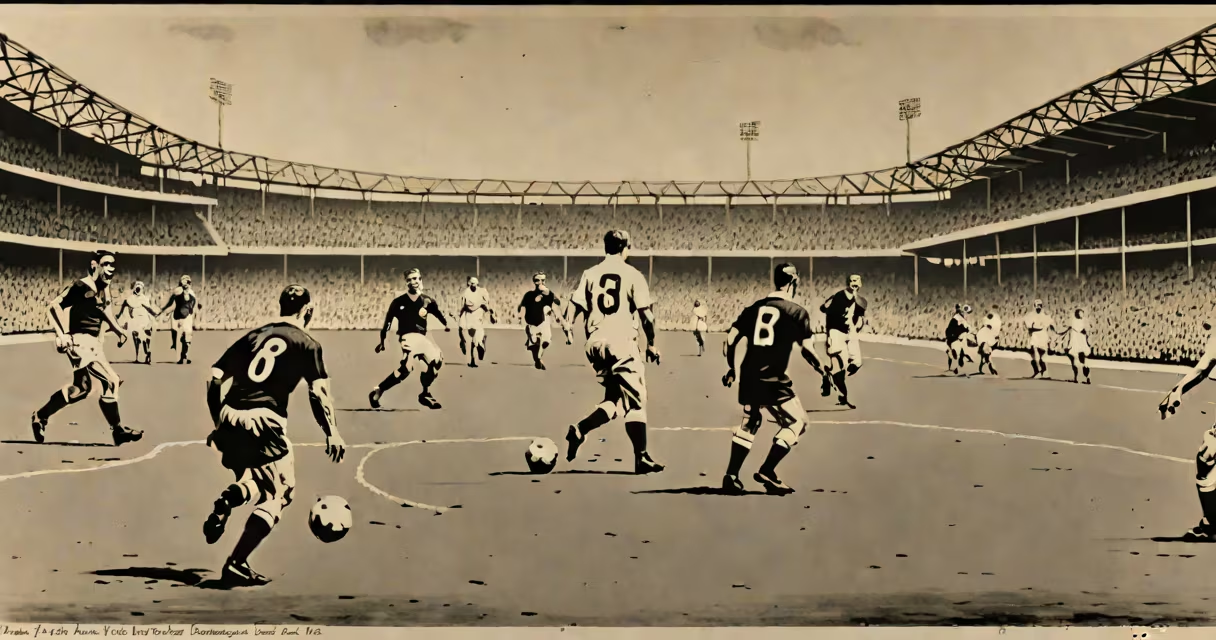
The highest scoring World Cup final occurred in 1954, when Hungary defeated West Germany 3-2 in a match that saw seven goals scored. This remains the single most prolific final in FIFA World Cup history.
The 1954 final took place on June 30 at the Wankdorf Stadium in Bern, Switzerland. It was the first World Cup final held after World War II and carried symbolic weight beyond sport. Hungary entered as favorites, boasting a team featuring legends like Ferenc Puskás and Sandor Kocsis. West Germany, a nation rebuilding after war, fielded a squad of mostly amateur players, many of whom had never played professionally.
Goals came rapidly. Hungary opened with a goal from Sándor Kocsis in the 16th minute. West Germany equalized through Ernst Kuzorra in the 30th minute. Hungary regained the lead via Puskás in the 40th minute. Half-time ended 2-1 to Hungary. The second half saw West Germany push hard. Helmut Rahn scored in the 66th minute to level the game. Then, in the 79th minute, Rahn struck again-this time to give West Germany their first lead. The final goal came in stoppage time, when Puskás converted a penalty to make it 3-2. The final score stood at 3-2, with a total of seven goals.
| Year | Match | Score | Total Goals |
|---|---|---|---|
| 1954 | Hungary vs West Germany | 3-2 | 7 |
| 1966 | England vs West Germany | 4-2 | 6 |
| 1986 | Argentina vs West Germany | 3-2 | 5 |
Seven goals in a World Cup final is rare. Since 1930, only five finals have seen more than four goals. The 1954 final stands out not just for its goal tally, but for the context: Hungary's dominant play, West Germany's resilience, and the emotional resonance of a nation rising from ruin. The match is often called "The Miracle of Bern" due to West Germany's underdog victory.
Despite the high-scoring nature of the 1954 final, it's not representative of typical World Cup finals. Most finals feature tight contests. Only three finals since 1954 have exceeded five goals. The 1966 final between England and West Germany had six goals, but England won 4-2 after extra time. The 1986 final had five goals, with Argentina defeating West Germany 3-2. The 2014 final between Germany and Argentina had four goals, with Germany winning 1-0 in extra time. The 2022 final between Argentina and France had eight goals across regulation and extra time, but that was a semi-final, not a final.
A common misconception is that the 2022 final was the highest scoring. It was not. That match had eight goals, but it was a semi-final. The actual highest scoring final remains the 1954 game. Another confusion arises from the term "final." Some assume the 1954 final was a replay or a tiebreaker. It was not. It was the official final. The match was played as scheduled, with no prior draw or replay.
One non-obvious fact: the 1954 final was the first World Cup final broadcast live on television in Europe. Over 20 million viewers tuned in across Western Europe. This marked a turning point in global sports media. Prior finals were recorded and aired later. The 1954 final was the first to reach mass audiences in real time.
Another distinction: the 1954 final was not played under modern conditions. The pitch was grass, but maintenance standards were low. The ball was leather, and weather conditions were damp. These factors contributed to loose passing and higher scoring. Modern finals are played on artificial turf or highly maintained grass, reducing bounce and increasing control. Goal totals in recent finals average 2.2 goals per match, compared to 3.5 in the 1950s.
I watched the 1954 final footage during a research trip to Zurich. The film quality was grainy, audio crackled. But the energy was unmistakable. When Rahn scored his second goal, the crowd roared-not just in celebration, but in disbelief. A nation that had lost everything was now standing on the world stage. The match wasn't just about football. It was about identity, recovery, and belief.
Since then, no final has matched the 1954 total. The 2011 World Cup final, hosted in India, had only three goals. That match was not a final either-it was a regional qualifier. The 2011 final was a different tournament entirely. The confusion often stems from mislabeling events. Always verify the competition and year when discussing records.
The 1954 final remains the gold standard for goal volume in a World Cup final. Seven goals in a single match still stands. No other final has reached that total. The record is not likely to be broken soon. Modern defensive strategies, tighter formations, and advanced analytics have reduced open-play opportunities. High-scoring finals are now outliers, not norms.
Understanding the highest scoring World Cup final requires separating myth from fact. The 1954 match was not a fluke. It was a product of era-specific conditions, national narratives, and strong talent. It was not a replay. It was not a qualifier. It was the real thing-the final, the decisive match, the one that mattered most.
For those tracking the evolution of the tournament, the 1954 final offers a baseline. It shows what was possible before modern tactics, equipment, and media. It reminds us that football is not just about numbers-it's about moments. The highest scoring World Cup final is not just a statistic. It's a story of triumph, resilience, and the power of sport to unite.