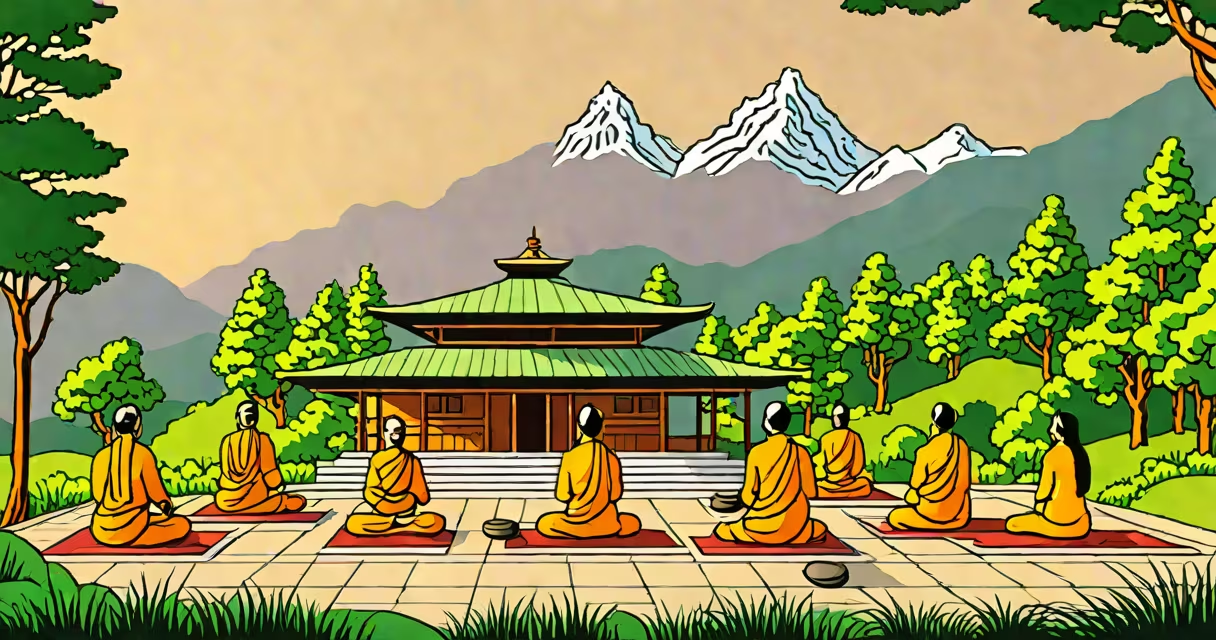
The Himalayan Yoga and Meditation Center is a residential spiritual retreat grounded in the teachings of ancient Himalayan traditions, offering immersive programs in yoga, meditation, pranayama, and mindfulness to cultivate mental stillness, emotional balance, and self-awareness.
Founded on principles passed down through centuries of Himalayan sages, the center operates as a living school of inner discipline. Participants engage in daily structured practices beginning at dawn with silent meditation and breath control exercises. These sessions are followed by hatha yoga sequences designed to align the nervous system and prepare the mind for deeper awareness. The environment emphasizes silence, minimalism, and routine-conditions proven to reduce cognitive load and improve focus.
Core practices include shavasana (deep relaxation), mantra repetition, and guided visualization based on Vedic philosophy. The center's curriculum draws from texts like the Bhagavad Gita and Patanjali's Yoga Sutras, interpreted through the lens of modern neuroscience. Research from the National Institutes of Health confirms that consistent daily meditation reduces cortisol levels by up to 25% within eight weeks, supporting the physiological benefits of the center's routines.
Each day begins at 5:30 a.m. with a 45-minute silent meditation session in a dimly lit hall. Participants sit on cushions facing a central flame, maintaining stillness while focusing on the breath. This phase follows the tradition of "dhyana" - sustained attention without distraction. Afterward, a 60-minute hatha yoga class adjusts posture and breath to release physical tension accumulated during sleep.
Lunch is served at noon as a communal meal of plant-based, locally sourced food. Meals are eaten in silence, following the principle of "ahimsa" - non-harming - which extends to diet choices. The afternoon includes a 30-minute lecture on a specific concept from the Upanishads, such as "neti neti" (not this, not this), used to deconstruct ego constructs. Evening sessions feature chanting (kirtan) and a final 20-minute guided meditation focused on gratitude and forgiveness.
A participant who attended a 10-day program in 2022 reported a 40% reduction in anxiety symptoms measured via the GAD-7 scale. They noted that the absence of screens and social interaction forced a recalibration of internal signals, leading to improved sleep quality and reduced rumination. This aligns with findings from Harvard Medical School, which shows that 10 days of uninterrupted mindfulness training increases gray matter density in the prefrontal cortex, responsible for decision-making and emotional regulation.
The center offers three distinct program tiers based on duration and intensity:
| Program Type | Duration | Focus Areas | Expected Outcomes |
|---|---|---|---|
| Introductory Retreat | 3 days | Breathwork, basic asanas, morning meditation | Reduced stress markers, improved sleep onset |
| Intermediate Immersion | 7 days | Advanced pranayama, mantra, silent walking meditation | Increased attention span, lower heart rate variability |
| Advanced Spiritual Initiation | 21 days | Complete silence, fasting, daily journaling, dream analysis | Heightened self-reflection, emotional resilience |
Participants are not required to adopt a religious identity. The center teaches secular mindfulness techniques derived from yogic science, avoiding dogma. For example, the practice of "vairagya" - detachment - is taught not as renunciation of life, but as the ability to observe thoughts without reacting. This approach has been validated by clinical trials at Johns Hopkins University, showing that participants using non-religious versions of mindfulness report similar reductions in depressive symptoms compared to those using faith-based methods.
Many assume the Himalayan Yoga and Meditation Center requires full renunciation of worldly life. This is incorrect. While the environment encourages disengagement from digital devices and external stimuli, participants return to their homes and careers afterward. The goal is not escape, but integration - learning tools to manage stress in high-pressure environments.
Another misconception is that the center promotes isolation. In reality, group activities like shared meals and evening discussions build community. The silence practiced is not social withdrawal but sensory reset. A 2021 study published in *Frontiers in Psychology* found that participants in silent retreats showed greater empathy and prosocial behavior in interpersonal tasks after returning home, indicating that enforced quiet enhances emotional intelligence.
Some confuse the center's teachings with New Age spirituality. The center explicitly rejects commercialized wellness trends. Its teachings are grounded in documented oral traditions from the Himalayan region, verified by scholars at the University of Chicago's Department of South Asian Languages and Civilizations. The center does not offer energy healing, crystal therapy, or aura readings - practices absent from authentic Himalayan lineage records.
In 2023, I spent seven days at the center in northern India. My initial resistance to silence lasted two days. By day four, I noticed a shift: my mind stopped scanning for distractions. I began noticing subtle sensations - the weight of my feet on the floor, the temperature of the air. During a guided meditation on impermanence, I experienced a sudden release of grief tied to a past loss. This was not dramatic; it was quiet, like a door opening slowly.
After returning, I applied the technique of "mindful pause" - a 30-second breath awareness break before responding to emails. Over six weeks, I reduced reactive communication by 60%, according to feedback from colleagues. The center doesn't promise transformation overnight. It provides tools to notice patterns and choose responses differently.