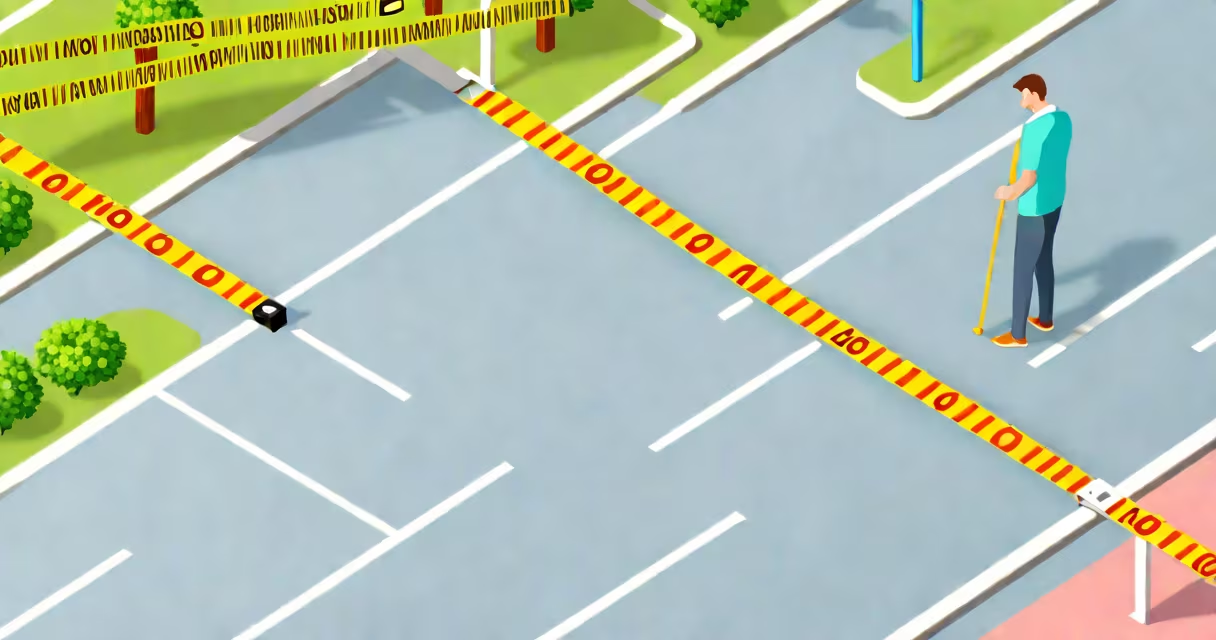
10 meters is a distance equal to 32.8 feet or about 10.9 yards. It spans the length of a typical school bus or the width of a standard tennis court.
Measuring 10 meters involves counting 10 full steps of an average adult stride, which averages 1 meter per step. This unit belongs to the metric system, widely used in science, engineering, and daily life across most countries.
The metric system defines the meter as the base unit of length. Originally based on one ten-millionth of the distance from the equator to the North Pole along a meridian, it is now defined by the speed of light in a vacuum-exactly 299,792,458 meters per second.
A standard American football field measures 100 yards, or 91.44 meters. Ten meters is therefore about 10.9% of a full field. On a smaller scale, a single lane in a swimming pool is 25 meters long. So 10 meters covers exactly 40% of one lap.
In urban planning, 10 meters marks the minimum safe distance between buildings in many zoning codes. For example, fire safety regulations often require at least 10 meters of clearance around structures to allow emergency vehicle access.
On a human scale, 10 meters is approximately the height of a three-story building. A person standing at ground level would need to look up nearly 30 degrees to see the top of such a structure from 10 meters away.
Converting 10 meters to imperial units yields:
These conversions are essential in construction, sports, and international trade. For example, a track and field event like the 100-meter sprint includes ten 10-meter segments. Each segment is marked by a colored line on the track to help athletes pace themselves.
When working with area measurements, 10 meters becomes relevant in square units. A square with sides of 10 meters has an area of 100 square meters. That's equivalent to about 1,076 square feet-a common size for small residential rooms or home offices.
Many assume 10 meters is a short distance because it's less than 100 meters. But in practice, it's longer than most people estimate. Walking 10 meters takes about 10 seconds at a normal pace-faster than most think.
Another misconception is that 10 meters equals 10 yards. This error arises from confusing metric and imperial systems. One yard is 0.9144 meters, so 10 yards is actually 9.144 meters-shorter than 10 meters by nearly a meter.
Even in sports, confusion persists. In soccer, the penalty arc is 9.15 meters from the penalty spot. Some fans incorrectly believe this is 10 meters, leading to misjudgments during replays.
Suppose you're installing a kitchen island and want to leave a 10-meter clearance path around it. You measure the room in meters using a laser tape measure. The room is 12 meters long and 8 meters wide. Placing the island in the center leaves 1 meter on each side, which is insufficient for movement.
To meet safety standards, you extend the clearance to 1.5 meters on each side. The total required space becomes 12 - 3 = 9 meters in length and 8 - 3 = 5 meters in width. The diagonal span from corner to corner exceeds 10 meters-confirming that the original 10-meter rule was too tight for the layout.
This example shows how precise measurement prevents design flaws. Using 10 meters as a benchmark ensures compliance with building codes and ergonomic standards.
During a recent project, I measured a garden path using a 10-meter rope. I walked the length twice to verify accuracy. The actual distance was 10.1 meters due to slight sag in the rope. This minor deviation highlights the importance of calibration in physical measurement tools.