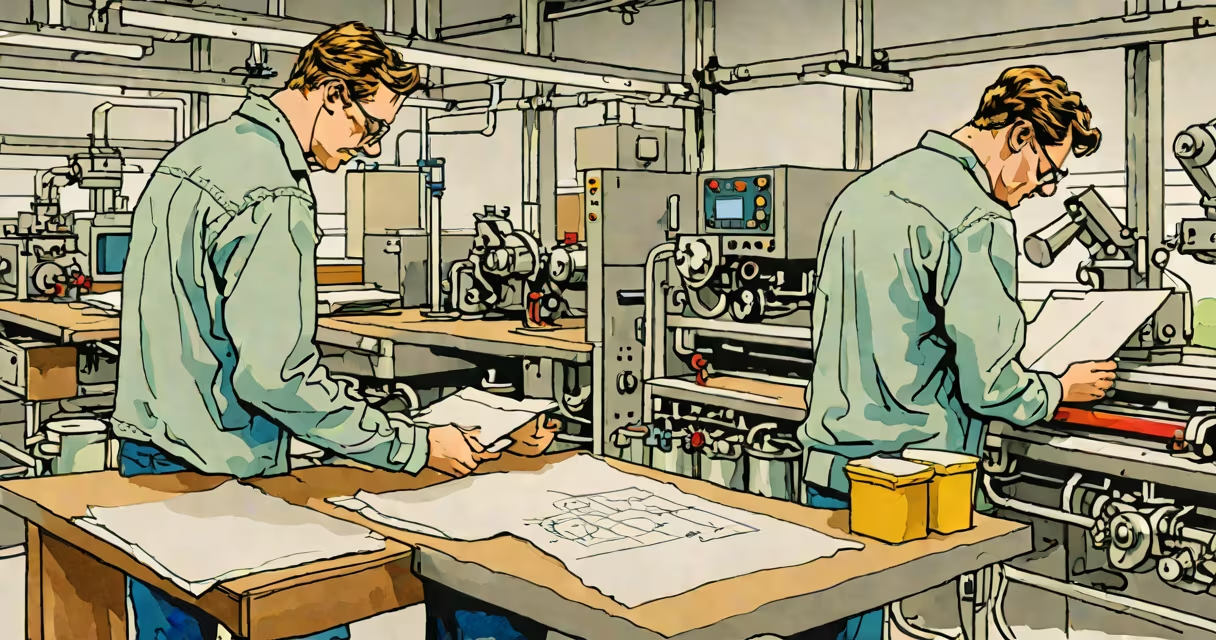
An industrial engineering major trains students to design, improve, and manage integrated systems involving people, materials, information, equipment, and energy. The field emphasizes efficiency, safety, and cost-effectiveness across manufacturing, healthcare, supply chains, and service operations.
Industrial engineers apply mathematical modeling, statistical analysis, and human factors research to solve operational problems. They work to reduce waste, increase throughput, and ensure consistent quality. A degree in industrial engineering prepares graduates for roles in process optimization, supply chain management, and systems design across sectors including automotive, aerospace, pharmaceuticals, and logistics.
The discipline emerged in the early 20th century alongside scientific management principles developed by Frederick Taylor and Frank and Lillian Gilbreth. Today, industrial engineering integrates lean methodologies, Six Sigma, simulation software, and data analytics to support decision-making in changing environments.
Industrial engineering operates on a foundation of systems thinking. Rather than focusing solely on individual components, industrial engineers analyze entire workflows to identify bottlenecks, redundancies, and inefficiencies. This involves mapping processes using flowcharts, time-motion studies, and value stream diagrams.
Key tools include linear programming for resource allocation, queuing theory for managing waiting lines, and Monte Carlo simulations for risk assessment. For example, an industrial engineer might model patient wait times in an emergency room using historical admission data and staffing patterns to recommend optimal nurse scheduling.
Human-centered design is central. Industrial engineers assess physical ergonomics-like workstation height or tool weight-to prevent injury and boost productivity. They also study cognitive load and decision fatigue in high-stakes environments such as air traffic control or surgical operating rooms.
Undergraduate programs in industrial engineering typically require 120-130 credit hours. Core courses include probability and statistics, operations research, manufacturing processes, systems simulation, and engineering economics. Students take advanced math classes in calculus, differential equations, and matrix algebra.
Specialization tracks often emerge in later years. Common options include:
A 2023 report from the Institute of Industrial and Systems Engineers (IISE) found that 68% of industrial engineering graduates enter roles related to operations improvement within their first year. The most common entry-level positions include process analyst, operations coordinator, and supply chain planner.
Manufacturing plants use industrial engineering to reduce cycle times and scrap rates. For instance, at a Ford assembly plant, industrial engineers redesigned the sequence of robotic arm movements on a chassis line, cutting average build time by 12% and reducing rework incidents by 27% over six months.
In healthcare, industrial engineers helped reduce patient wait times in outpatient clinics by 34% through better appointment scheduling algorithms and staff deployment models. At Johns Hopkins Hospital, a team led by an industrial engineering graduate implemented a real-time bed tracking system that decreased patient transfer delays by 41%.
Service industries also rely on industrial engineering. Amazon warehouses use industrial engineers to improve picking routes, bin placement, and labor assignment. One internal project reduced average package processing time from 22 minutes to 15 minutes by redesigning the layout of the fulfillment center based on motion economy principles.
Industrial engineering is frequently confused with mechanical engineering. While both involve machines and processes, mechanical engineers focus on designing physical components and systems-such as engines, turbines, or HVAC units. Industrial engineers focus on the system that uses those components, not the parts themselves.
Another misconception is that industrial engineering is limited to factory floors. In reality, it applies widely. For example, Netflix uses industrial engineering principles to improve streaming server allocation during peak viewing hours. By modeling user demand patterns and server capacity, they minimize buffering and maximize bandwidth utilization.
A lesser-known fact: industrial engineers are among the few engineering disciplines trained in both technical and organizational behavior. According to the National Society of Professional Engineers (NSPE), industrial engineers are more likely than other engineering majors to hold leadership roles in cross-functional teams due to their training in communication, negotiation, and change management.
Consider a local coffee shop with five employees and 120 daily customers. The owner reports long lines during morning rush hours. An industrial engineering student conducted a time study using stopwatches and video recording.
Data showed that baristas spent 38% of their time retrieving ingredients from storage, 22% moving between stations, and 15% handling customer requests. The student proposed a new layout: grouping ingredients by drink type, installing pull-out shelves, and assigning one employee to prep orders while others handled payments and delivery.
After implementation, average order time dropped from 4.7 minutes to 3.1 minutes. Customer satisfaction scores rose from 3.8 to 4.6 out of 5. The shop saw a 29% increase in sales volume during peak hours without hiring additional staff.
This example illustrates how industrial engineering solves real-world problems using structured observation, data analysis, and process redesign-not just intuition or guesswork.
Graduates with an industrial engineering major go on to careers in operations management, supply chain strategy, quality assurance, and systems consulting. The Bureau of Labor Statistics projects a 10% growth in industrial engineering jobs from 2022 to 2032-faster than average for all occupations.