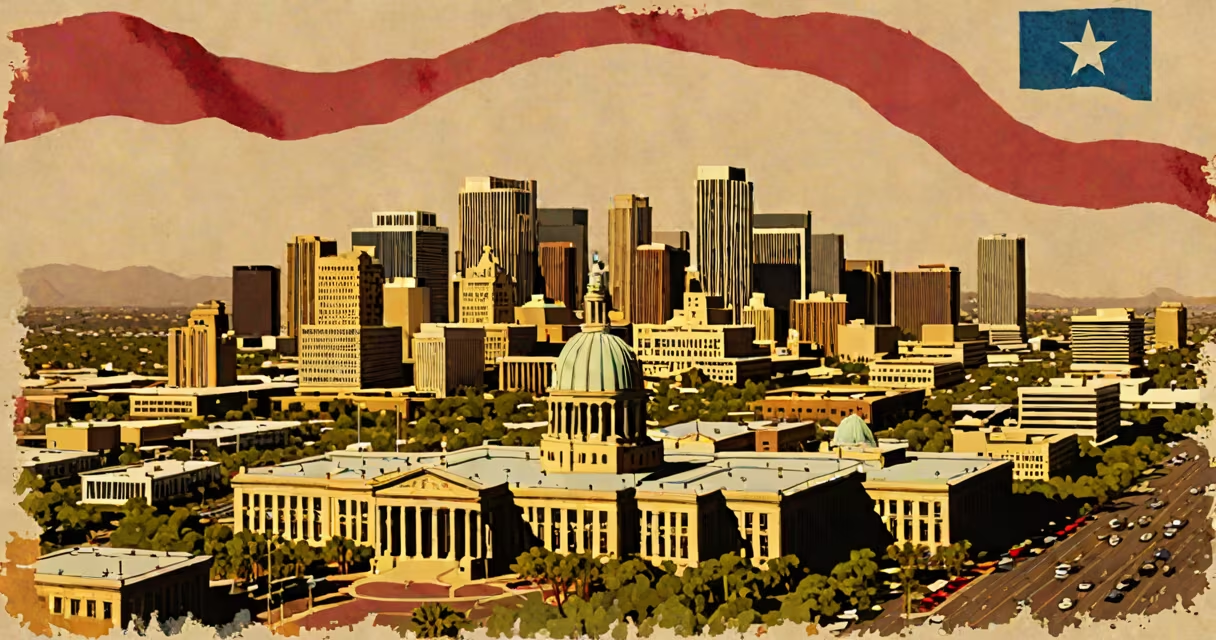
Yes, Arizona is a state. It joined the United States as the 48th state on February 14, 1912, after years of territorial governance and legislative approval.
Arizona's path to statehood began in 1863, when Congress established the Arizona Territory following the Gadsden Purchase. The territory covered land previously part of New Mexico and Alta California. Over the next half-century, residents petitioned for statehood, citing population growth, economic development, and infrastructure improvements. By 1910, Arizona had met the requirements set by the U.S. Constitution for state admission: a permanent government, a constitution ratified by voters, and a population exceeding 100,000.
The final step came when President William Howard Taft signed the Enabling Act on June 20, 1910. This authorized Arizona to draft a state constitution and apply for statehood. Voters approved the document in November 1910. Congress then passed the Arizona Statehood Act, which Taft signed into law on February 14, 1912. Arizona officially became a state on that date, with the capital at Phoenix.
Statehood required three legal steps: federal authorization, constitutional ratification, and congressional approval. Arizona completed each phase under strict timelines. The enabling act specified that the state constitution must include provisions for public education, a bicameral legislature, and a governor with veto power. Arizona's 1910 constitution included all these elements.
Opposition arose from some eastern lawmakers who questioned whether Arizona's population was large enough to support a state government. Census data showed 192,000 residents in 1910, well above the threshold. The House passed the statehood bill 228-103, and the Senate confirmed it 63-15. President Taft signed the act on February 14, 1912.
A common misconception is that Arizona was admitted during the Progressive Era because of its mining economy. While copper production fueled early growth, statehood was driven by political organization and voter participation. Arizona's 1910 constitution was among the most progressive of its time, including women's suffrage - a provision that helped secure national support.
Arizona's geography shapes its identity. It spans 113,998 square miles, making it the sixth-largest U.S. state by area. The field includes deserts, mountains, canyons, and rivers. The Sonoran Desert covers much of the south and west. The Grand Canyon, carved by the Colorado River over six million years, lies within the state's northern border.
Arizona's climate varies widely. Phoenix averages 100 days above 100°F annually. Northern areas like Flagstaff experience snowfall and cold winters. The state has five federally recognized Native American tribes: Navajo Nation, Hopi Tribe, Apache Tribes, Tohono O'odham Nation, and Pascua Yaqui Tribe. These nations have sovereign status and manage their own governments, courts, and laws.
Arizona's economy relies on mining, tourism, agriculture, and technology. Copper accounts for 25% of U.S. domestic production. Tourism generates $22 billion annually, driven by attractions like the Grand Canyon, Sedona's red rock formations, and Phoenix's golf resorts. The state hosts major tech companies, including Intel's semiconductor plants in Chandler and Phoenix.
Arizona serves as a hub for federal agencies, military installations, and research centers. The Department of Defense operates Davis-Monthan Air Force Base near Tucson. NASA's Johnson Space Center uses the White Sands Test Facility in New Mexico, but Arizona supports related aerospace testing through partnerships with universities and private firms.
Arizona's role in federal policy is growing. The state has hosted multiple presidential conventions and debates. In 2020, it was a battleground state in the presidential election, with Biden winning by 10,400 votes. Arizona's electoral college delegation totals 11 votes, reflecting its population of 7.2 million as of 2023.
Many assume Arizona was admitted later than other Western states. In reality, it was the 48th state, admitted just before Alaska and Hawaii. The 48 contiguous states were all admitted between 1819 and 1912. Arizona's timing was influenced by its strategic location near Mexico and the need for rail access to the Pacific Coast.
Another error is equating "Arizona" with "Phoenix." Phoenix is the capital and largest city, but the state includes 15 counties and over 300 incorporated cities and towns. Tucson, Yuma, and Prescott are larger in area than Phoenix, though smaller in population.
A lesser-known fact: Arizona was the first state to adopt a statute allowing citizens to recall elected officials. Passed in 1911, the law enabled voters to remove judges, mayors, and members of the legislature through petitions and elections. This feature predates similar laws in California and Oregon.
| Feature | Arizona | Colorado | New Mexico |
|---|---|---|---|
| Admission Date | February 14, 1912 | August 1, 1876 | January 6, 1912 |
| Population (2023) | 7.2 million | 6.0 million | 2.1 million |
| Largest City | Phoenix | Denver | Albuquerque |
| State Capital | Phoenix | Denver | Santa Fe |
| Major Industry | Copper, tourism, tech | Oil, tourism, renewable energy | Oil, defense, agriculture |
Arizona's statehood timeline is documented by the National Archives and the Library of Congress. According to the U.S. Census Bureau, Arizona's population grew 25% between 2010 and 2020, outpacing the national average. The state's admission process is detailed in Public Law 62-187, which authorized the creation of the state.
I once visited the Arizona State Capitol in Phoenix during a summer heatwave. The building's air conditioning system struggled to keep up. Inside, I saw the original 1912 statehood certificate displayed in a glass case. The ink was faded, but the signature of President Taft remained legible. That moment underscored how recent and deliberate statehood was - not a historical accident, but a formal legal event.
Arizona is a state. It has a constitution, elected officials, and representation in Congress. It participates in federal programs, including Medicaid, SNAP, and the Affordable Care Act. The state's boundaries are defined by the U.S. Supreme Court in the 1920s case Arizona v. California, which settled water rights disputes along the Colorado River.