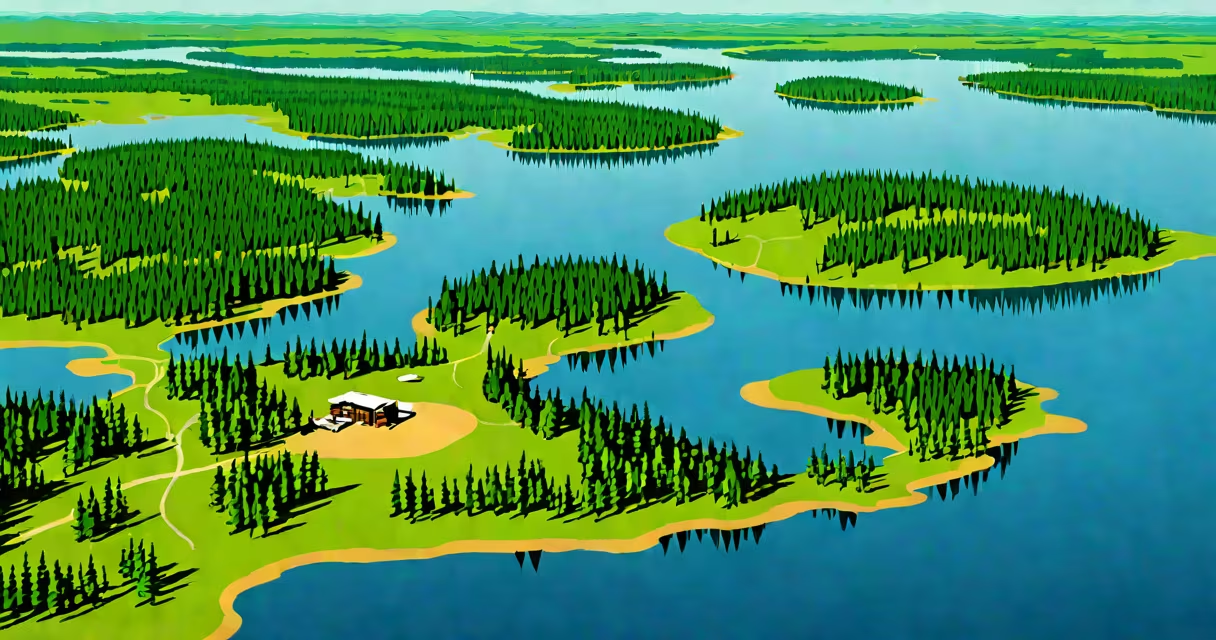
Lac Seul First Nation is a First Nation community in northwestern Ontario, part of the Anishinaabe people, with a reserve situated along the shores of Lac Seul Lake. The community exercises self-governance under the Indian Act and manages its own affairs through a band council elected by members.
The name "Lac Seul" comes from French, meaning "Lake of the Sun," though the original Anishinaabemowin name is Bimisawin, reflecting the deep connection to the land and water. The community's traditional territory spans parts of the Rainy River District, including forested uplands, wetlands, and waterways critical to hunting, fishing, and gathering.
As of 2021, the population of Lac Seul First Nation was approximately 1,200 members, with around 600 living on-reserve. The community operates a health clinic, school, and housing programs. Band members have a right to reside on reserve lands under federal legislation, and the band maintains jurisdiction over local services and resource management.
Lac Seul First Nation is governed by a band council consisting of a chief and six councillors. Elections occur every four years, and voting rights are extended to registered members aged 18 and older who live on or off reserve. Council decisions are made through consensus and formal meetings held monthly.
The band administers programs related to education, housing, employment, and environmental protection. For example, the Lac Seul First Nation Environmental Department monitors water quality in Lac Seul Lake and enforces fishing regulations based on seasonal and ecological data. Since 2018, the community has implemented a fishery management plan approved by the Ontario Ministry of Natural Resources and Forestry.
Self-governance is exercised under the First Nations Land Management Act (FNLMA), which allows communities to manage their reserve lands independently. Lac Seul First Nation adopted FNLMA in 2015, enabling it to approve land use plans, issue leases, and regulate development without federal oversight. This shift reduced administrative delays and increased transparency in land decisions.
Language is central to Lac Seul First Nation's identity. The community promotes the use of Anishinaabemowin through language revitalization programs. A curriculum developed in collaboration with the University of Manitoba includes audio recordings, flashcards, and classroom lessons taught by fluent speakers. As of 2022, over 40 children were enrolled in immersion classes at the Lac Seul First Nation School.
Cultural practices include seasonal ceremonies such as the Midewiwin (Grand Medicine Society) gatherings, which occur annually during the summer solstice. These events involve drumming, storytelling, and teachings passed down through elders. The community also hosts an annual Pow Wow in August, drawing attendees from nearby reserves and urban centers.
A lesser-known fact is that Lac Seul First Nation holds ancestral ties to the historic trade route known as the "Mystery Trail," a network of canoe paths connecting the Great Lakes to the Hudson Bay watershed. Archaeological surveys conducted in 2019 identified 12 pre-contact sites within the reserve boundary, including stone tool workshops and burial mounds.
Lac Seul First Nation uses its reserve lands for residential, agricultural, and economic development purposes. The community owns and operates a small-scale forestry business, harvesting timber sustainably under a 20-year agreement with the provincial government. Annual revenue supports infrastructure projects and youth scholarships.
Energy development is underway through a solar microgrid project launched in 2021. The system powers 15 homes and a community center, reducing reliance on diesel generators. The project received $1.2 million in funding from Indigenous Services Canada and is monitored by a technical advisory committee including band staff and external engineers.
Despite progress, challenges remain. A 2020 report by the Assembly of First Nations noted that 38% of homes on Lac Seul First Nation reserve lacked access to safe drinking water due to aging infrastructure. The band has since secured $4.5 million in federal funding to replace pipelines and upgrade treatment facilities by 2025.
| Type of Program | Examples | Funding Source |
|---|---|---|
| Environmental Management | Water quality monitoring, fishery regulation | Ontario Ministry of Natural Resources |
| Economic Development | Solar microgrid, sustainable forestry | Indigenous Services Canada |
| Health and Education | Community health clinic, language immersion | First Nations Health Authority |
Lac Seul First Nation is sometimes conflated with Membertou First Nation in Nova Scotia due to similar naming patterns. However, Membertou First Nation is Mi'kmaq and located on the Atlantic coast, while Lac Seul is Anishinaabe and situated in northern Ontario. The two communities share no historical or linguistic ties.
Another misconception is that all First Nations in Ontario operate under the same governance model. Lac Seul First Nation participates in the Nishnawbe Aski Nation (NAN), a political organization representing 49 First Nations in northern Ontario. However, not all communities in NAN are part of the same treaty group or share the same land claim status. Lac Seul is signatory to Treaty 3, signed in 1873, which ceded land in exchange for annuities and reserved territories.
When discussing land rights, it's incorrect to assume that reserve lands are owned outright by the band. Under Canadian law, reserve land is held in trust by the Crown. The band has exclusive use and control but cannot sell or transfer title without federal approval. This distinction affects how communities manage resources and respond to development proposals.
In 2022, I attended a community meeting in Lac Seul where elders discussed the impact of climate change on traditional food sources. They reported declining populations of wild rice (manoomin) in Lac Seul Lake due to rising temperatures and altered water levels. The band responded by launching a restoration initiative using seed banks from neighboring Anishinaabe communities. Over 200 kg of wild rice seeds were planted in shallow bays, and monitoring began in spring 2023. Early results show a 35% increase in germination rates compared to previous years.
This project reflects how Lac Seul First Nation integrates traditional ecological knowledge with scientific methods. Elders and youth work together to track changes in plant growth, weather patterns, and animal migration. The data informs both local decision-making and submissions to provincial environmental boards.