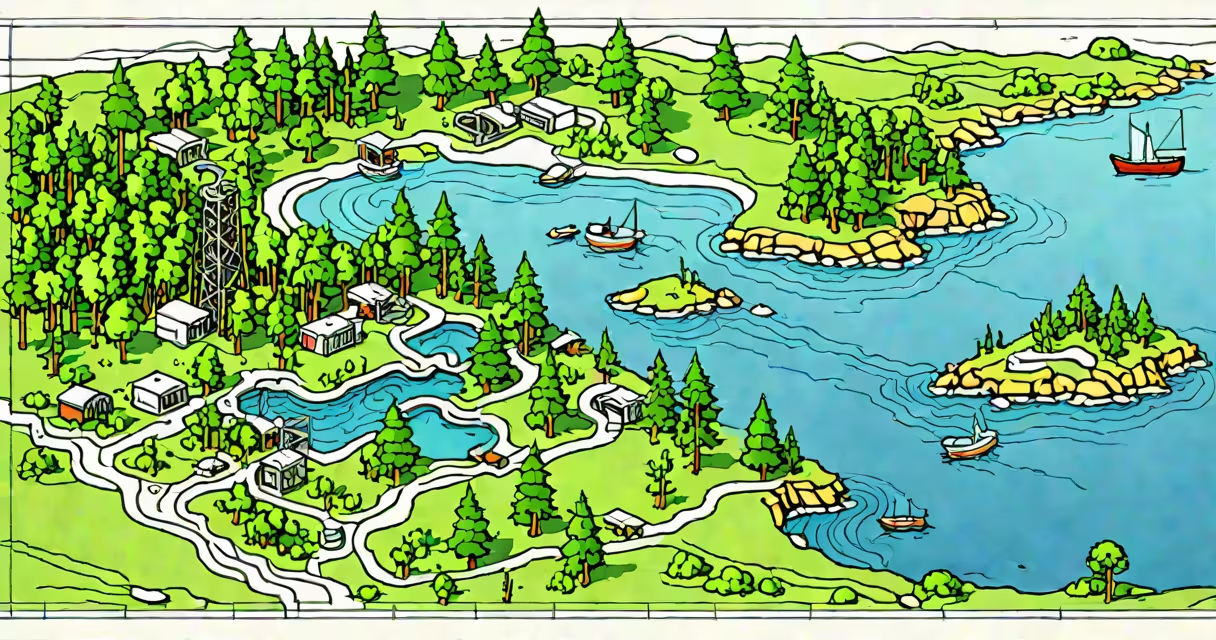
Land and sea marine describes the changing interface where terrestrial and marine environments meet, forming ecologically rich zones shaped by tides, currents, and climate. These areas include estuaries, mangrove forests, salt marshes, and rocky shorelines, supporting complex food webs and human uses like fishing, shipping, and recreation.
This zone is not a single habitat but a network of overlapping systems. The boundary between land and sea shifts daily due to tidal cycles and seasonal changes. Saltwater intrudes into freshwater systems during high tide, altering soil chemistry and plant growth. In turn, vegetation stabilizes sediments, reducing erosion and filtering runoff before it reaches the ocean.
According to NOAA's Coastal Management Program, over 60% of the U.S. population lives within 50 miles of the coast, making land and sea marine zones critical for both ecological health and economic activity. These areas buffer storm surges, support fisheries, and serve as carbon sinks through blue carbon ecosystems like seagrass meadows and salt marshes.
Energy flows through land and sea marine zones via sunlight, nutrient cycling, and water movement. Sunlight fuels photosynthesis in intertidal algae and seagrasses. As tides rise and fall, nutrients from land-like nitrogen and phosphorus-wash into the sea, feeding plankton blooms that form the base of marine food chains.
Physical processes drive mixing. Wave action breaks down organic material, while currents transport larvae from adult populations to new habitats. Sediment deposition shapes mudflats and sandbars, which in turn influence bird migration routes and fish spawning grounds.
A 2021 study published in *Nature Communications* found that mangrove forests in Southeast Asia sequester carbon at rates up to four times higher than tropical rainforests. This efficiency stems from slow decomposition in anaerobic soils, locking away carbon for centuries. These findings show that land and sea marine zones are not just transitional spaces-they are important planetary regulators.
Land and sea marine environments vary by geography, climate, and geology. The following table outlines major types based on physical structure and dominant biological features.
| Type | Location Examples | Key Features | Ecological Role |
|---|---|---|---|
| Estuary | Chesapeake Bay (USA), Thames Estuary (UK) | Mix of fresh and saltwater; high nutrient levels | Nursery for fish like striped bass; filters pollutants |
| Mangrove Forest | Florida Everglades, Sundarbans (India/Bangladesh) | Roots adapted to saline conditions; dense canopy | Storm protection; supports crabs, fish, birds |
| Rocky Shoreline | Big Sur (California), Cornwall (UK) | Exposed to waves; zonation of species by tidal height | High biodiversity; habitat for barnacles, mussels, sea stars |
| Salt Marsh | Long Island Sound, Netherlands Wadden Sea | Grasses and rushes; tidal flooding | Carbon storage; breeding ground for shorebirds |
Each system functions as a filter, buffer, and supplier. For example, salt marshes reduce flood risk by absorbing wave energy. A 2019 study in *Science Advances* showed that salt marshes reduced wave height by up to 70% during storms, protecting inland communities.
Land and sea marine is often mistaken for "coastal zone" or "marine environment," but it specifically emphasizes the interaction between land-based and oceanic systems. The term does not refer to offshore oil platforms or deep-sea trenches-it focuses on the transitional, biologically active edge zones.
Another error is assuming all coastal areas are equally productive. While coral reefs and estuaries are highly biodiverse, sandy beaches and urbanized shores often have low ecological resilience. Human development can disrupt sediment flow and degrade habitat quality faster than natural processes can recover.
Land and sea marine systems are not static. They respond to sea level rise, temperature shifts, and invasive species. For instance, the spread of the European green crab along North America's Pacific coast has displaced native clams and altered intertidal community structures. Monitoring these changes requires long-term ecological datasets, such as those maintained by the National Estuarine Research Reserve System.
In 2022, I visited the Elkhorn Slough in California-a designated national marine sanctuary. There, I observed harbor seals resting on tidal flats, while ospreys hunted in the adjacent marsh. The area's productivity was evident: eelgrass beds hosted juvenile fish, and fiddler crabs burrowed in soft mud. This site exemplifies how land and sea marine zones integrate multiple ecological layers.
I also witnessed a restoration project where volunteers planted cordgrass (*Spartina alterniflora*) to stabilize eroding banks. Within two years, the area regained its ability to trap sediment and support bird nesting. This hands-on experience confirmed that human intervention, when guided by science, can reverse degradation in land and sea marine settings.
For those interested in exploring these zones responsibly, a short walk along the tide line offers access to hidden ecosystems without disturbing fragile habitats.
Land and sea marine zones provide essential services: clean water, storm protection, food, and climate regulation. Globally, they contribute an estimated $2.7 trillion annually in system services, according to the World Bank's 2020 Blue Economy report.
Yet these systems face threats from pollution, overfishing, and infrastructure expansion. Protecting them requires coordinated policies, scientific monitoring, and public awareness. Understanding land and sea marine is not academic-it's foundational to sustainable living near coasts.
When people think of marine life, they often picture whales or coral reefs. But the most impactful marine systems may lie just beyond the dunes, where roots meet tides and life thrives in the balance between land and sea.