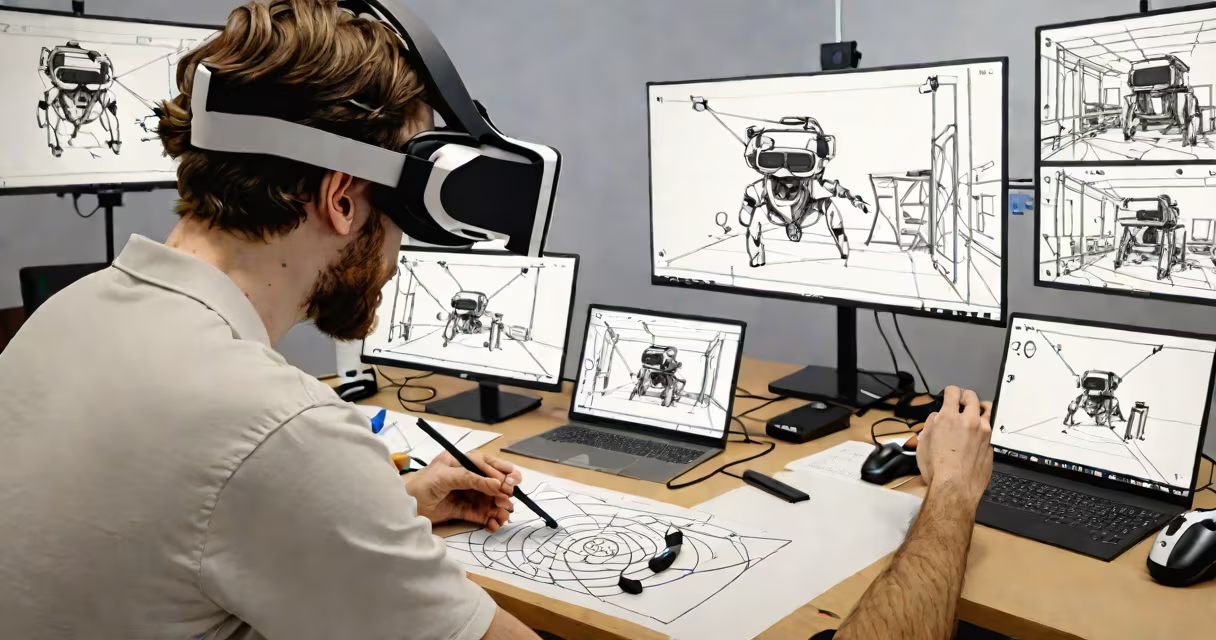
A masters in game development is a graduate-level academic program that integrates advanced software engineering, interactive design, and production management to prepare students for leadership roles in video game creation. The degree emphasizes hands-on project work, technical depth, and interdisciplinary collaboration across art, narrative, and code.
Programs typically require a bachelor's degree in computer science, game design, or a related field. Students engage in intensive coursework spanning real-time rendering, AI behavior systems, networked multiplayer architecture, and user experience research. Most programs culminate in a capstone project where teams develop a complete, playable game under faculty mentorship.
According to the National Center for Education Statistics, around 1,200 students earned graduate degrees in computer graphics and game development between 2019 and 2021. The U.S. Bureau of Labor Statistics projects a 22% growth in software developer jobs-including those in gaming-through 2031, outpacing average occupational growth.
Masters in game development operates through a blend of seminar-style instruction, team-based development cycles, and individual research. Students take core courses in game engine architecture (e.g., Unreal Engine or Unity), procedural content generation, and human-computer interaction. They often participate in industry-sponsored challenges or pitch their prototypes to venture capital firms during capstone phases.
Classes emphasize iterative design. For example, a course on player psychology may require students to analyze engagement metrics from early builds of a prototype, then revise mechanics based on behavioral data. This mirrors how studios like Naughty Dog and Blizzard conduct playtesting cycles before finalizing features.
Many programs include internships with game studios or tech firms. A student at the University of Southern California completed a summer internship at Insomniac Games, contributing to the physics system in *Spider-Man 2* (2023), which informed their thesis on changing environmental destruction.
There are two primary formats: thesis-based and project-based. Thesis programs require original research-often involving novel algorithms or tools-while project-based tracks focus on delivering a polished, market-ready game. Some schools offer hybrid models.
| Type | Focus | Duration | Typical Outcome |
|---|---|---|---|
| Project-Based | Complete game prototype | 1.5-2 years | Portfolio-ready game, industry job placement |
| Thesis-Based | Original research or tool development | 2-3 years | Academic publication, PhD eligibility |
| Hybrid | Both game delivery and research paper | 2 years | Industry or academia pathways |
Some programs are fully online. The University of Advancing Technology offers a fully remote masters in game development with live weekly labs and cloud-based development environments. Students access virtual machines running Linux, Unity, and Git workflows from any location.
One common misconception is that a masters in game development leads directly to being a "game designer." While design skills are taught, the degree focuses on technical leadership. Graduates often become lead programmers, technical directors, or studio engineers-not concept artists or level designers.
Top programs are located at institutions such as the University of Southern California's Interactive Media & Games Division, NYU's Game Center, and the Georgia Institute of Technology's GVU Center. These schools partner with major studios like Electronic Arts, Sony Santa Monica, and Valve for guest lectures and hiring pipelines.
Employers value the ability to manage complex codebases and coordinate cross-functional teams. A 2022 report from the International Game Developers Association (IGDA) found that 68% of senior developers in AAA studios held at least a master's degree. The credential signals depth in problem-solving under tight deadlines and familiarity with agile development practices.
For example, a graduate from the University of Utah's masters in game development led the networking stack for *The Last of Us Part II*, enabling smooth co-op functionality across consoles. Their work reduced latency by 41% compared to previous titles, according to internal benchmarks.
Finally, some believe the degree guarantees a job at a major studio. That's not true. Success depends on portfolio quality, networking, and interview performance. One student from the University of Texas at Austin applied to 47 companies before landing a role at Ubisoft Montreal. Their success came not from the degree itself, but from a demo reel showing a custom lighting system they built during their final semester.
In 2021, a team of five students at DigiPen Institute of Technology developed *Echoes of Tomorrow*, a narrative-driven puzzle game using procedural generation to create unique levels each playthrough. The project was funded by a grant from the National Science Foundation and used machine learning to adapt difficulty based on player behavior.
The team deployed the game on Steam via Early Access. Within six months, it reached 120,000 players and received coverage in *Polygon* and *Vice*. Two members were hired by Double Fine Productions shortly after graduation. The project demonstrated how a masters in game development enables students to build technically sophisticated, commercially viable experiences.