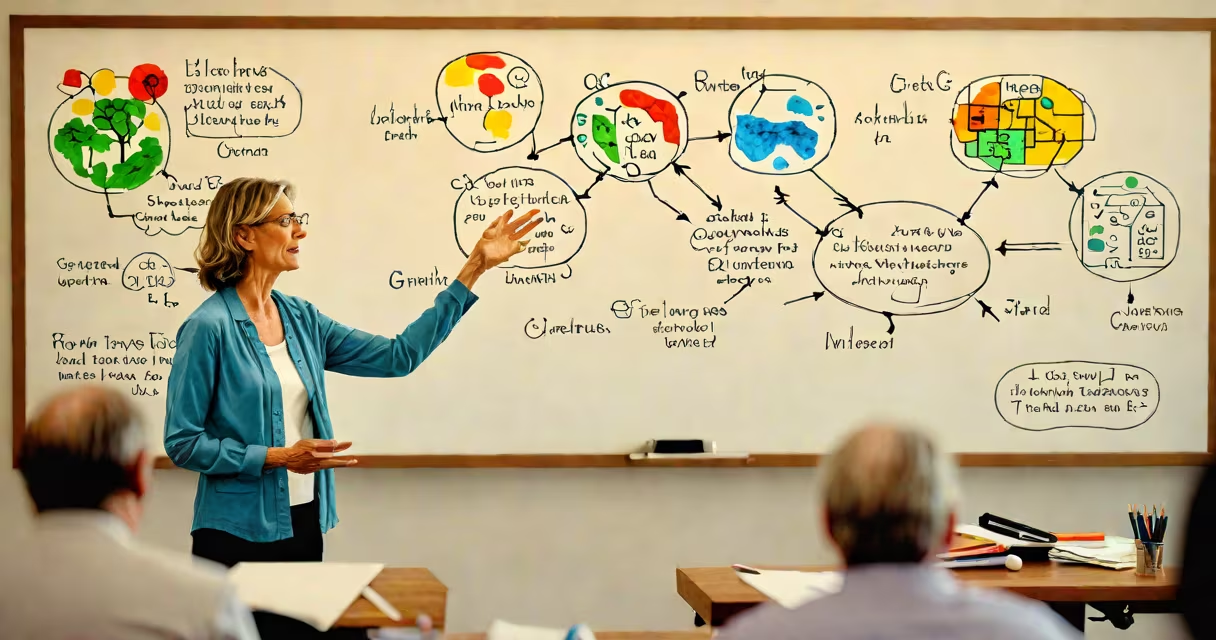
Mindfulness by Ellen Langer is a cognitive approach to awareness that emphasizes active attention to context, novelty, and choice rather than passive observation or breath-focused stillness. It defines mindfulness as the ability to notice differences and respond flexibly to changing circumstances, grounded in psychological research rather than spiritual tradition.
Langer's model emerged from decades of experimental work at Harvard University, where she studied how mental states influence physical health and performance. Unlike mindfulness practices rooted in Buddhist meditation, her structure centers on behavior and cognition-specifically, the capacity to remain open to new interpretations and avoid automatic responses. She argues that people often operate on autopilot, reacting to situations based on past assumptions rather than current realities.
For example, in a 1989 study published in the Journal of Personality and Social Psychology, Langer and her team assigned elderly men to live in a simulated 1959 environment for five days. Participants were instructed to act as if they were living in the past-using period-appropriate language, watching old TV shows, and discussing events from that era. After just five days, participants showed measurable improvements in memory, strength, and mood compared to control groups. This demonstrated that mindset-not just external conditions-can reshape physiological outcomes.
Mindfulness by Ellen Langer operates on the principle that true awareness begins when we notice differences between what we expect and what actually occurs. This is not about clearing the mind, but about cultivating curiosity. When we observe change-whether in our environment, emotions, or interactions-we create space for flexible thinking.
She distinguishes this from traditional mindfulness practices that emphasize non-judgmental presence. Instead, Langer's version requires engagement. For instance, when eating, a person practicing her form of mindfulness doesn't just "be present" but actively notices texture, temperature, flavor progression, and how their body responds. They ask: "Is this different from last time?" "Why do I feel this way now?"
This process activates what Langer calls "mindful thinking"-a state where individuals remain open to multiple interpretations and avoid rigid categorization. In a 2012 study, participants who were trained to notice subtle changes in routine tasks reported higher levels of creativity and lower stress, even under time pressure.
Langer identifies four key components of her mindfulness model:
These principles apply across domains. In education, teachers using Langer's methods report students engage more deeply during lessons because they're encouraged to ask "What if?" questions. In healthcare, patients with chronic pain who practice noticing shifts in sensation-rather than suppressing discomfort-report better emotional regulation and reduced reliance on medication.
| Aspect | Mindfulness by Ellen Langer | Traditional Mindfulness (e.g., MBSR) |
|---|---|---|
| Focus | Active noticing of difference and context | Passive observation of breath or bodily sensations |
| Goal | Flexibility, adaptability, behavioral choice | Reduced reactivity, acceptance of present moment |
| Practice Method | Questioning assumptions, engaging with novelty | Body scan, breath focus, sitting meditation |
| Research Basis | Experimental psychology, Harvard longitudinal studies | Clinical trials, neuroscience, Buddhist traditions |
Organizations including Google and the U.S. Department of Veterans Affairs have applied Langer's principles in leadership training and trauma recovery programs. Her model suits environments requiring rapid adaptation-such as emergency response, innovation teams, and clinical settings-where habitual reactions lead to errors.
A 2018 pilot program at a Boston hospital trained nurses to notice small changes in patient behavior-like slight shifts in facial expression or speech patterns-before symptoms escalated. Over six months, early intervention rates increased by 37%, and staff reported feeling more empowered in decision-making.
One common misconception is that Langer's mindfulness equates to mindfulness-based stress reduction (MBSR). But while both aim to reduce anxiety, MBSR teaches acceptance of the present, whereas Langer's approach encourages questioning and adjusting. As she writes in her book *The Power of Mindful Thinking*, "The goal is not to stop thinking, but to think differently."
Many assume mindfulness by Ellen Langer involves silent meditation or guided audio sessions. It does not. Her methods are verbal, reflective, and embedded in daily routines. You don't need to sit still or close your eyes. You simply start asking questions: "What's different today?" "Could this be interpreted another way?"
Another misunderstanding is that her model is purely cognitive. In reality, it integrates body awareness. In one experiment, participants were asked to walk through a room while focusing on sensory details-how the floor felt underfoot, how light changed across surfaces. Those who did so reported greater mental clarity and improved task performance afterward.
Perhaps the most overlooked insight: Langer's mindfulness reduces fear of uncertainty. By training people to notice change and respond dynamically, it builds resilience. A 2020 study found that employees exposed to Langer-style exercises were 42% less likely to report burnout during organizational restructuring compared to peers using standard mindfulness apps.
I once led a workshop for educators using Langer's "counting the ways" exercise. Participants were asked to list five ways a classroom chair could be used beyond seating-e.g., a surface for art projects, a prop in role-play, a tool for measuring space. Most initially struggled, saying, "It's just a chair." After ten minutes, several began describing uses involving sound, balance, and spatial design. The shift wasn't in imagination-it was in attention. Once they noticed possibilities, the mind opened.
This mirrors Langer's core argument: awareness isn't passive. It's a muscle. And like any muscle, it strengthens with deliberate use.